Akhnoor: Where the Indus Valley Civilisation Reached Jammu
Akhnoor sits on the right bank of the Chenab river, about 28 to 35 kilometres from Jammu city, depending on where you measure from. The river is wide here, and the town looks across it towards the hills.
Ganga AI · This story
Category: Culture & Heritage | Reading Time: 7 minutes
A town on the Chenab
Akhnoor sits on the right bank of the Chenab river, about 28 to 35 kilometres from Jammu city, depending on where you measure from. The river is wide here, and the town looks across it towards the hills.
It is a place where many periods of history meet. A site linked to the Indus Valley Civilisation lies here, along with the remains of a Buddhist settlement, a fort above the river, and a ghat where an important coronation took place.
This guide takes those layers in turn and ends with advice on visiting as a guest.
Takeaway: Akhnoor on the Chenab holds Harappan, Buddhist, and Dogra-era sites within a short distance.
The Indus Valley layer
Akhnoor is described as the northernmost point reached by the Indus Valley Civilisation. The claim appears in official descriptions and in accounts that credit the Archaeological Survey of India, and it is the reason the town is often mentioned in discussions of Harappan sites.
Excavations at the fort site have found three broad periods. The earliest is Harappan, with pottery in red and grey ware, including jars, beakers, and goblets. The later periods include early historic pottery and objects of the Kushan period.
Takeaway: Akhnoor is described as the northernmost point of the Indus Valley Civilisation, with Harappan pottery at the fort site.
Later layers
After the Harappan period, the site shows a long history of occupation. Objects of the Kushan period have been found, and the Kushan presence is one of the better-attested layers in the area.
These layers matter because they show Akhnoor as a place that people returned to, over and over, probably because of the river and the routes that passed through it.
Takeaway: Akhnoor shows layers of occupation, including Kushan-period objects, above the Harappan base.
Ambaran: the Buddhist settlement
About one kilometre upstream of Jia Pota Ghat lies Ambaran, the site of a Buddhist settlement on the Chenab. Excavations have revealed a stupa and a monastery, and the remains show brick structures and the layout of a monastic complex.
Different sources give different dates for the site, and the settlement is generally placed in the early centuries of the Common Era, in the Kushan period. Ambaran is one of the few Buddhist sites of this kind in the Jammu region.
Takeaway: Ambaran, about a kilometre upstream, is a Buddhist settlement with the remains of a stupa and monastery.
Akhnoor Fort
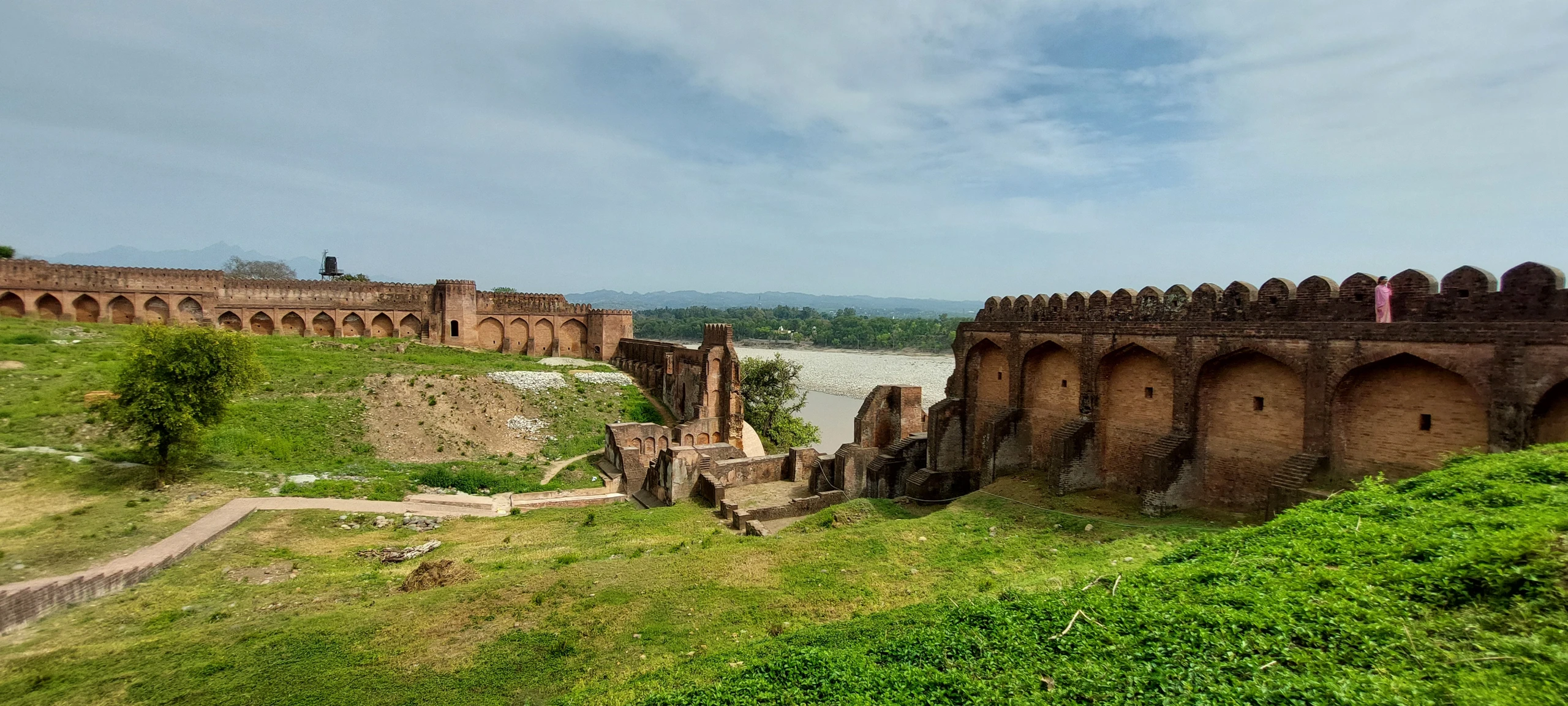
The fort stands on a cliff above the Chenab. It was begun in 1762 by Raja Tegh Singh and completed in 1802 by his son, Raja Alam Singh. It has two storeys, with watch towers at the corners and access from the river side.
The Archaeological Survey of India has protected the fort since 1982. It is a national monument, and conservation work has gone on over several years.
From the walls, visitors can see the Chenab flowing below, which explains why the site was chosen for a fort.
Takeaway: The fort was built between 1762 and 1802, and it has been protected by the Archaeological Survey of India since 1982.
Jia Pota Ghat
Below the fort lies Jia Pota Ghat, named after the Jia Pota tree. According to accounts, Maharaja Gulab Singh was crowned here by Maharaja Ranjit Singh on 17 June 1822, under this tree beside the fort.
The original tree was lost in the Chenab floods of 1957, and younger trees now stand in Jia Pota Park. The coronation is described as the first step towards the formation of the modern state of Jammu and Kashmir.
Takeaway: Jia Pota Ghat is the place of Gulab Singh's coronation on 17 June 1822.
The river and its festivals
The ghat is also a place of ritual. A dip in the river is traditional on Magh and on Makar Sankranti, and an evening arti is held on Sankranti. The Department of Tourism holds cultural events here, including a Baisakhi fair.
In the past the Chenab was known as the Chandrabhaga, a name still heard in local tradition.
Takeaway: The ghat hosts a Magh dip, a Sankranti arti, and cultural events through the year.
The Mahabharata tradition
Local tradition links Akhnoor with Virat Nagar, the kingdom where the Pandavas are said to have spent their final year of exile in disguise. It is a tradition and not a record, and it is part of how people understand the place.
Such traditions are common in the Jammu region, where the landscape is often tied to the stories of the Mahabharata and the Ramayana.
Takeaway: Akhnoor is linked in tradition with Virat Nagar and the Pandavas' year in hiding.
A day in Akhnoor
A day in Akhnoor can follow the river. Start with the fort in the morning, when the light is soft on the walls. Walk down to Jia Pota Ghat, and spend time at the river. Then go upstream to Ambaran in the afternoon.
Allow about two hours for the fort and the ghat and another hour for Ambaran. The sites are close, but the walking involves steps and uneven ground.
Takeaway: A day can run from the fort to the ghat to Ambaran, following the river upstream.
A short glossary
Harappan refers to the Indus Valley Civilisation. Kushan refers to the dynasty that ruled in the early centuries of the Common Era. A stupa is a Buddhist monument. A vihara is a monastery. A ghat is a flight of steps to a river. Arti is a ritual of lamps.
These words appear on signboards and in guides to the site.
Visiting as a guest
Akhnoor is a living town as well as a heritage site. Respect the monuments by staying on paths and not climbing on walls. Take care near the cliff edge at the fort, where there is no fence in places.
At the ghat, remember that the river is a place of worship for local people. Keep your voice low during rituals, and ask before photographing people.
Visiting hours change, so check with the Archaeological Survey of India or local tourism offices before you go.
Reading the fort site
At the fort site, excavation has revealed three periods. A Harappan layer with red and grey ware lies at the base. Above it are early historic pottery and Kushan objects, along with a rubble wall and a street about three metres wide.
The work is described as continuing in phases, and what a visitor sees is a snapshot of an excavation that is still unfolding.
Takeaway: The fort site shows Harappan, early historic, and Kushan layers, with excavation continuing in phases.
The Kahi Devta tradition
A local legend tells of Kahi Devta, the son of the serpent king Vasuki Nag, who is said to have brought the waters of the Chandrabhaga to the area. It is a legend, and it is retold at the river.
Stories like this help explain why the river is treated as sacred, and they connect the Chenab to the wider tradition of serpent deities in the Jammu hills.
Takeaway: The legend of Kahi Devta links the river to the serpent traditions of the hills.
The bicentenary
In 2022, a three-day event marked 200 years since the coronation of Gulab Singh, run by a memorial trust. A commemorative tablet or mural at the ghat records the occasion.
For visitors, the ghat is a good place to think about how a small riverbank became part of the history of the region.
Takeaway: A three-day event in 2022 marked 200 years since the coronation.
A heritage visit to Ambaran
In March 2023, a department of Buddhist Studies and a heritage organisation led a group visit to Ambaran. Such visits show how the site is used for teaching and how interest in it is growing.
A guided visit can add a great deal, since the site's remains are low and need explanation.
Takeaway: Guided visits help make sense of Ambaran's low remains.
Why it matters
Akhnoor shows how many periods of history can sit within a few kilometres of a river. A visit helps to see Jammu as a region with deep roots, from the Harappan period to the Dogra era.
Take your time, and let the river set the pace.
Questions worth asking
Which layer is which at the fort site? What do the signboards say about Ambaran? Where did the old Jia Pota tree stand? Which festivals are held at the ghat? What do local families say about Virat Nagar?
Residents and guides often know the stories that signboards leave out.
Before you go
Go in the cooler months, if you can, and carry water, a hat, and sturdy shoes. Check conditions at the river, and take care near the water. Leave time for a cup of tea in the town.
Take a notebook, and write down the names of the sites and layers, since they are easy to confuse on the day.
Travel with Folk Experience
A river town is best understood slowly, with time to listen to the people who live on its banks. Travelling thoughtfully and spending with local people supports the communities who care for places like this.
In the Jammu region, Folk Experience runs From the Goddess to the Farmer-Saint: Vaishno Devi & Jhiri Mela, a 3-night, 4-day journey with a window from 23 November to 2 December 2026. To ask what is possible for visiting Akhnoor, write to journeys@folkexperience.com or call +91 77808 32412.
Sources
- https://jammu.nic.in/tourist-place/akhnoor-fort/
- https://risingkashmir.com/akhnoors-jia-pota-ghat-witness-to-civilizations-since-centuries/
- https://www.daijiworld.com/news/newsDisplay?newsID=941727
- https://jammuuniversity.ac.in/node/4202