Beyond Varanasi & Lucknow: Day trips to Ayodhya, Prayagraj & the Mango Orchards of Malihabad
Most people who come to Uttar Pradesh have two cities in mind from the start. Varanasi is known for its burning ghats and predawn aarti. Lucknow is known for its biryani and the particular kind of courtesy that has become part of the city's identity. These are genuine places w...
Meet your AI Story Guide
Turn this field note into a one-minute brief with the essential places, people, and traditions.
Ayodhya: The Birthplace of Rama & the City of Dharma
A. Spiritual Significance
There are places that carry their identity lightly and places that carry it like a stone in the chest. Ayodhya is the latter. This is the janmabhoomi of Lord Rama, the city at the moral center of the Ramayana, and arriving here feels less like reaching a destination and more like entering something that has been waiting for you. The Sarayu flows beside it without any particular drama. The streets are not especially grand. And yet there is a quality to the air here, in the way conch shells echo before dawn, in the bare feet of pilgrims on worn stone, and in the saffron flags catching wind above temple entrances—that is genuinely difficult to shake off once you have felt it.
Ayodhya is counted among the Sapta Puri, the seven cities considered most sacred in Hindu tradition. Its name appears in the Atharvaveda and runs through bhakti poetry across centuries. What is striking about the city is that the myth does not feel archived or displayed; it feels active, still being lived in the small daily rituals that happen at every corner and ghat.
B. Major Landmarks
Shri Ram Janmabhoomi Temple
The newly built Ram Janmabhoomi Temple is the city's spiritual center, and its scale is striking in person in a way that photographs do not fully capture. The carved pillars, the wide courtyards, and the quality of the stonework show that this building was clearly meant to last. Arriving at sunrise, before the crowds thicken, is worth the early alarm.
Hanuman Garhi
The climb up to Hanuman Garhi is worth taking slowly. The steps are steep, the view at the top opens across the whole city, and there is a particular atmosphere at the shrine itself, something between fierce guardianship and steady reassurance. Devotees say Hanuman himself watches over Ayodhya from this hill, and standing there, it is not hard to understand why the belief took root.
Kanak Bhawan
Of all Ayodhya's temples, Kanak Bhawan has the most intimate quality. The legend attached to it says that Kaikeyi gifted this palace to Sita as a wedding present, and something of that original gesture seems to have survived into the atmosphere of the place. The idols of Rama and Sita here are unusually warmly adorned, and the courtyards are quiet enough that you find yourself staying longer than you had planned.
Guptar Ghat
Guptar Ghat sits on the Sarayu at the spot associated with Rama's final departure from the mortal world. The evening aarti here is not the spectacle you get at Varanasi; it is gentler, more reflective, and in some ways more moving because of it. The riverbank has the quality of a place where time is not quite moving at the same speed as everywhere else.
C. Experiences & Ritual Life
Sandhya Aarti at Sarayu River
When the sky goes orange and pink above the Sarayu, the priests begin. Lamps swing in long arcs, chanting rises in waves, and the river catches the light in a way that makes the whole scene feel slightly unreal. It calms, like things do when you repeat them with full attention for a very long time.
Ram Leela Performances
In the weeks around Dussehra and Diwali, Ayodhya becomes a performance. Local troupes stage episodes from the Ramayana in streets and open grounds, with music and staging that ranges from humble to genuinely spectacular. The audience is mixed, locals who know every scene by heart and visitors encountering it fresh, and that combination gives the performances an unusual energy.
Devotional Bazaars
The lanes running between Ayodhya's temples are worth wandering slowly. Prasad shops sell handmade idols of Rama and Sita, brass lamps, saffron flags, and traditional sweets sold by weight. It sounds like a list of things for sale, and it is, but the cumulative effect is of a marketplace that has grown up in service of something larger than commerce.
D. Travel Tips
• Ideal Duration: A half-day is possible if your time is tight, but a full day gives you the temples in the morning, the bazaars in the afternoon, and the Sarayu aarti in the evening, which is the right sequence for understanding what Ayodhya actually is.
• Best Time to Visit: Early morning means thinner queues, cooler air, and the kind of soft golden light that makes the temples look the way they look in your memory afterwards.
• Connectivity: Ayodhya is reachable from both Varanasi and Lucknow without much difficulty, which makes it a natural addition to a U.P. trip rather than a separate expedition.
Prayagraj: Where Three Rivers & Three Worlds Meet
Prayagraj is a city that earns its mythology. The Triveni Sangam, where the Ganga and Yamuna converge and the subterranean Saraswati is believed to join them invisibly, is one of those geographical facts that has accumulated so much meaning over so many centuries that the water itself seems weighted with it. Pilgrims have been coming here for thousands of years: saints, emperors, scholars, and ordinary families carrying their dead for last rites. When you arrive at the riverbank, you are standing in the scale of that accumulated devotion.
A. Significance of the Sangam
In Hindu cosmology, a confluence like this is called a tirtha, a crossing point where the boundary between the human and the cosmic becomes permeable. Prayagraj is considered the holiest such point in India. The Kumbh Mela, the largest peaceful gathering of human beings on earth, takes place here every twelve years and at the Ardh Kumbh every six. Sadhus, Naga saints covered in ash, scholars, and families from every part of the country converge on the Sangam in numbers that are genuinely difficult to comprehend until you have seen it.
What you feel at the Sangam on an ordinary day, without the Kumbh's millions around you, is something subtler but still palpable. The rivers do carry visibly different colors where they meet, the Ganga's greener clarity against the Yamuna's darker blue. That visible difference, the literal line where they merge, is where most pilgrims wade in.
B. Things to See
Triveni Sangam
A boat ride out to the confluence point is the essential Prayagraj experience. Mid-river, you will experience a quality of stillness that is hard to find on land, with the two rivers meeting around you and the ghats receding behind. Pilgrims perform pujas from small wooden boats, their offerings floating outward on the current. The boatmen know these waters well and will give you as much time as you need.
Allahabad Fort
Akbar built this fort in the 16th century at the edge of the Sangam, which tells you something about how seriously the Mughal court took this geography. Most of it is now restricted military territory, but even seen from a boat on the river, its scale is impressive. The Akshayavat, the legendary indestructible banyan tree mentioned in ancient texts, is within the fort's walls and is considered eternal, surviving every age and destruction. Access is limited, but the weight of its mythology reaches you even from outside.
Akshayavat Tree
Inside the fort lies the legendary Akshayavat, the “indestructible banyan tree” mentioned in ancient texts. Believed to be eternal, it symbolizes the idea that life, knowledge, and spirit endure even through cycles of destruction.
Though entry is limited, its myth lends a powerful aura to the area.
Anand Bhawan
The Nehru family home is now a museum, and a well-maintained one. Rooms, photographs, and personal objects preserve the texture of a household that was also, for decades, one of the nerve centers of India's independence movement. It is the kind of place where history feels personal rather than monumental.
Khusro Bagh
A walled Mughal garden containing the tombs of Prince Khusro and members of his family. The sandstone carvings are intricate, the pathways are quiet, and the whole place has the slightly melancholy quality of something beautiful that most visitors walk past. Worth an hour of your afternoon.
C. Cultural Feel
Prayagraj at the ghats has a particular rhythm. Priests conducting pujas on gently rocking boats. The low sound of mantras drifting across the water at dawn. Migratory birds in winter are sweeping low over pilgrims. Vendors offering flowers, incense, diyas, and sacred threads in voices that are somehow never quite intrusive. Devotees cupping water in their palms, lips moving quietly. It is a place where activity and stillness somehow occupy the same space.
D. Travel Tips
• Best Time: November through February. The weather is manageable, migratory birds are present along the river, and the water is calm enough for comfortable boat rides.
• Experience to Prioritize: An early morning boat ride at the Sangam, before the day gets busy, is probably the single best thing. Prayagraj offers. Mist hangs over the river, the sun is just coming up, and there is a quietness before the ghats fill. It stays with you.
• Duration: A half-day covers the Sangam by boat, Anand Bhawan, and Khusro Bagh without feeling rushed.
Malihabad: The Mango Capital of India
Lucknow gets the literary reputation, the kebabs, and the carefully maintained idea of itself as a city of refinement. Malihabad, sitting just 25 kilometers outside it, operates on entirely different terms. This is mango country, specifically Dasheri mango country, and arriving here in summer is a sensory experience that no amount of prior description quite prepares you for. The smell hits you before the orchards are even visible.
A. Legacy of Mango Culture
The Dasheri mango's story in Malihabad goes back to the 18th century and to a single mother plant, still alive, still producing, that is treated with something close to veneration by the families who tend it. From that original tree, grafting traditions spread across the region, and generations of orchard families built their livelihoods around preserving its lineage and developing new varieties alongside it.
Malihabad is home to Padma Shri-awarded horticulturist Haji Kaleemullah Khan, known across the country as the Mango Man of India, who developed more than 300 distinct mango varieties on a single tree. That achievement, which sits somewhere between horticultural science and obsessive art, tells you a great deal about the spirit of the place. Here, a mango is not just a fruit. It is the result of a year's attention, a family's accumulated knowledge, and an ongoing argument with the weather and the soil about what perfection might look like this season.
Orchard families in Malihabad tend to be natural storytellers. Ask about a particular tree and you will get a family history, a monsoon memory, a theory about soil composition, and probably a tasting. The conversation usually ends with someone handing you a piece of fruit.
B. What to See & Do
Walk Through Centuries-Old Orchards
The older orchards have a particular quality that newer plantings cannot replicate. Trees over a hundred years old have branches thickening into forms that look almost architectural, creating corridors of shade you can walk through without needing to talk. Dasheri trees, Langra trees, and experimental grafting zones are being used to coax into existence varieties that nobody has quite named yet. It is peaceful in the way that places are peaceful when the work happening in them is patient.
Learn Traditional Mango Farming Techniques
Local growers are generally happy to demonstrate the kalami grafting technique, the way they read soil and moisture through the season, how they protect blossoms during the vulnerable flowering period, and why they rely on natural ripening rather than chemical shortcuts. These methods have not changed much because they work, and the families who use them learned them from people who refined them over their lifetimes. Watching them in practice makes the orchards feel less like farms and more like ongoing conversations across generations.
Taste Multiple Mango Varieties
Depending on when you visit, the tasting possibilities change. The Dasheri is the most celebrated: sweet, juicy, and aromatic, justifying everything written about it. The Langra has a firmer texture and a distinctive tang. The Chausa is extraordinarily sweet and almost fiberless. The Safeda is mild and smooth. The Fazli arrives late in the season, large and fragrant. Farmers typically cut fruit fresh under the trees and hand you a slice while explaining which tree it came from and why this particular season went the way it did.
Meet Local Growers & Storytellers
The conversations in Malihabad have a quality you do not often find in places that have been set up for tourism. These are people who have been working most of their lives, whose fathers did it before them, and who have strong opinions about soil, weather, rootstock, and the relative merits of different varieties. They are not performing for visitors. They are just talking about what they know, and what they know is considerable.
Rural Picnics & Photography
The visual textures of Malihabad in summer are truly beautiful. The filtered light through orchard canopies, the silhouettes of old trees against a white sky, wooden charpoys in the shade, and bullock carts parked at field edges. It photographs well because it is not arranged for photography. It just looks the way it does.
C. Why It Makes a Perfect Day-Trip
• Close to Lucknow: Twenty-five to thirty kilometers, roughly forty-five minutes to an hour by road. It is a short drive that delivers a significant change of atmosphere.
• A genuine contrast to city life: Lucknow has its own kind of elegance. Malihabad has earthy simplicity, open air, and a pace that makes it feel like the city has been left behind entirely. Both are worth experiencing, and they make each other clearer.
• Works for most kinds of travelers: Families find it safe and interactive. Food-focused visitors get tastings and context that no restaurant can replicate. Photographers find material everywhere they look. Anyone interested in craft traditions and the way knowledge passes between generations will find the orchard families genuinely worth talking to.
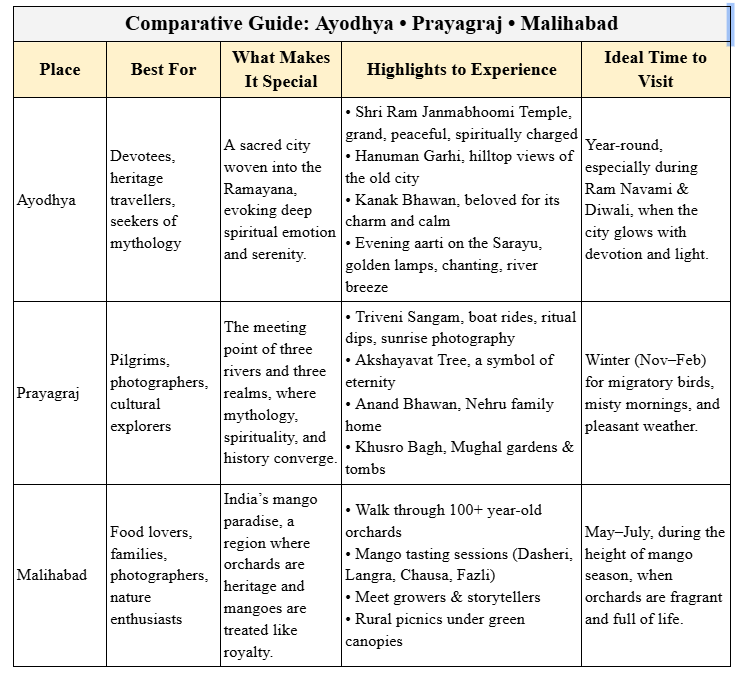
Comparing the Three Day-Trip Destinations
Below is an elaborative comparison table that helps travellers understand what each destination offers, who it is ideal for, and when to visit. Instead of a dry grid, the descriptions carry warmth and imagery to match the blog’s tone.
Suggested Day-Trip Itineraries
From Lucknow, each of these destinations unrolls into something different. Ayodhya is about two hours away and works well as a full day: temples in the morning when the light is right and the queues are manageable, the bazaars in the afternoon, and the Sarayu aarti as the day closes. Prayagraj is three hours and rewards a structured circuit: sunrise on the water at the Sangam, the Mughal tombs at Khusro Bagh in the late morning, and Anand Bhawan after lunch. Malihabad, at forty-five minutes, is the easiest commitment and the most relaxed: a morning in the orchards, tastings, conversation with the growers, and back to Lucknow in time for dinner.
From Varanasi, Prayagraj makes a natural half-day trip along the highway. Ayodhya is about three and a half hours away and is genuinely better with an overnight stay; trying to see the sunrise rituals and the evening aarti in a single day without staying means one of them gets rushed, and neither deserves that.
Cultural & Historical Themes That Connect Them
These three places look quite different on the surface, and they are, in important ways, genuinely different from each other. But the cultural threads running between them are worth noticing. Rivers appear in all three, not as background but as active participants in how each place understands itself. The Sarayu in Ayodhya is inseparable from the mythology of Rama's life and departure. The Sangam in Prayagraj is the main attraction of the area, the geographical feature that gave rise to everything else. In Malihabad, seasonal flooding shapes which soils drain well and which hold moisture, making the orchards possible.
The Ramayana threads through the region in ways that are still active, not just commemorated. Malihabad may not have an obvious Ramayana connection, but it carries its own form of inherited knowledge and oral tradition, the kind of thing that gets transmitted through demonstration rather than documentation. In that sense, watching a grower in Malihabad graft a new tree using the technique his grandfather taught him is not so different from watching a priest in Ayodhya perform a puja whose precise form has been carried forward across centuries. Both are about continuity, about keeping something alive through practice.
Traveller Tips
• Start early. Mornings in all three places are better than afternoons: cooler, less crowded, and the light in Ayodhya and Prayagraj at dawn is worth setting an alarm for. In Malihabad, the orchards are more active and the growers more available before midday.
• Dress modestly at the religious sites. This guideline applies particularly around the ghats and temple precincts in Ayodhya and Prayagraj. It is not an onerous requirement, and it is genuinely appreciated.
• Consider a guide, at least for Ayodhya and Prayagraj. Local priests at the Sangam or heritage interpreters in Ayodhya can explain the ritual logic behind what you are watching, which makes the experience considerably less like tourism and more like learning something.
• Carry cash. Digital payments are spreading but are not universal. Small vendors, temple offerings, roadside tea stalls, and orchard-gate sales in Malihabad all run on cash. Having some avoids the awkward moment of wanting to buy something you cannot pay for.
• For summer visits to Malihabad: Bring water, wear something light, and expect to walk. Orchard tours are not strenuous, but they happen under the open sky, and the summer heat in U.P. is not subtle.
Photography Tips
Ayodhya: The Sarayu ghats at dawn are probably the best single photographic opportunity in the city. The light is soft, the temples glow behind devotees, and the river surface catches everything. Arrive before full sunrise.
• Prayagraj: Shoot from the water rather than from the bank. A boat gives you the sweep of the rivers meeting, the scale of the ghats from the right distance, and access to the ritual moments that happen mid-river, with priests setting diyas afloat and pilgrims dipping into the confluence that you cannot reach from shore.
• Malihabad: The best images here tend to be close and slow: a hand on a mango, filtered light dropping through old branches, and the pattern of bark on a tree that has been grafted thirty times over eighty years. The landscapes are beautiful, but the details are what make the photographs feel specific rather than generic.
Experiencing These Day-Trips with Folk Experience
Folk Experience is built around the idea that the most interesting thing about any place is usually not what most visitors come to see, or at least not the way they usually see it.
Ayodhya: Guided Temple Walks
• Heritage guides trace the Ramayana's geographical connections through the city's actual spaces, so the temples and ghats start making sense as a map rather than as separate stops.
• Lesser-known legends and temple histories that do not appear in any brochure, the kind of thing that only survives in the memory of people who grew up here.
• The ritual practices that happen daily, not just during festivals, are explained in terms of what they mean and how they evolved rather than just what to watch.
Prayagraj: Ritual Interpretation at the Sangam
• Facilitators who can decode what is actually happening during a puja: which offering corresponds to which intention, what the mantra structure does, and why the Sangam is considered more powerful than either river on its own.
• A guided boat session where storytelling is woven into the experience of being on the water so that geography, mythology, and living practice arrive together rather than separately.
Malihabad: Orchard Immersion & Mango Culture
• Orchard families who welcome visitors into spaces they actually work in rather than spaces set up for demonstration, which makes every conversation feel like an exchange rather than a presentation.
• Mango tastings with enough context that the differences between varieties become interesting rather than just delicious. The history of a particular variety, the season it has had, the family that has been growing it—all of that changes what you taste.
• An honest look at what grafting involves, what gets passed down, what gets lost, and why the people doing this work think it matters.
Ethical & Community-Supportive Tourism
• Small groups that do not overwhelm the spaces they visit or the people who inhabit them.
• Direct support to the priests, farmers, artisans, and storytellers who hold this knowledge, rather than having that support filtered through intermediaries.
• Tourism designed to strengthen the things worth preserving rather than simply extracting value from them.
Travel a little beyond the city, and Uttar Pradesh reveals its soul, sacred rivers, ancient kingdoms, and orchards that smell like memory.
keep wandering