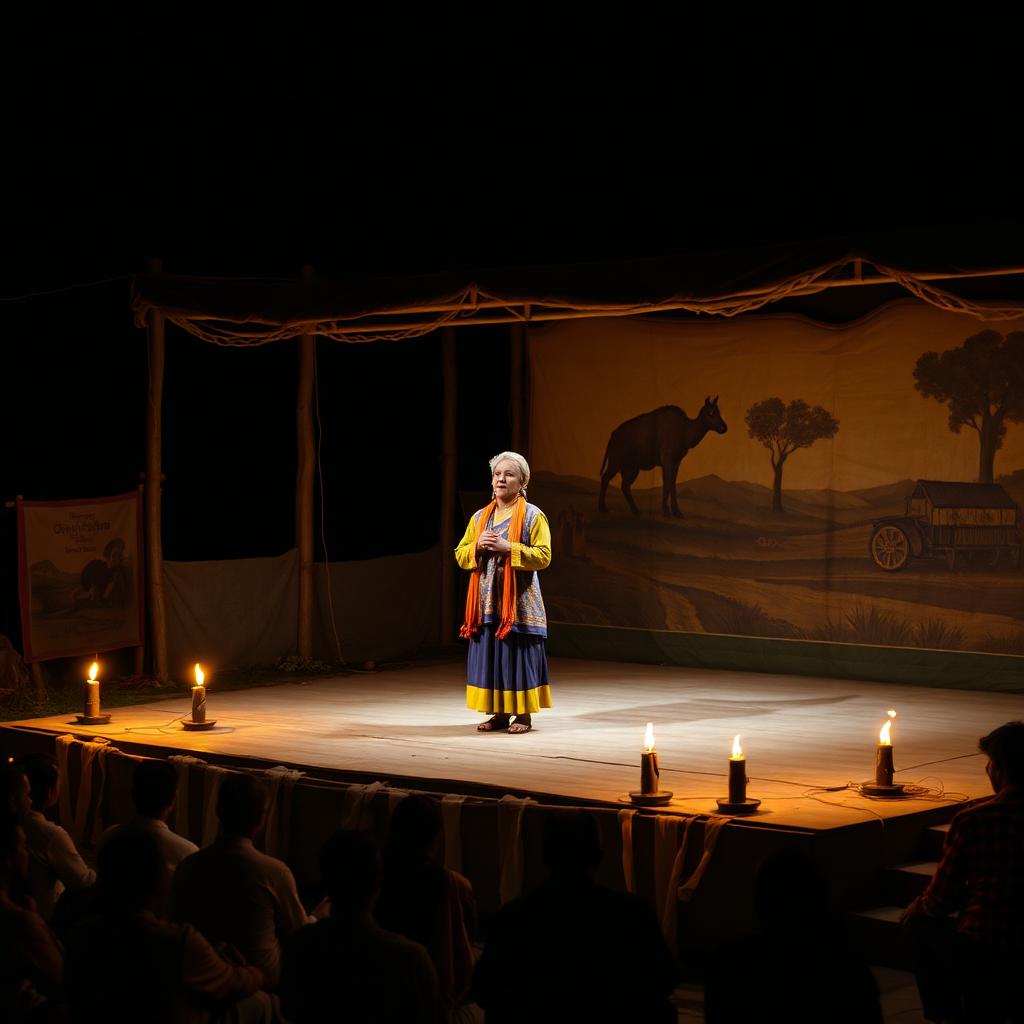
Bidesia and Jat Jatin: Bihar's Folk Theatre of Migration, Love, and Survival
There is a kind of art that does not exist to entertain. It exists to witness, to hold up a mirror to lives that formal history rarely records, and to say clearly and without flinching: this is what we have lived through, and it deserves…
Folk Editorial
Folk Experience
Meet your AI Story Guide
Turn this field note into a one-minute brief with the essential places, people, and traditions.
There is a kind of art that does not exist to entertain. It exists to witness, to hold up a mirror to lives that formal history rarely records, and to say clearly and without flinching: this is what we have lived through, and it deserves to be told. Bihar has two folk theatre traditions that do exactly this. Bidesia, created by Bhikhari Thakur, in the early 20th century, gives voice to the experience of migration, the men who leave and the women who wait. Jat Jatin, rooted in the Mithila and Koshi regions of North Bihar, tells the story of love tested not by fate or drama but by something far more ordinary and far more brutal: poverty. They are different traditions with different origins, different structures, and different regional homes. But they share the quality that makes both worth seeking out as a traveller: the refusal to make rural life more beautiful, more resolved, or more comfortable than it actually is. "In Bihar, folk art is not escapism. It is the most honest account of what it costs to live here, told by the people who pay that cost every day."
Bidesia: The Art That Followed Migration
The word 'Bidesia' means 'one who lives abroad,' and the tradition it names emerged from one of the most defining realities of Bihar's social life: the departure of men for distant cities and the long waiting that their families were left with.
Bidesia was created by Bhikhari Thakur, born in 1887 in the Saran district, a barber by caste, a farmer by necessity, and a folk artist by calling. Thakur saw what migration did to rural families: fractured households, women managing alone, men losing themselves in urban alienation, and promises made across distance and gradually broken. He responded not through protest alone but through performance, creating a folk theater form that combined song, dance, dialogue, and unflinching social critique.
He performed in villages, not auditoriums. He used Bhojpuri, the language of everyday life, not Sanskritized formal speech. His audience were the farmers, laborers, and women whose stories he was telling. For this, Bhikhari Thakur is often called the Shakespeare of Bihar, though the comparison risks obscuring what made him specific: he was not writing for posterity. He was writing for his community's emotional and social survival.
A typical Bidesia performance begins with a song. The story unfolds through dialogue, movement, and music, with dholak, harmonium, and tabla providing the emotional backbone. The choreography is not elaborate: a woman's slow pacing expresses waiting; a man's hurried steps suggest departure. Movement serves the story, not the spectacle.
The themes Thakur addressed extended beyond migration. He wrote about widow remarriage at a time when widows were socially ostracized. He critiqued caste discrimination openly, a significant act for a man of the Nai caste considered lower in the hierarchy. He gave his female characters voices that expressed anger, resilience, and grief, not the passive suffering that patriarchal narratives preferred.
Bidesia performances still draw crowds in rural Bihar today, not as nostalgia but as recognition. The themes are not historical. Bihar remains one of India's largest sources of migrant workers. The separation, the economic insecurity, and the emotional labor of those left behind that Thakur documented over a century ago continue without resolution.
Jat Jatin: Love in the Face of Everything Working Against It
Where Bidesia speaks to the community experience of migration, Jat Jatin speaks to something even more intimate: what happens to love when poverty will not leave it alone.
The tradition comes from the Mithila region and the Koshi belt of North Bihar, areas shaped by the unpredictable Koshi river, seasonal flooding, agricultural precarity, and the particular kind of endurance that communities develop when survival must be negotiated year after year. Jat is a cowherd, poor and dependent on daily labor. Jatin is his wife, managing a household with scarce resources. The story begins with love, sincere and genuine, and then poverty intrudes.
Debts accumulate. Food runs short. Jat considers leaving for work in distant cities. Jatin pleads with him to stay. What follows varies across regional versions, but the emotional truth remains constant: love is present, but it is not enough to solve hunger. Loyalty matters, but it does not pay debts. The characters do not overcome their circumstances through heroism. They endure them, or they break under them.
The performance structure of Jat Jatin blends dance, dialogue, and song. The movements are grounded and repetitive, mirroring the rhythm of rural labor rather than the ornamental vocabulary of classical dance. Dialogue is delivered in Maithili or Bhojpuri and is often partly improvised, performers drawing on personal experience and community knowledge rather than a fixed script. Songs carry the emotional weight that dialogue alone cannot hold, and audiences frequently sing along, transforming the performance into a collective act of remembering rather than a spectacle to be watched.
Jatin is not a supporting character in this tradition. She is a protagonist: managing scarcity, confronting social expectations, and navigating her relationship with Jat with a complexity that goes well beyond resignation. In some versions she challenges his decisions; in others she expresses anger. The narrative does not reduce her to victimhood or idealize her as a silent sufferer.
Historically, men performed all roles in Jat Jatin, as in much of Bihar's folk theater. Over time, women have entered the performance tradition, adding layers of lived experience to a character that male performance could only interpret from outside.
What the Two Traditions Share
Bidesia and Jat Jatin emerged in different parts of Bihar from different specific circumstances, shaped by different creators and communities. But they share something essential that makes them worth understanding together.
Both use folk performance not to celebrate or to escape but to witness. Both give form to experiences that official culture, formal education, and heritage tourism rarely acknowledge: the specific grief of families separated by economic necessity, the emotional labor of women managing alone, and the slow accumulation of hardship in communities where resilience is not a choice but a requirement.
Both traditions are also facing the same pressures. Younger generations are less drawn to folk theater. Urban entertainment dominates. Funding is limited and inconsistent. Many troupes perform only during festivals or government-sponsored cultural events, struggling to sustain themselves between those occasions. The performers who remain committed describe their work not as a career but as a responsibility: a way to ensure that what their communities have lived through is not forgotten simply because it was not written down by anyone with access to an archive.
For a traveler in Bihar, these two traditions offer something that no monument or heritage site can: direct access to the emotional and social interior of the state. Attending a Bidesia performance in a village in the Bhojpuri-speaking districts of central Bihar or watching Jat Jatin performed in a village square in the Mithila region is not a cultural activity to be completed and photographed. It is an encounter with art that was made because the community that made it had no other adequate language for what it needed to say.
How to Engage as a Traveller
Neither Bidesia nor Jat Jatin is available on demand. They are community traditions performed at specific occasions, festivals, village gatherings, and seasonal events, and finding them requires either the right timing or the right introduction.
Folk organizations working with performing arts communities in Bihar can facilitate encounters with both traditions. In the Saran district and the broader Bhojpuri-speaking region, Bidesia is most alive. In the Mithila and Darbhanga districts and the Koshi belt, Jat Jatin is most at home. Travelling with a culturally grounded guide who has genuine relationships in these communities will give you access that arriving unannounced cannot.
If you attend a performance, understand what you are watching before you watch it. The social critique embedded in Bidesia, the caste commentary, and the acknowledgement of women's labor and the refusal to romanticize migration are only visible if you know to look for them. The emotional honesty of Jat Jatin, its refusal to resolve the tension between love and poverty, is only felt if you understand the specific circumstances it reflects.
Support the performers directly where possible. For most, this is not a profession that provides stable income. Your attendance and your willingness to pay for the experience contribute to the economic conditions that determine whether the tradition continues.
Why Choose Folk Experience to Travel Bihar
Traveling in Bihar is not about ticking destinations off a list. It is about understanding people, practices, and the everyday lives that unfold in this landscape. That is where a folk-led travel approach makes the difference.
Folk Experience takes you into villages where Bidesia is still performed as social commentary, not cultural decoration, and where Jat Jatin is still told by communities who recognize their own lives in the story. Culture here is lived, not staged, and the journeys of folk designs reflect that reality.
Art in Bihar reveals what history hides. Understanding Bidesia offers deeper insight into migration, caste, and social reform than any official narrative provides. Understanding Jat, Jatin shows you how rural communities process love, hardship, and survival in the only language available to them: performance.
Folk-led travel supports living traditions and the people who sustain them. It connects you with performers who are keeping these forms alive not because there is economic incentive to do so but because they understand that some things must not be forgotten. Your engagement with them is not tourism. It is participation in an act of cultural continuity.
Bihar reveals itself slowly, honestly, and with lasting impact to those patient enough to let it.
At Folk Experience, we do not simply take you to Bihar. We help you understand why it matters.
" Bihar's folk theatre does not ask you to be moved by its beauty. It asks you to be honest enough to recognise what it is showing you. That recognition is the beginning of understanding Bihar as it actually is. "
Subscribe to our newsletter
Folk Experience © 2026 – All Rights Reserved