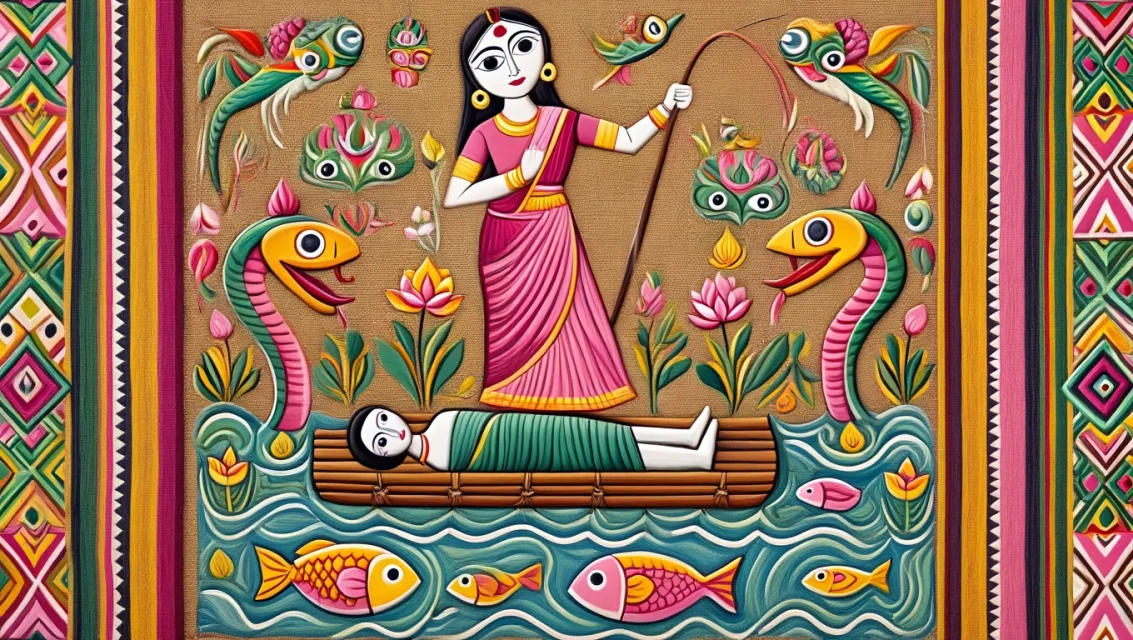
Bihula Bishari Puja: Folklore, Faith, and Manjusha Art
On the night of Lakhandar's wedding, a snake entered the iron chamber his father had built to keep him safe. The chamber had been constructed specifically to protect Lakhandar from the fate that an astrologer had foretold: that he would die of a snakebite on his wedding night....
Meet your AI Story Guide
Turn this field note into a one-minute brief with the essential places, people, and traditions.
The Anga Region and Its Specific Ecology
The Anga region, the ancient territory centred on Bhagalpur in eastern Bihar, sits in a landscape defined by the Ganga and its tributaries. The river is generous and unpredictable: it brings fertile soil and it floods fields; it brings water and it displaces communities; it brings fish and it carries disease. The communities that have lived here across centuries have organised their belief systems around this specific ecological reality rather than around any abstract theology.
FACT: The Anga region of eastern Bihar, corresponding roughly to the present-day Bhagalpur and Banka districts, is one of the oldest continuously inhabited river territories in the Gangetic plains. Archaeological evidence from sites in the Anga region indicates human settlement dating to the Neolithic period. The region's cultural traditions, including Bihula Bishari Puja and Manjusha art, are documented in oral and visual records going back at least 300 to 400 years, with scholars suggesting the underlying narrative tradition is considerably older.
Snake worship in the Anga tradition is not the fearful propitiation of a dangerous animal. It is the acknowledgement of a power that the landscape makes visible every monsoon, when rising floodwaters displace snakes from their ground-level habitats into the paths of people. Bishari, the snake goddess to whom the puja is addressed, is not a deity of death but of balance: the guardian of the boundary between human and natural space that the monsoon makes porous. Worshipping her is the ritual equivalent of what the contemporary world calls ecological awareness.
The Bihula story encodes this understanding at the level of narrative. Chand Saudagar's refusal to worship Bishari is not simply pride. It is the specific error of a man who believes that human construction, the iron chamber, can substitute for an appropriate relationship with the natural world. The iron chamber fails. The goddess acts. The consequences are real and immediate. And the restoration comes not through defeating the goddess but through the kind of sustained, humble devotion that acknowledges her authority.
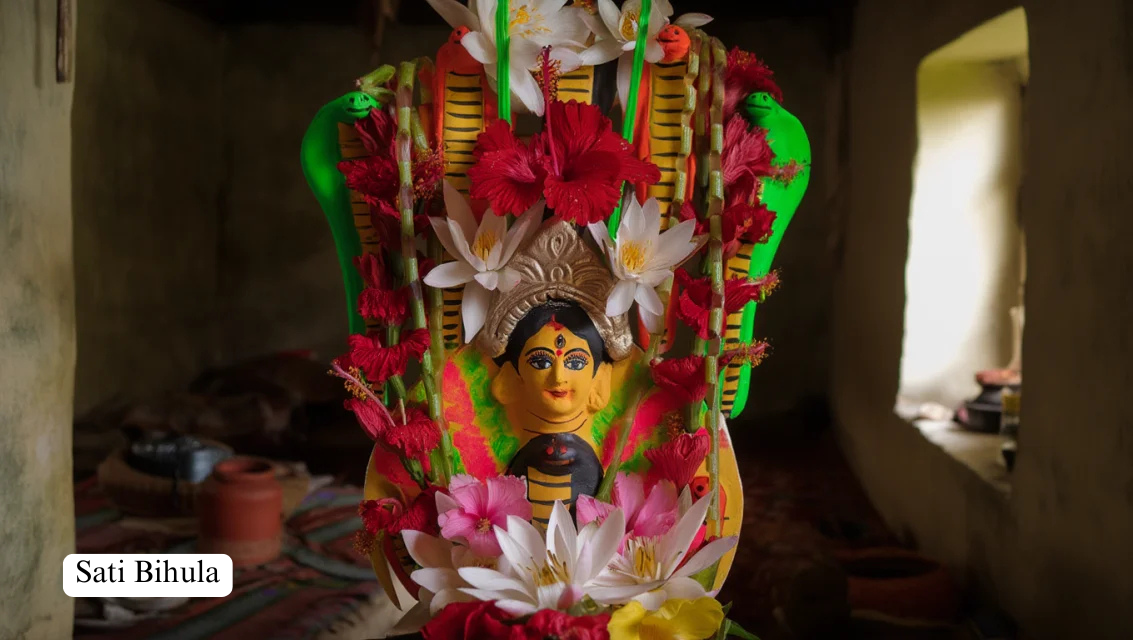
Manjusha Art: The Scroll That Carries the Story
The most visually distinctive element of the Bihula Bishari tradition is Manjusha painting, a folk art form specific to the Anga region whose name comes from the box-shaped containers, manjushas, on which the earliest versions of the paintings were mounted.
Manjusha paintings are narrative scrolls. Each panel depicts a specific episode from the Bihula legend in sequence: the marriage, the death, the raft journey, the encounters along the river, the confrontation with Bishari, and the restoration. The composition uses bold lines, flat colour fills, geometric borders, and a specific set of symbolic motifs that the Anga painting tradition has maintained across generations.
FACT: Manjusha art is classified as a Geographical Indication product of Bihar, protecting the name and the production geography. The art was first brought to national attention through the work of artist and researcher Upendra Maharathi in the mid-20th century, who documented the tradition when it was at risk of disappearing. The 7th-century Chinese traveller Xuanzang, who visited the Anga region during his Indian pilgrimage, recorded observations of local cultural practices that some scholars have used to argue for the tradition's antiquity, though direct genealogical connection to the contemporary form has not been definitively established.
The figures in a Manjusha painting are recognisable but not naturalistic. Human forms are schematic, with specific conventions for depicting Bihula, Lakhandar, Bishari, and the other characters in the legend that an Anga viewer would read as immediately as we read facial expressions. The snake is ubiquitous in the visual vocabulary, appearing as both threat and divine presence, which reflects the story's own ambiguity: Bishari is the cause of the crisis and the source of its resolution.
The green parrot, called Chungua, is a recurring motif with a specific narrative function. In the Bihula legend, a parrot serves as a witness and a messenger, carrying information between characters in ways that shape the story's development. The parrot in a Manjusha painting is not decorative. It is a narrative indicator, signalling the episode and the character relationships of the specific panel.
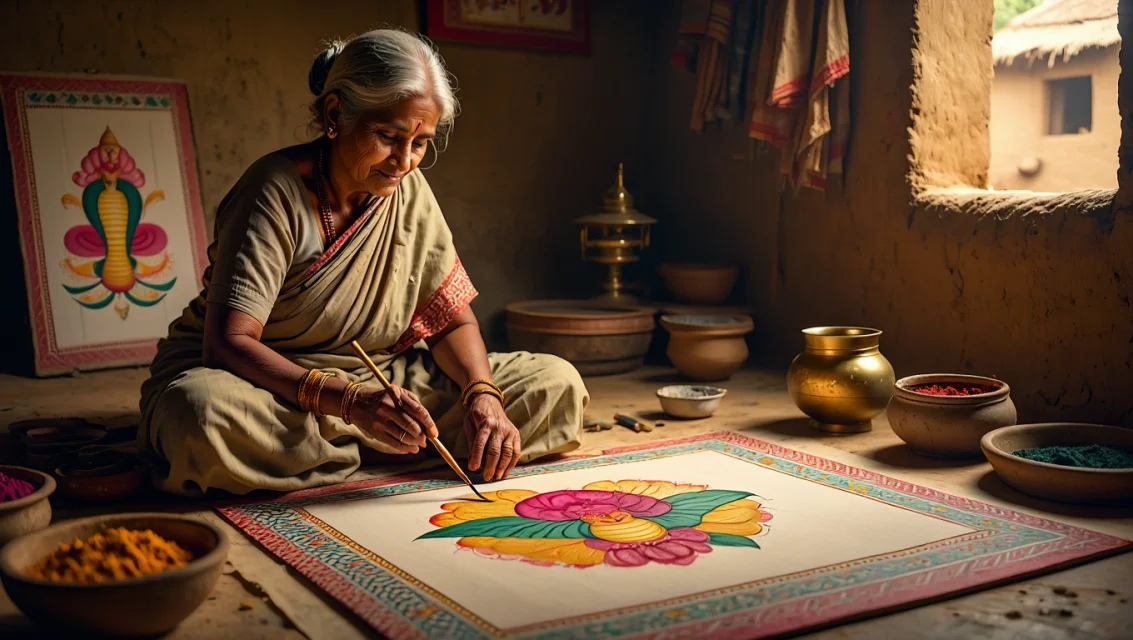
The Puja and Its Practice
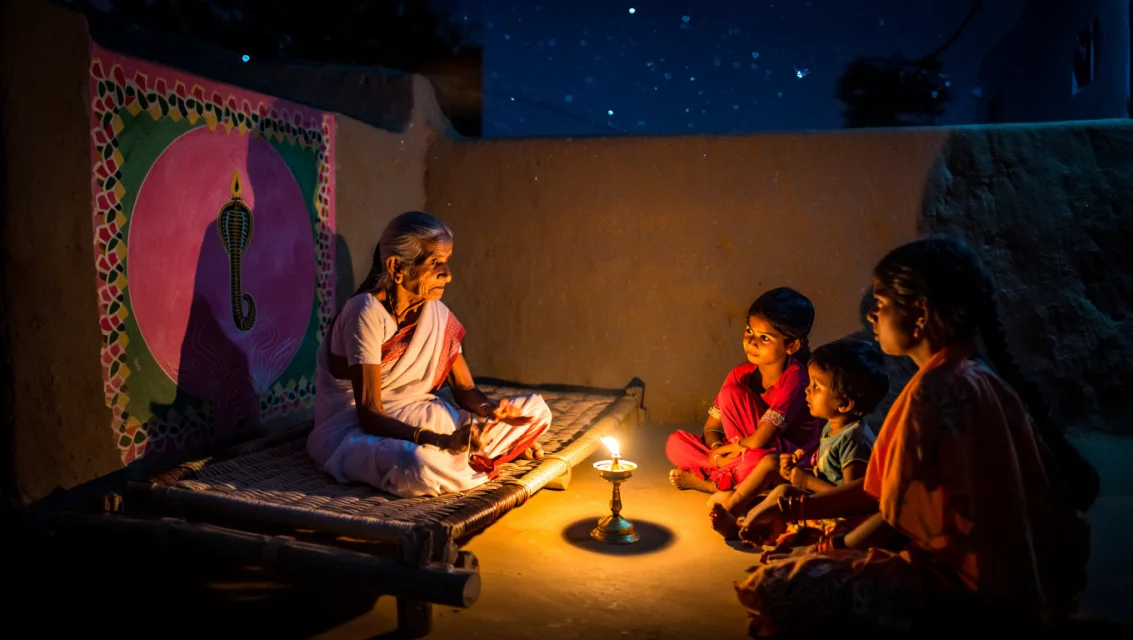
Bihula Bishari Puja is observed primarily in the Bhagalpur and Banka districts, and it has always been a household-level rather than a public-scale tradition. Women are the primary practitioners and the primary transmitters of the ritual knowledge: the specific prayers, the sequence of offerings, the stories that accompany each stage of the observance, and the preparation of the ritual spaces where Manjusha motifs are painted on walls and wooden surfaces.
The monsoon timing of the puja is not accidental. The festival falls in the period when snake encounters are most likely, when the river is at its most powerful, and when the specific anxieties that Bihula's story addresses are most present in the life of the community. The ritual is performed in the season for which it was designed.
FACT: Bihula Bishari Puja is observed during the monsoon months, typically in July and August, coinciding with the period when snakebite risk historically peaks in the flood-prone areas of eastern Bihar. The puja's timing reflects an integrated understanding of seasonal ecology: the worship of Bishari during the monsoon acknowledges the snake's increased presence in human spaces as a natural consequence of flooding and seeks the goddess's protection in the specific season when that protection is most needed.
The river carries symbolic weight throughout the observance, reflecting Bihula's own river journey at the story's centre. In communities along the Ganga and its tributaries near Bhagalpur, the river is not merely a landscape feature during Bihula Bishari Puja. It is a participant in the ritual: the space through which the story's most important journey is made and the element whose power over human life the tradition acknowledges.
The domestic character of the puja, its survival in homes and neighbourhoods rather than in public ceremonies, is the same quality that has protected it from the pressures that have affected larger, more publicly visible traditions. It does not require institutional support. It does not require a stage or an audience. It requires a woman who knows the story, a family that gathers to hear it, and the ritual space that the household prepares.
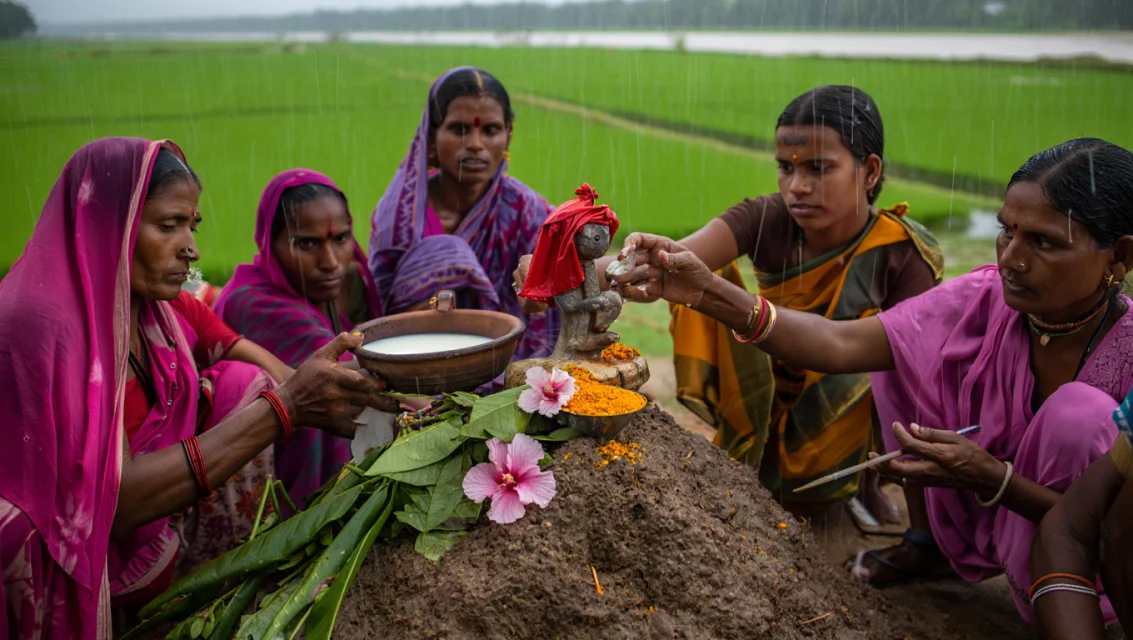
Why the Tradition Survived and What Threatens It Now
Bihula Bishari Puja survived because it was never large enough to become generic. The traditions that have maintained the most authentic continuity in Bihar are typically those that remained rooted in specific places, specific communities, and specific ecological realities rather than those that expanded to become pan-Bihar or pan-Indian phenomena. The Anga region's specific flood ecology, snake encounter history, and river culture are what gave the tradition its specific character, and remaining specific to those conditions is what protected it from dilution.
What threatens it now is not change but silence. The oral transmission that has always been the tradition's primary vehicle depends on the act of telling, and the act of telling requires the space and the occasion that contemporary life increasingly does not provide. When the grandmother who knows the full Bihula story in all its narrative complexity is no longer the centre of a gathered household, the story does not automatically find another transmission path.
"The Bihula story is not in danger of being forgotten because it is irrelevant. It is in danger of being forgotten because the social structures that sustained its transmission, the extended family, the seasonal gathering, and the household ritual space where women told stories to younger women, are themselves under pressure from migration, urbanisation, and the replacement of communal storytelling with individual screen consumption. The story is still true. The occasion for telling it is becoming rarer."
Manjusha art faces a different but related challenge. The GI tag protects the name but cannot ensure that the artists who produce the paintings understand the narrative tradition that gives the paintings their meaning. As the art reaches markets that value the visual form without necessarily knowing the story it carries, the risk is that Manjusha becomes a decorative style rather than a narrative tradition. The painting without the story is a different object from the painting with it.
Why Folk Experience for Bihula Bishari
The Bihula Bishari tradition is not accessible through standard Bihar tourism itineraries. It is not a public festival with a schedule, and Manjusha art in its authentic form is not produced in craft centres set up for visitor access. Both the festival and the art exist in the households and communities of the Anga region, and engaging with them requires the relationships that make household-level access possible.
Folk Experience approaches Bihula Bishari as a cultural encounter with one of Eastern Bihar's most distinctive and least-known traditions.
The Bhagalpur area visit is designed around the communities where the tradition is most actively maintained, with introductions to families who observe the puja and are willing to share its context with respectful visitors. The conversation about Bihula's story in the home where the story is still told is the encounter that no museum or craft fair provides.
The Manjusha art encounter connects visitors with artists who maintain the narrative tradition alongside the visual one, understanding what each panel depicts and why the parrot appears where it does and what the snake's specific form in a given painting indicates about the episode being shown. The painting with the story is an entirely different object from the painting without it.
The river context: Folk Experience designs the Bhagalpur visit to include the Ganga in its role as the landscape of Bihula's journey, giving the story the physical geography that makes it more than legend.
The Anga region ecology: understanding why Bishari is worshipped in the monsoon months and what the snake's relationship to flooding means in this specific landscape gives the tradition a depth that the legend alone does not provide. Folk Experience makes this ecological context part of every Bihula Bishari encounter.
Eastern Bihar does not announce its most important stories. It keeps them in homes, in paintings on domestic walls, and in the voices of women who learnt them from women who are no longer living.
Folk Experience will take you to where those stories are still being told.
keep wandering