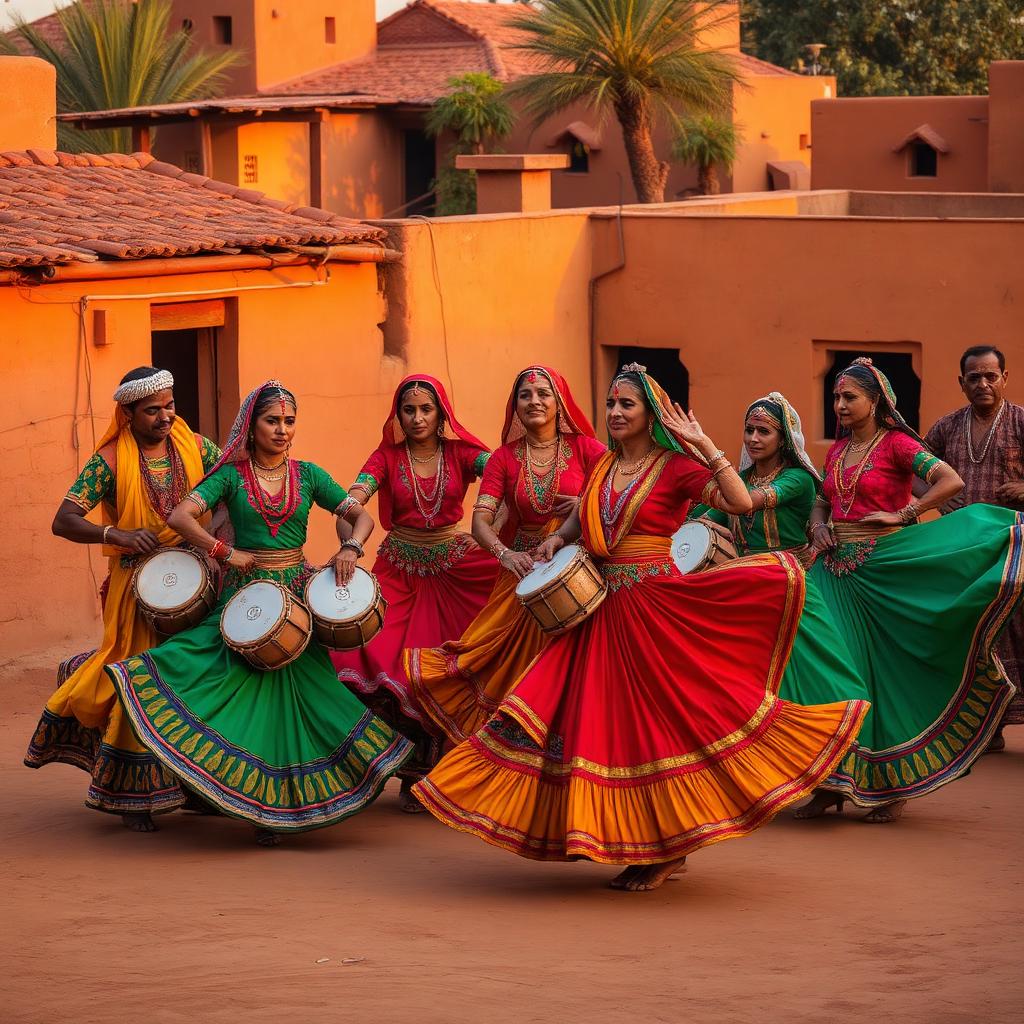
Folk Dances of Bihar: Stories, Rituals, and Community Expression
In Bihar, dance has never been a separate activity from living. It emerges during the first monsoon rains, accompanies a birth, mourns a departure, celebrates the harvest coming in. Before anyone documented it, filmed it, or put it on a…
Folk Editorial
Folk Experience
Meet your AI Story Guide
Turn this field note into a one-minute brief with the essential places, people, and traditions.
In Bihar, dance has never been a separate activity from living. It emerges during the first monsoon rains, accompanies a birth, mourns a departure, celebrates the harvest coming in. Before anyone documented it, filmed it, or put it on a stage, it was movement inside everyday life, in courtyards and fields and the open air of village squares at night. These are not choreographed forms. They were never designed for audiences. They are rituals, records, and social practices shaped by the specific conditions of life in this part of the subcontinent, by migration, agriculture, belief, and the particular quality of hardship and joy that the Gangetic plains produce. Understanding Bihar through its folk dances is understanding how communities use their bodies to remember what they cannot afford to forget.
Bidesia: The Dance That Migration Made
Bidesia begins with an absence. The word means one who lives abroad, and the form was created in the early 20th century by Bhikhari Thakur, a barber from Saran district who became, through sheer artistic force, one of the most significant cultural figures Bihar has produced. Thakur's own community was among the most affected by the mass migration of Bihari men to factories and plantations across colonial India, and what he made from that experience was not a lament but a complete theatrical and dance tradition.
FACT: Bhikhari Thakur (1887-1971) is referred to as the Shakespeare of Bihar by literary scholars, a comparison that acknowledges both his prolific output and his ability to use popular performance forms to address the social realities of his time: caste discrimination, widow remarriage, the abandonment of families by migrant husbands, and the specific vulnerability of women left behind. His Bidesia tradition combined folk song, dance, and dialogue into a form that communities could perform with minimal resources.
The content of Bidesia is raw in a way that the term 'folk dance' does not prepare you for. A wife waits. A husband does not return, or returns changed, or returns with another woman from the city. The male performers who traditionally played female roles were not making an aesthetic choice but a practical one: women did not perform in public spaces. The absence of women from the stage made the performances, paradoxically, entirely about the women who stayed home.
Bidesia is still performed across Bihar, in village squares and at cultural festivals, and it carries the same themes because the same conditions persist. Bihar continues to be one of the largest sources of migrant labor in India. The women who wait are still waiting. The dance that Bhikhari Thakur made from that reality remains one of the most honest documents of what economic migration costs.
Jat Jatin: What the Cowherd and His Wife Know
Jat Jatin is a narrative dance-drama, performed primarily in the Mithila and Kosi belts of northern Bihar, that tells the story of a cowherd and his wife. The story varies across villages and across performers, but the core remains consistent: a marriage under pressure from poverty, social expectation, and the specific strains that rural life in this region places on domestic relationships.
What Jat Jatin does not do is idealize the village. The cowherd and his wife argue. There is humor, but it is the humor of recognition rather than comfort. The reconciliation, when it comes, is earned rather than assumed.
Jhijhia: The Lamp That Balances on the Head
Jhijhia is performed by women during the monsoon season, in the weeks of uncertainty between the rains arriving and the harvest being secured. Women carry lit earthen lamps balanced on their heads as they dance, the flame moving with the movement of the body without going out. The songs invoke Goddess Durga and local deities associated with protection, rainfall, and family welfare.
FACT: The balancing of a lit lamp on the head during Jhijhia is not a performance of skill but a devotional act, requiring the dancer to maintain a quality of stillness within movement that the tradition understands as itself a form of prayer. The lamp does not go out because the dancer does not let her mind go elsewhere.
The women who dance Jhijhia are of all ages, and the dance has no formal hierarchy. Older women teach younger ones not through instruction but through doing it beside them, which is how most things worth knowing in Mithila are transmitted. The gathering in the courtyard or the open space at the edge of the village is both ritual and reunion, a regular reassertion of the bonds between women in communities where those bonds carry much of the weight of daily life.
Kajari: The Monsoon's Two Faces
Kajari is a dance of the monsoon, but the monsoon in Bihar is not a simple blessing. It brings the water the crops require and the flooding that destroys what the water was meant to sustain. The songs sung during Kajari carry both registers: joy at the rain's arrival and the specific melancholy of a season that also means the men have gone away.
Performed near rivers, ponds, and fields, Kajari connects the human body to the landscape in a way that indoor performance traditions cannot replicate. The rhythm of the clapping and the rhythm of the rain are not accidentally similar. The dance was made in the season for which it is performed, and it knows the season from the inside.
Sohar Khilouna: When a Child Arrives
Sohar Khilouna is the dance of birth, performed inside the home when a child is born, traditionally with more celebration when the child is male. Women gather in the inner rooms and sing songs of blessing and protection while moving in the intimate, unhurried way that the domestic space allows.
The patriarchal framing of the tradition is worth naming honestly: the arrival of a son has historically been celebrated in ways that the arrival of a daughter has not. That is the social reality the tradition reflects. It is also worth noting that the central participants in this celebration are entirely women, maintaining the rituals of family continuity in the spaces from which they were largely excluded in public life.
FACT: Sohar songs, which accompany the Sohar Khilouna dance, are among the oldest folk music traditions in the Bhojpuri and Maithili linguistic regions. Some Sohar compositions have been traced back several centuries, preserved through oral transmission by the women who sang them at every birth in their communities.
Domkach: The Wedding's Women's Side
Domkach is what happens at Bihar's weddings on the women's side of the celebration, which is to say it is energetic, participatory, and entirely unconcerned with the formalities happening elsewhere in the ceremony. Women of all ages dance in synchronized formations, clapping and singing songs that bless the couple with a directness and humor that the formal ritual does not permit.
The social function of Domkach is not incidental to its form. Weddings in rural Bihar bring together women from different families, different villages, and sometimes different social backgrounds, and the shared dance creates a temporary community that the occasion requires. The energy is collective and equalizing: the grandmother dances with the same commitment as the teenager beside her.
Jumari: The Circle That Includes Everyone
Jumari is danced in a circle, participants holding hands or linking arms, moving together in patterns that require coordination without demanding skill. The inclusivity is structural: a circle has no front and no back, no leading position and no marginal one. Everyone is equally visible. Everyone is equally necessary to the form.
Jumari is performed at festivals and community gatherings, often continuing late into the night, the circle growing and shrinking as people join and step away. The singing is communal. The rhythm is communal. The exhaustion, at the end, is communal.
Paika Dance: Discipline as Devotion
The Paika Dance comes from the martial communities of Bihar, and it carries the aesthetic of training rather than the aesthetic of entertainment. The footwork is precise. The weapon handling is controlled. The synchronization between performers reflects hours of practice rather than spontaneous expression.
FACT: The Paika martial tradition in Bihar is distinct from but historically connected to the Paika warrior communities of Odisha, who led the 1817 rebellion against the British East India Company. In Bihar, the Paika dance has historically been associated with communities that provided soldiers to regional armies and who maintained martial training traditions through performance as much as through active combat.
What the Paika Dance preserves is not nostalgia for warfare but the specific quality of attention that physical discipline develops. The dancer who performs the Paika correctly has achieved something: not a performance, but a sustained state of coordinated awareness. For communities that have historically defined themselves through martial identity, the dance is the ongoing practice of that identity in the absence of the original context.
The Absence of the Spotlight
What all of Bihar's folk dances share, across their different contexts and communities and emotional registers, is the absence of hierarchy. There are no lead dancers. There are no spotlights. There are no seats reserved for the more important members of the audience because the distinction between performer and audience is not the organizing principle of these traditions.
Everyone participates. Mistakes are not corrected. Perfection is not the goal. The elderly woman who cannot keep the pace of the younger dancers is still part of the dance. The child who does not yet know the movements learns them by being inside the circle, not by watching from outside.
This is not a romantic claim about the equality of village life, which is stratified in ways that the dance does not entirely erase. It is an observation about what these specific forms ask of the people who practice them: not excellence but presence, not skill but commitment to the shared activity.
Why Folk Experience for Bihar's Dance Traditions
Bihar's folk dances lose their meaning when they are removed from the contexts that produced them. A Jhijhia performed on a lit stage in a festival tent is a different thing from Jhijhia performed in a courtyard during the monsoon, with the rain audible beyond the walls and the lamps actually necessary for light. A Bidesia viewed in a theater is a different thing from Bidesia performed in the village square of a community where half the adult men are working somewhere else.
Folk Experience approaches Bihar's dance traditions as what they are: social practices embedded in specific seasons, specific communities, and specific occasions. The Bidesia performance in Saran that Folk Experience facilitates is attended because a community is actually performing it, not because a performance has been staged for visiting guests. The Domkach at a Mithila wedding is witnessed because Folk Experience has the community relationships that make attendance possible as a respectful guest rather than an uninvited observer.
The seasonal calendar matters here. Kajari happens in the monsoon. Jhijhia happens when the rains are uncertain and the harvest is not yet secured. Sohar Khilouna happens when a child is born. These are not events that can be scheduled for visitor convenience. Folk Experience designs Bihar itineraries around the calendar of the communities rather than the calendar of the tourist season, which is the only way to encounter these traditions in the form that makes them worth encountering.
Folk Experience will take you to where the dance is happening, not where it has been arranged.
Subscribe to our newsletter
Folk Experience © 2026 – All Rights Reserved
keep wandering