Folk Music and Songs of Bihar: Work, Seasons, and Life Stories
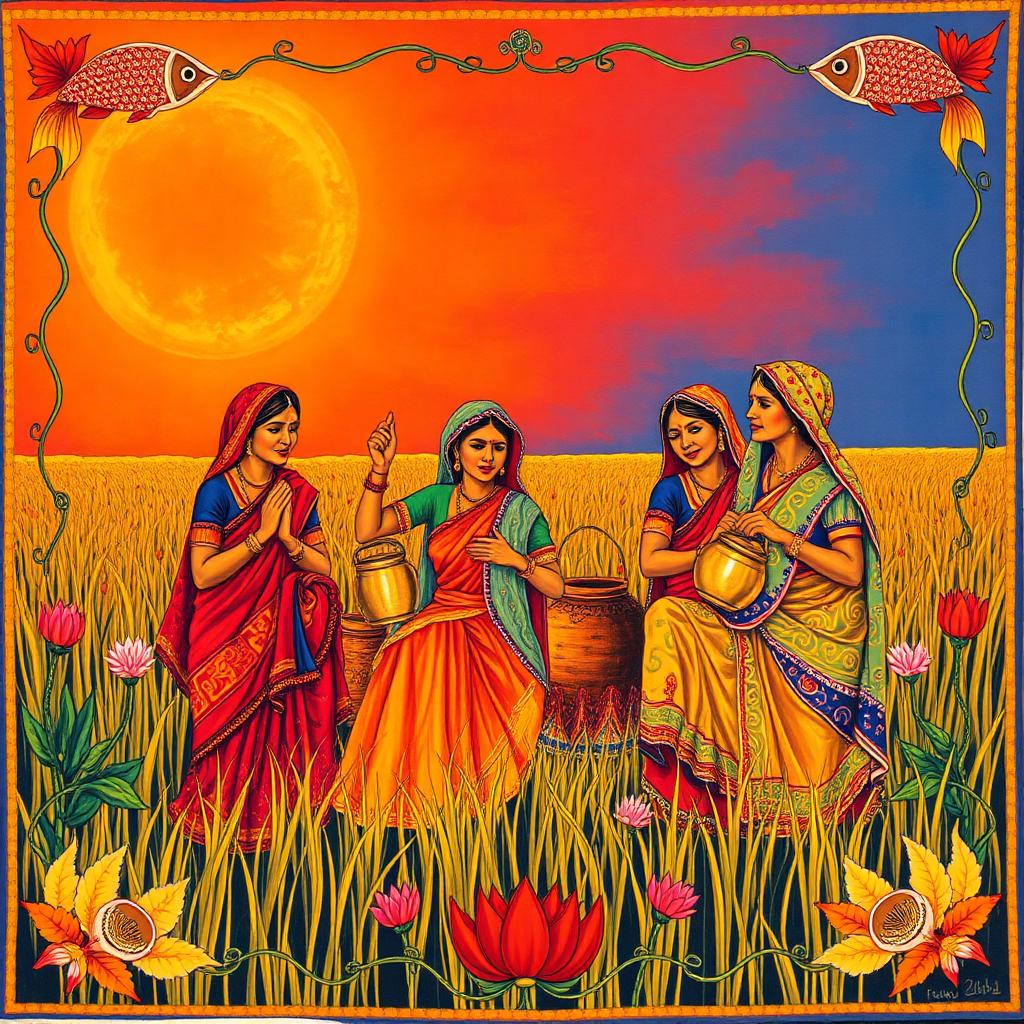
A mother hums while nursing her newborn. Women sing in rhythm as they push rice seedlings into waterlogged soil, their backs bent, their feet in the mud, the melody setting the pace of work that would otherwise be unbearable. A man alone…
Folk Editorial
Folk Experience
Meet your AI Story Guide
Turn this field note into a one-minute brief with the essential places, people, and traditions.
A mother hums while nursing her newborn. Women sing in rhythm as they push rice seedlings into waterlogged soil, their backs bent, their feet in the mud, the melody setting the pace of work that would otherwise be unbearable. A man alone in a distant city sings of the village he left behind. During Chhath, millions of voices rise simultaneously at the water's edge, facing the setting sun, offering what words alone cannot carry. In Bihar, music has never been a separate category from living. It is woven into the fabric of the day, structuring labour, marking seasons, processing what cannot be spoken directly, and sustaining faith in the specific way that collective voice sustains it, not through argument or doctrine but through the shared physical experience of sound. These songs are not written down. They are not taught in classrooms. They are absorbed through living, heard from mothers, learnt in fields, shared at festivals, and carried in memory across the distances that migration creates.
What Makes Bihar's Folk Music Different
Bihar's folk music resists the category of performance. The songs emerge within daily routines and are not rehearsed for audiences or staged for cultural programs. A woman singing Sohar after a birth is not performing. She is blessing a newborn and creating the atmosphere in which a new life is welcomed. Agricultural workers singing Ropnigeet are not entertaining anyone. They are coordinating their bodies through a shared rhythm that makes collective labor possible.
This functional quality gives Bihar's folk music a character that listeners trained on classical or popular forms sometimes find confusing. The vocal quality is often raw, shaped by outdoor singing and agricultural work rather than formal training. Melodies are repetitive by design, built for group participation rather than individual display. Lyrics are frequently improvised or adapted to the specific occasion, which means no two performances of the same song are identical.
FACT: Bihar's folk music traditions span several distinct linguistic regions within the state, including the Maithili-speaking north, the Bhojpuri-speaking west, the Magahi-speaking center and south, and the Angika-speaking northeast. Each region carries its own musical vocabulary, instrument preferences, and song traditions, which is why Bihar's folk music cannot be treated as a single unified category but as a family of related traditions with shared underlying values.
The songs also serve as the primary vehicle for emotional expression in communities where direct complaint or grief may be socially restricted. A woman who cannot tell her mother-in-law she is exhausted can sing about exhaustion. A wife who cannot write to the husband who has not come home can sing about his absence. Music becomes the permissible space for emotional truth, which is why the songs tend toward honesty in a way that formal communication in the same communities does not.
Sohar: When the Voices Gather Around a Birth
Sohar songs are sung inside homes when a child is born, with women gathering in the inner rooms to bless the newborn and support the new mother. The melodies are gentle, and the lyrics are full of welcome and description: the child's beauty, the child's imagined future, and gratitude to the deities for safe delivery. The singing creates an atmosphere that the occasion requires: warmth and collective reassurance at a moment of vulnerability.
The songs also carry the social reality of where they were made. Sohar for male children has historically been more elaborate, more joyful, and more prolonged than Sohar for female children, reflecting the gender preferences that have governed domestic life in Bihar for centuries. This is not a peripheral detail but the central fact about the tradition: it blesses new life and simultaneously enacts the hierarchy that decides which new life is more worth blessing.
Bidesia Songs: The Sound of Departure
the SaranThe Bidesia songs of Bihar are the folk music of migration, which means they are the folk music of roughly half of rural Bihar's domestic experience for the past century and a half.
The name means one who has gone elsewhere. The songs were given their formal structure by Bhikhari Thakur in the early 20th century, but the emotional content they carry predates him: the wife who manages everything alone, the husband who does not write, the children who are growing in the absence of the man who fathered them, the promises made at departure that distance erodes.
FACT: Bhikhari Thakur (1887-1971), a barber from Saran district who became the most significant figure in Bhojpuri folk theater and song, created the Bidesia tradition as a form of social commentary as much as entertainment. His works addressed caste discrimination, widow remarriage, and the specific devastation that economic migration inflicted on the families left behind. He was awarded the Padma Shri in 1971, months before his death.
The Bidesia songs do not romanticize the absent husband. They are frequently angry. The wife in the song is not waiting patiently; she is waiting resentfully, which is the more honest account of what waiting through years of a husband's absence actually feels like. Singers often weep while performing them. Listeners weep while hearing them. The music creates a collective space for grief that communities across Bihar have found necessary for as long as the economic conditions that cause separation have persisted.
Those conditions have not changed significantly. Bihar continues to send more migrant workers to other states than almost any other region in India. The Bidesia songs remain current because the situation they describe remains current.
Chhath Geet: Faith at the Water's Edge
Chhath Puja is Bihar's most significant festival, and the songs that accompany it are the most widely heard folk music tradition in the state, spread now across every city in India where Bihari migrants have settled and every country where they have gone.
The festival honours Surya, the sun god, and Chhathi Maiya through four days of rigorous fasting, ritual bathing, and offerings made at water bodies at the precise moments of sunset and sunrise. The Chhath Geet accompanies every stage of this observance, describing the sun's power, praising the deity's benevolence, requesting protection for families, and expressing a devotion that is collective rather than individual.
FACT: Chhath Puja and its associated songs have spread with Bihar's diaspora to become significant cultural events in cities across India and internationally. The festival is now observed in Mauritius, Fiji, the Caribbean, the United States, and across Southeast Asia, wherever Bihari and eastern Uttar Pradesh communities have settled. The Chhath Geet sung on the banks of the Ganga in Patna and on the banks of the East River in New York are the same songs, connecting communities separated by thousands of kilometers through shared music.
What makes Chhath Geet particular is its scale. At the river ghats during Chhath, thousands of voices sing the same songs simultaneously, the sound building across the water in a way that the individual voice cannot achieve and that recorded music cannot replicate. The collective voice is the point. The individual singer participating in that collective voice is both a person and a part of something larger than a person, which is what devotional music in this tradition is trying to produce.
Kajari: Joy and Longing in the Same Season
Kajari songs are sung during the monsoon months of Sawan and Bhadra, and they carry both the joy of the rains arriving and the specific sadness that monsoon brings in Bihar's agrarian communities: the season when many men leave for distant work and when women are managing the farm and the household and the children through the most physically demanding months of the agricultural year.
The songs do not choose between these two emotional registers. They hold both simultaneously: the landscape transformed by rain and the house emptier than it should be; the fields green and the absence of the man who should be there to see them. Kajari is not melancholy masquerading as celebration or celebration masquerading as melancholy. It is both, which is the honest account of what monsoon season in rural Bihar feels like.
The melodies are fluid and rhythmic, sung near ponds and rivers where women gather. The setting is not incidental: Kajari is connected to the element it celebrates, the water that the rain brings and that the river carries, and the outdoor space where women can sing without the constraints of the household.
Ropnigeet and Katnigeet: When Work Has Its Own Music
Rice transplantation is one of the most physically demanding agricultural tasks in the Gangetic plains. Women stand in waterlogged fields, bent at the waist, pushing seedlings into the mud one by one, moving backward through the field in lines that must be coordinated to ensure even spacing and consistent depth. The work takes days. Without a shared rhythm, the coordination falls apart, and the work becomes individual exhaustion rather than collective labor.
Ropnigeet is the solution. The planting songs set the pace, coordinate the movement, and transform back-breaking work into something communal and, when the songs are good, almost bearable. The lyrics range across topics: the hope for a good harvest and the difficulty of the work itself, and topics entirely unrelated to rice that provide mental distance from physical repetition. Some ropnigeet are teasing, directed at specific women in the group. Some are contemplative. All of them function as technology before they function as art.
FACT: The work songs of Bihar's agricultural communities, including Ropnigeet for planting and Katnigeet for harvesting, are documented by ethnomusicologists as among the most functionally integraitself andted folk music traditions in India, meaning the music is more deeply embedded in the work process itself than in most comparable traditions. The rhythm of the songs corresponds directly to the physical rhythm of the task, making them difficult to separate from their labor context even in recording or performance.
Katnigeet, the harvesting songs, carry a different emotional character: faster and more energetic, reflecting the relief and celebration of the harvest being brought in. But they also contain the anxiety of the harvest moment: the calculation of whether the yield will cover the debts, whether the price will be sufficient, and whether this year's work will be enough. The songs hold the joy and the worry together, which is what harvest is: relief that something has grown and fear that it may not be enough.
Purbi: The Melody That Travels
Purbi is the musical form most associated with the eastern Bihar and eastern Uttar Pradesh region, and it is the form that has most successfully crossed into popular music, influencing film songs and contemporary folk-pop hybrids across North India.
The traditional Purbi is slower and more melodic than work songs or devotional music. The themes are romantic and lyrical, concerned with longing, beauty, and the emotional texture of relationships across distance. The form prioritizes individual emotional expression in a way that the collective, functional folk traditions do not, which may be why it has adapted more successfully to the commercial music context.
What traditional Purbi carries that its commercial descendants do not is the specific emotional register of its origin: the wistfulness of a particular landscape at a particular time of year, sung by people for whom the separation and longing in the lyrics are not aesthetic experiences but lived ones.
The Instruments Behind the Songs
Bihar's folk music uses instruments that are portable, accessible, and learnable without formal training, which reflects the tradition's requirement that the music remain participatory rather than specialist.
The dholak, a two-headed hand drum, provides the rhythmic foundation for most folk songs. It is the instrument most commonly heard at festivals, weddings, agricultural celebrations, and the devotional gatherings that punctuate the Bihar calendar. The harmonium, introduced during the colonial period and now fully absorbed into the folk tradition, provides melodic accompaniment, particularly in devotional music. The bansuri, the bamboo flute, appears in the pastoral and romantic forms, its sound carrying the quality of longing that the songs it accompanies require. The manjira, small cymbals, adds rhythmic accent in devotional music and is often played by multiple participants simultaneously, creating the layered texture that distinguishes collective devotional singing from individual performances.
Why Folk Experience for Bihar's Music Traditions
Bihar's folk music is most itself in the contexts that produced it, which means it is least itself on a stage. Chhath Geet heard at a river ghat at dawn during the festival is a different experience from Chhath Geet heard in a cultural program. What Ropnigeet heard in a waterlogged field where women are actually planting rice is a different experience from what Ropnigeet described in a guidebook.
Folk Experience designs Bihar itineraries around the seasonal calendar of these traditions rather than the convenience of the tourist season. The Chhath experience at the ghats in Patna or along the rivers of the Mithila region is attended during the festival, not simulated. The agricultural music of the planting season is accessible to visitors who arrive in the right months and are introduced by people the communities trust.
The Bidesia tradition in the Bhojpuri belt, the Sohar gatherings after births in Mithila households, and the Harkirtan devotional sessions at dawn in the villages of the Ganga plains: these are not staged for visitors. They happen because they serve functions that the communities require them to serve. Folk Experience facilitates access to these contexts through the relationships and the local knowledge that make respectful engagement possible.
Bihar's folk music will not sound the way you expect it to. It will not be polished or performed. It will be functional, communal, and emotionally direct in a way that formal music rarely achieves. That is the point.
Folk Experience will take you to where it is happening.
Subscribe to our newsletter
Folk Experience © 2026 – All Rights Reserved