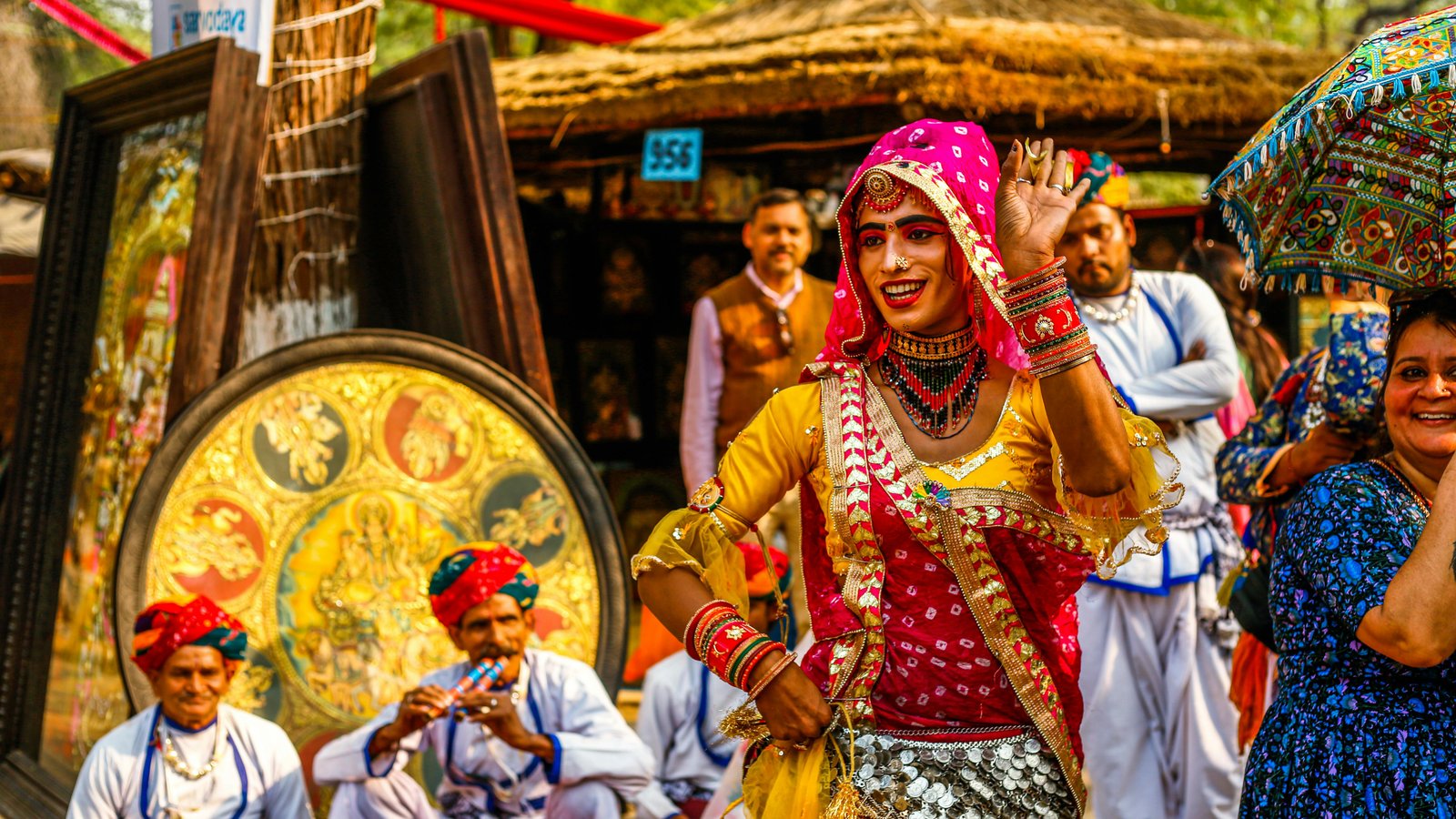
Ghoomar: The Folk Dance That Embodies Elegance and Tradition
There are thousands of folk dances across India. You watch most of them and then move on. Ghoomar takes hold of you. There's something about a circle of women spinning in heavy ghagras, anklets crashing against stone, and colours blurring into one another; it doesn't let you l...
Meet your AI Story Guide
Turn this field note into a one-minute brief with the essential places, people, and traditions.
Rajasthan: Where Culture Dances Through Every Heartbeat
The Land of Kings. That's what they call it. The British used to call it Rajputana. Whatever name you use, this place runs on art and history the way other places run on coffee. Jaipur's bazaars are loud and chaotic and full of colour. Udaipur's lakes shimmer like they're showing off. And everywhere you go, there's music; there's a festival around the corner; there's someone celebrating something.
Rajasthanis do more than just appreciate their culture; they live it. It's in the ornaments, the fabric, the way people carry themselves. And whenever there is a celebration, such as Diwali, Teej, Holi, or someone's wedding, one dance is always performed: Ghoomar. It's basically the heartbeat of Rajasthani folk expression, and that's not an exaggeration.
The Origins: From Tribal Ritual to Royal Grace
Most people assume Ghoomar started in some grand palace. It didn't. This all started with the Bhil tribe, which is one of Rajasthan's oldest groups. They danced it as a devotion to Goddess Saraswati. Part prayer, part celebration. Women would come together to express gratitude, strength, and happiness, all at once.
Then history took its course. The Kachhwaha Rajputs of Jaipur made peace with the Bhils, and along with that alliance came a sharing of traditions. Ghoomar was one of the biggest ones. It slowly moved from tribal courtyards to the halls of the palace. Royal women started performing it, and they brought their own elegance to it. Over time, it evolved into this refined, dignified dance form.
But here's what's interesting: even after all that transformation, the heart of Ghoomar didn't change. Not really. It was still a women's dance. Still communal. Still about joy and gratitude. The Bhil hearths and Jaipur's royal courts are very different places, but Ghoomar connects them.
The Journey and Style: One Dance, Many Shades
Ghoomar didn't stay in one place. As it spread across Rajasthan, different regions put their own stamp on it.
Go to Udaipur and you'll notice the movements are softer. There's a fluidity to it, almost like Gujarat's Garba rubbed off a little. Jodhpur is a different story. The steps there are sharper, more punchy, and more dynamic. Then there's the Kota-Bundi region, where things get really lively, with lots of dramatic spins, clapping, and energy that's infectious.
Different flavors, same dish. No matter where you see it performed, in a small home or a grand haveli, it's about the same thing. Celebration. Togetherness. Marking a moment that matters. Every twirl is an offering to something bigger, whether that's divine or just the beauty of an ordinary day.
How Ghoomar is Performed: The Language of Movement
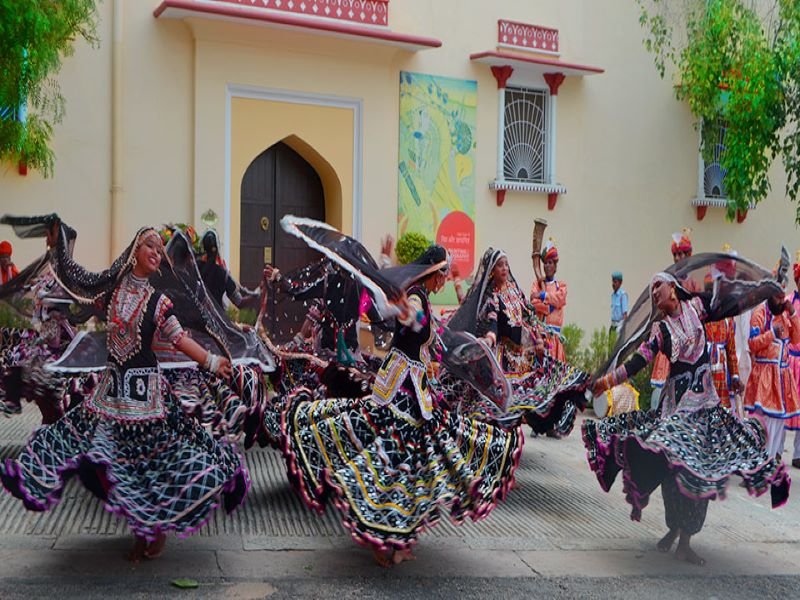
The name gives it away. Ghoomar comes from "ghoomna," meaning "to spin." And spinning is the whole point. Women arrange themselves in circles, moving clockwise, then switching to anti-clockwise. Their skirts fan out, and it looks like flowers opening up in fast motion.
Nothing about the footwork is complicated. Sway. Clap. Step. But as the music builds, everything gets faster, and the simplicity turns into something genuinely hypnotic. Women of all ages dance together, grandmothers next to teenage girls, forming these concentric circles that feel like a visual metaphor for the cycle of life. Maybe that's intentional. Maybe it just happened that way.
The sound is layered too. Ghunghroos on the ankles are mixing with dhol and nagada drums. When the women hold hands and move together, there's this ripple effect, like watching sand dunes shift if sand dunes had rhythm.
And then there are the mudras. Hand gestures that tell stories without words. A wrist turning just so. Eyes glancing from behind a veil. Love, longing, devotion, pride; it's all in there if you know what to look for. Small movements, but they carry a lot of weight.
Costume and Jewellery: The Art of Adornment
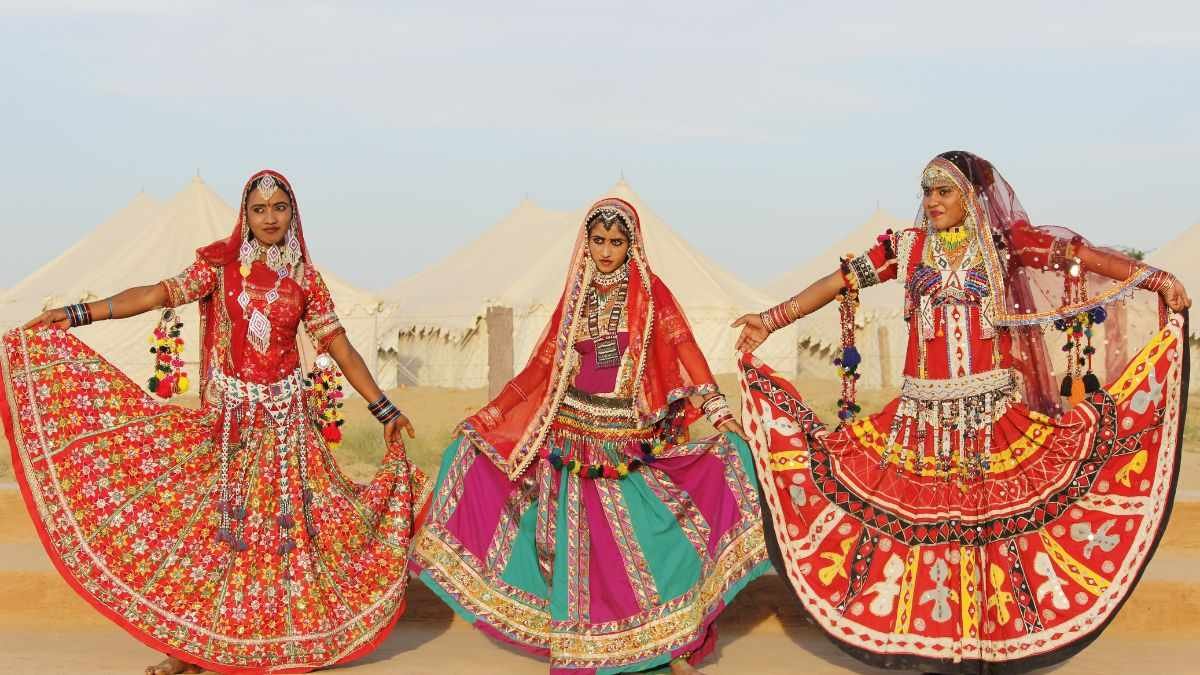
You have to talk about what the women wear when you talk about Ghoomar. Half the visual power of this dance comes from the clothes. The traditional outfit is called a poshak, and it's a four-piece ensemble that's pretty breathtaking.
First, the ghagra is the flowing skirt that is heavy with mirror work and embroidery. It does all the dramatic swirling work. On top, there's a kachli (short blouse) with a kurti (sleeveless tunic) layered over it. Then comes the odhna, a veil that's sheer but detailed, covered in fine embroidery. It adds this whole dimension of modesty and mystery to the look.
And the jewelry: heavy Kundan pieces, silver payal on the ankles, and bangles stacked on both arms. The dancer's forehead ornament, called a borla, catches light every time she turns her head. Every silver piece and tiny mirror woven into the fabric captures light in a different way with each spin. "Kaleidoscopic" is the right word for it. Each dancer turns into a piece of art that walks and twirls.
Ghoomar Music: Songs that Touch the Heart
Take away the music and Ghoomar just doesn't work. The songs, called Ghoomar Geet, aren't just background noise; they are the heart of stories about love, bravery, longing, and everyday life, all set to melodies that people in Rajasthan have been singing for generations.
You've probably heard of some of these songs, like "Ghoomar Re Ghoomar Re," "Gorband Nakhralo," "Chirmi Mhari Chirmali," "Mor Bole Re," and "Aave Hichki."
The musicians are Langas, Manganiyars, and Dholis, families who've carried these songs forward as a birthright. Dholak beats and kartal rhythms mix with voices that can only be described as soulful. And every song hits differently. One is about a woman waiting for her husband to return. Another follows a bride walking into her new home for the first time. Friends laughing and dancing under the night sky. There's joy, but also this ache sometimes, a bittersweet quality that makes the music stick with you.
Significance in Culture: Beyond a Dance
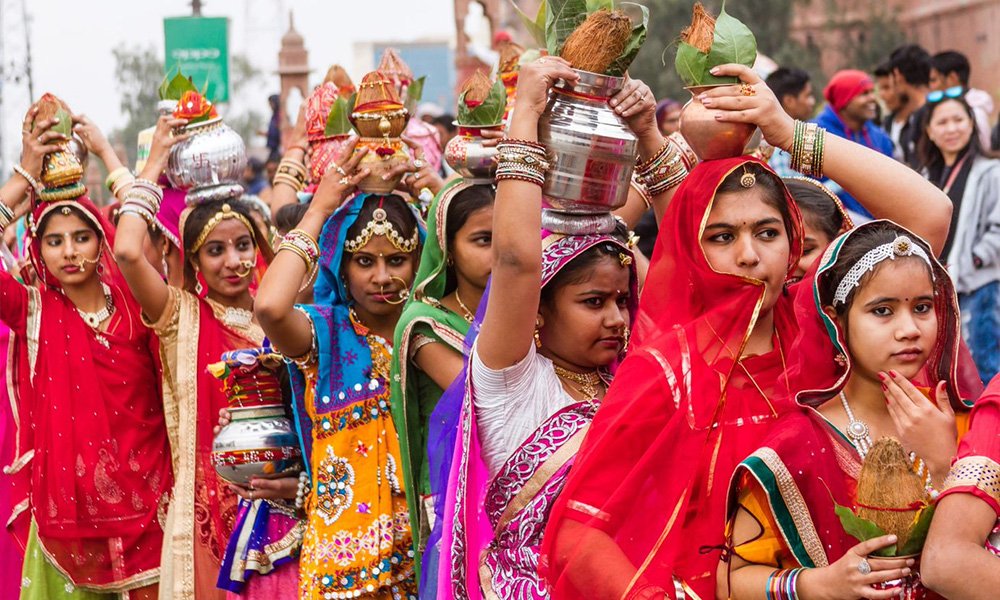
The significance of Ghoomar extends well beyond entertainment. For Rajasthani women, it has been, for centuries, one of the rare spaces where they could be completely free. Free to move, to laugh, to be loud, to be seen. That matters. That's not a small thing.
In many communities, when a young girl performs Ghoomar for the first time, it's treated as a rite of passage. She's stepping into womanhood, and the dance marks that transition with celebration rather than ceremony. It shows up at weddings, at religious festivals, at temple rituals, and basically at every point in life that people consider important.
And through all of that, Ghoomar quietly does something else. It keeps Rajasthan's oral traditions alive. The songs carry stories. The steps carry memory. One generation teaches the next, and the chain stays unbroken. It looks like a dance, but really it's a vessel for identity, for heritage, for that feeling of belonging to something bigger than yourself.
Bollywood and Beyond: Ghoomar in Contemporary Times
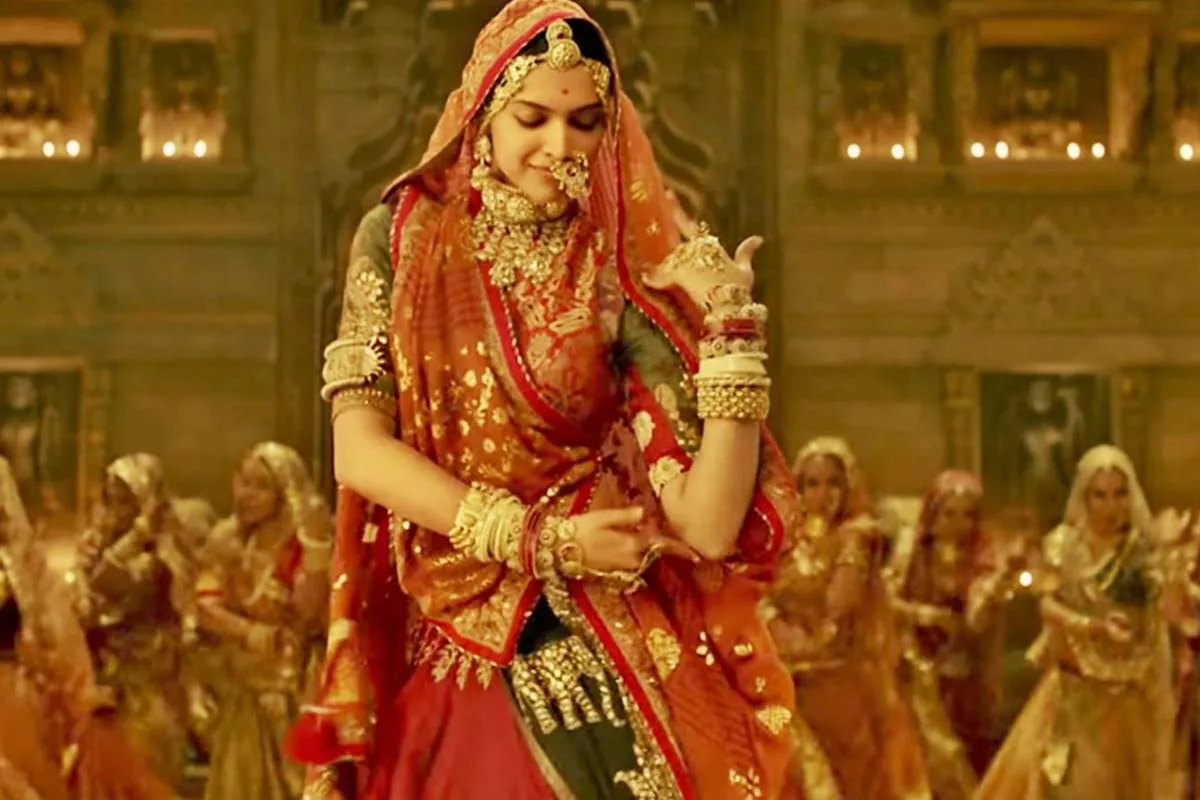
If you know Ghoomar at all and you're not from Rajasthan, Bollywood is probably the reason. The "Ghoomar" sequence from Padmaavat, with Deepika Padukone in full regal mode, spinning like she was born doing it, put the dance form on the global map. Whatever you think of the movie's controversies, that scene did something important for visibility.
And before Padmaavat, there was "Dholi Taro Dhol Baaje" from Hum Dil De Chuke Sanam. That one blended traditional Ghoomar energy with full-on Bollywood spectacle, and it ended up on every wedding playlist in the country.
Today, Ghoomar is performed on international stages and at cultural events far from Rajasthan. It crossed borders. It's become a symbol of Rajasthani identity that people around the world recognize.
But under all the fame and the film sequences and the viral clips, Ghoomar is still what it always was. Women dancing together. Joy expressed through rhythm. Tradition that refuses to fade.
Ghoomar: A Living Legacy
Every swirl holds a story. Every drumbeat carries a kind of blessing. Ghoomar has survived for centuries, and it's not because someone preserved it in a museum. It survived because people kept dancing it. Because it means something real.
It bridges the tribal and the royal. The ancient and the modern. The earthly and the spiritual. When the ghagras spin and the anklets ring out, Rajasthan isn't just performing for an audience. It's being itself, proud, poetic, stubborn in the best way, and absolutely alive with colour.
Experience Ghoomar with Folk Experience
At Folk Experience, we think the best way to understand Rajasthan's culture isn't watching from the sidelines. It's jumping in.
Our journeys take you past the tourist performances and into real courtyards, places where women still gather around lantern light to sing Ghoomar geet like they've always done. You'll sit with folk artists. You'll learn what those hand gestures actually mean. You'll hear the stories behind the songs. And yeah, you'll get a chance to try spinning in a ghagra yourself, guided by local dancers who've been doing this their whole lives.
We run private workshops in Jaipur and Udaipur. We also do smaller, more intimate sessions in rural villages where Ghoomar isn't a show; it's just part of life. Everything is built on real respect for the communities and traditions we're working with. No packaging culture into a product or making it performative for outsiders.
Because honestly? You don't really get Ghoomar by reading about it or watching it on YouTube. You get it when you're standing in a circle, feet moving, ghagra heavy around your ankles, surrounded by women who've been doing this since they were little girls. That's the version of Rajasthan we want to share.
Dance with Rajasthan. Learn its rhythm. And through Ghoomar, discover the grace that binds a culture together.