How to Experience the Ganga Aarti: Rituals, Timing & Cultural Meaning
Something shifts in Varanasi around the time the sun goes down. The light changes first, going from afternoon gold to something softer and more uncertain, and then the activity on the ghats changes too. People who were washing clothes or sitting in conversation begin moving in...
Meet your AI Story Guide
Turn this field note into a one-minute brief with the essential places, people, and traditions.
What Is the Ganga Aarti? Understanding Its Origins and Spiritual Meaning
An aarti, in the straightforward sense, is an offering of light to the divine. The word comes from Sanskrit. But in Varanasi, the aarti offered to the Ganga has significance that goes far beyond the basic definition, because the Ganga here is not a geographical feature. She is a goddess, a mother, a presence believed to nourish and protect and carry the prayers of the living and the departed alike. People have been bringing their grief, their gratitude, and their dead to her banks for centuries, and the aarti is the nightly acknowledgement of that relationship.
The form of the ceremony as it currently exists, with multiple priests on raised platforms moving in coordinated sequences, developed over roughly the last hundred years, shaped by temple trusts and priest lineages who gradually built it into something more elaborate and more visible. The choreography is relatively recent. The impulse behind it is not.
What the aarti is expressing, at its core, is gratitude. The river sustains this city. It cleanses. It receives the bodies of the dead and is still believed capable of carrying karmic weight that nothing else can shift. Offering flame to the water is a way of giving something back, a gesture of return to the source. There is a humility in it that survives even the crowds and the cameras.
Where to Experience the Ganga Aarti in Varanasi
Dashashwamedh Ghat is where most visitors end up, and there are good reasons for that. The scale here is genuinely impressive: several priests, elevated platforms, synchronized movements, and a crowd that fills every available step and spills onto boats anchored just offshore. If you have never seen the aarti before, this performance is the version that tends to stay in memory. The sheer density of sound and light and gathered humanity creates an experience that is difficult to be neutral about. First-time visitors often describe it as overwhelming, but not in a way that makes them want to leave.
Assi Ghat, at the southern end of the main riverfront, runs a quieter version. The morning aarti here, part of what locals call Subah-e-Banaras, is particularly worth seeking if you can manage an early start. Classical music plays, yoga practitioners are on the steps, the river catches the first light, and a ceremony feels more like a daily conversation with the water than a public performance. The evening aarti at Assi is smaller and more intimate than that at Dashashwamedh, shaped more by the neighborhood's residents than by tourism.
Beyond the named ghats, there are dozens of smaller spots along the riverfront where a priest and a lamp and a family conduct their quiet aarti with no platform and no crowd. Some people find these versions most affecting precisely because they do not arrange anything about them for an audience. If you walk the ghats at dusk rather than heading straight to the main ceremony, you will encounter a few of these without looking for them.
The aartis of Haridwar and Rishikesh are worth mentioning here as well. They belong to the same tradition but carry their character, shaped by their riverbanks and communities. Each one is worth experiencing on its own terms if your travels take you there.
The Aarti changes with every ghat, but its flame carries the same longing: to touch the divine, if only for a moment.
Timings, Seasons & the Best Time to Witness the Aarti
The aarti follows the sun, not a fixed clock. In winter it begins around 6 in the evening; in summer, closer to 7, because the sun takes longer to go down. The ceremony starts after sunset, and arriving 45 minutes early is not excessive; it gives you time to find a place, settle in, and catch the slow build of atmosphere that precedes the first lamp being lit. That build-up is part of the experience, and rushing to arrive just as things start means missing it.
Winter, from October through February, is when the ghats are most comfortable to sit on for an extended time. The air is clear, the light goes through beautiful stages in the hour before the ceremony, and the temperatures keep you from wishing you were somewhere else. Summer brings heat but also a particular intensity of devotion; more pilgrims arrive, and the aarti takes on a charged quality that the cooler months sometimes lack. During monsoon, from July through September, the river rises significantly, sometimes swallowing several tiers of steps entirely. The ceremony continues, but the logistics shift; platforms rise higher, space shrinks, and surfaces near the water become slippery. The monsoon Aarti is atmospheric in its own way but requires more care.
Certain nights change the aarti into something beyond its usual form. Kartik Purnima, when the full moon sits above the river, adds a stillness and a particular quality of light that the ceremony does not have on ordinary evenings. Dev Deepawali is in a category of its own: every step of the ghats is lit with lamps, and the aarti happens inside an ocean of flame, one of the more genuinely overwhelming sights available anywhere in India. Ganga Dussehra, marking the descent of the river to earth in Hindu mythology, heightens everything. Diwali and Makar Sankranti fold the aarti into a larger celebration that runs through the whole city.
Whether you go on a quiet Tuesday in November or on Dev Deepawali with the ghats blazing, the aarti is consistent. The ritual does not change. What changes is the mood surrounding it.
Anatomy of the Ritual: How the Ganga Aarti Unfolds
The preparation begins well before the ceremony itself. As the sky turns amber, priests carry their equipment to the platforms: brass lamps, incense holders, baskets of flowers, and conch shells. Volunteers guide people into position and help anchor the boats that form a semicircle on the water. The riverfront shifts from its ordinary evening pace to something more deliberate, and you can feel the transition even if you cannot name it.
The ceremony opens with mantras, soft at first through the microphone, then the bell from somewhere in the temple behind, and then the conch shell in a long, deep note that travels across the water and does something to the noise of the crowd. People who were talking stop. It happens without instruction.
The lamps are displayed in sequence, starting with the smallest first. The priests draw circles of flame facing the river, and the light catches on their faces and on the moving surface of the Ganga below them. As the ritual develops, the lamps grow larger, multi-tiered brass constructions whose arcs of fire trace shapes in the darkening air that are specifically prescribed, each one carrying a meaning. Clockwise circles, vertical sweeps, and intricate hand positions called "mudras" that correspond to particular honorings of particular elements. Incense rises in slow spirals. Camphor burns with a particular brightness and leaves nothing behind when it is done. Peacock-feather fans move in the air around the space where the goddess is being addressed.
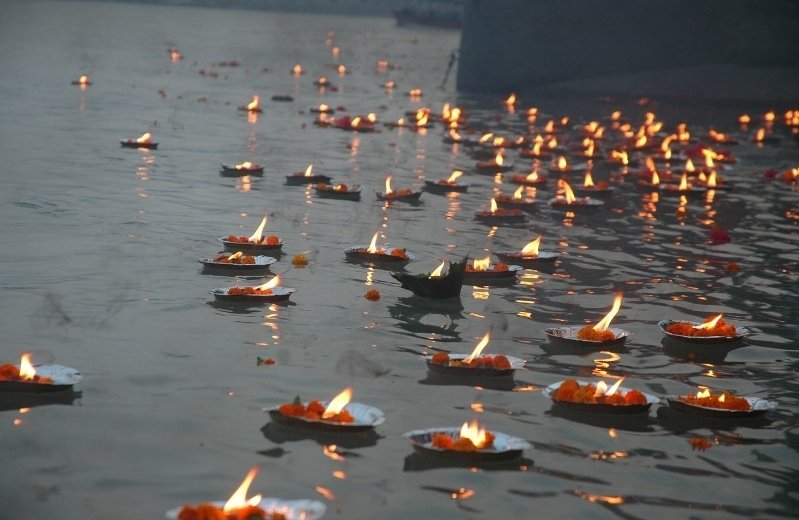
The closing has a different quality from the rest. The final prayers are followed by a collective chant that the crowd joins, its sound spreading across the river. Priests move through the steps distributing prasad and charanamrit. Children and adults both lean forward to set small leaf boats holding lit diyas onto the water, and the diyas move away downstream, flickering, until they disappear. That image, the little lights going, is often what people remember most afterwards.
The Aarti is not just something you watch; it is something that slowly begins to move inside you.
The Symbolism Behind the Aarti: Understanding the Language of Devotion
Every element in the Ganga Aarti means something specific, and knowing what it means changes what you see. Fire is the most obvious starting point. The lamps, the deepams, the camphor flames: all of these represent consciousness, the burning away of ego, the illumination that comes from letting go of the self in the presence of something larger. Offering light to the river is offering clarity and surrender, acknowledging that the guidance you need comes from somewhere beyond your own calculation.
The Ganga herself represents purity and the continuous movement of life. Bringing flame to the water is honoring the cycle the river embodies: it cleanses, it renews, and it carries things away that you can no longer carry. In Hindu understanding, the Ganga absorbs not just physical impurities but karmic residue. The meeting of fire and water in the aarti is not decorative; it is the enactment of that meeting, that exchange.
Incense and camphor carry the devotion upward through smell and smoke, the fragrance rising the way prayer is understood to rise. Camphor in particular has a specific meaning: it burns completely and leaves nothing, which is a deliberate metaphor for the dissolving of ego that devotion asks for.
The conch opens everything. Its sound is associated in Hindu cosmology with the primordial vibration that preceded creation, with Om, and with the moment before the world began. Sounding it marks the beginning of sacred time, sets the space apart from ordinary time, and is said to clear unseen negative energies from the area. The bells throughout the ceremony serve a related purpose: they interrupt the wandering of the mind, returning attention to the ritual in front of you.
The circular movements of the lamps offer light in all directions at once—north, south, east, and west—which carries the meaning of protection and completeness. Nothing is left unaddressed. Flowers released into the river give back beauty and acknowledge impermanence at the same time.
Understood this way, the aarti is a complete language, with grammar and vocabulary, saying specific things to a specific presence. What changes when you know the meaning is that you stop watching a ceremony and start reading a conversation.
When you understand the symbols, the aarti stops being a performance and becomes a language of devotion.
The Sensory Experience: Sound, Light & Emotion
The aarti reaches you through every sense at once, making it hard to process in the moment and hard to forget afterwards. The sound is layered in a way that is almost architectural: mantras in the foreground, bells at different rhythmic intervals, the conch cutting through everything periodically, and under all of it, a constant soft texture of crowd murmurs, oars in water, pigeons somewhere on the ledges above, and a temple drum from a distance. The layers sit on top of each other without cancelling out, and the effect is of a sonic environment that is both dense and strangely peaceful.
Visually, it is the fire you follow. The priests' saffron robes catch the lamplight. The brass instruments throw arcs of gold into the darkening sky. Smoke rises in grey and silver threads, lit from below, and the Ganga picks up everything: the flames, the platforms, the silhouettes of boats. The water becomes a second version of the ceremony, slightly distorted, moving with the current, and somehow this reflected version can be as affecting as the one above it.
The emotional experience tends to come on suddenly. Most people begin as observers. Then the conch sounds, and something happens: a physical response, a tightening in the chest, and a prickling that is not quite goosebumps. As the ceremony reaches its middle, the combination of sound and light and the knowledge of where you are and what has happened here over centuries can produce a quietness in people who were not expecting to feel anything in particular. The final Om, when it moves across the ghats, has a way of making the crowd fall very still for a moment. That stillness is worth paying attention to.
Where you stand changes what you receive. On the steps near the ceremony, you feel the heat of the lamps, hear every syllable, and share the crowd's collective breathing. From a boat on the river, the whole thing becomes a panorama: ghats rising above the water, priests as silhouettes, flame and reflection merging into something that looks almost unreal. From a rooftop or terrace, you get the overview, which is quieter, more composed, and less immediate. None of these is the correct version. They are genuinely different experiences of the same event.
Choosing Your Vantage Point: Ghat, Boat, or Rooftop?
Standing on the steps at Dashashwamedh puts you inside the ceremony. You feel the heat; hear the mantras without amplification loss; and watch the priests' faces and hands closely. It is the most physically immersive option and the one that most people who attend the aarti more than once eventually prefer. The cost is arriving early, managing a crowd, and finding a space before the best ones go. But if you arrive 45 to 60 minutes ahead and position yourself on the lower steps near the platforms, what you get for that effort is the ceremony as it is actually meant to be experienced: close, warm, loud in the right ways, and impossible to feel detached from.
A boat on the river gives you the cinematic version. The ghats rise before you like a stage set, the reflections multiply the fire on the water, and the whole scene can be taken in at once in a way that is impossible from the steps. Photographers tend to favor this position for its compositional possibilities. The trade-off is distance: the sound carries less clearly, and the ritual's intimacy is replaced by a kind of grandeur. It is beautiful, genuinely, but it is a different thing from being on the steps. Choose a licensed boatman, agree on the price before boarding, and clarify whether you are paying per person or for the boat.
Rooftops, terraces, and the restaurant balconies that overlook the ghats offer a peaceful, uncrowded view that is ideal for people who find dense crowds tiring, for families with children, and for photographers attempting long-exposure shots. You lose the ground-level energy entirely from up there, and what you gain is space and a different geometry of the scene. Many people do one version one evening and another the next, which is a reasonable approach if your schedule allows it.
Etiquette & Respect: The Unspoken Rules of Witnessing the Aarti
The aarti is a religious ceremony, not a performance, and the people around you at the ghats are primarily there to pray, not to be photographed or navigated around. Modest clothing is appreciated, covering shoulders and legs. Nobody will turn you away if you are not dressed this way, but wearing something that covers you reasonably well shows awareness of your surroundings.
During the main sequence of the aarti, keeping quiet matters. This guideline does not mean enforced silence, but it does mean not conducting a running commentary, not talking loudly on your phone, and not pushing through people who are sitting in prayer to get closer to something you want to photograph. Moving gently and being aware of those behind and beside you is a basic consideration that matters more in a space like this.
For offerings and donations, use the official channels: the priests, the temple organizations, and the designated collection points. You should politely decline touts and unsolicited intermediaries who offer to conduct special pujas or ensure you a better position. A small contribution through legitimate channels genuinely supports the people who maintain the ritual.
Photography is permitted, and most people take photographs. The lines to observe are simple: no flash directly into the faces of priests or devotees during prayer, no intrusive close-up shots of people in moments of private worship, and an absolute prohibition on photographing cremations or grieving families at Manikarnika or Harishchandra Ghat. That last one is not a cultural preference; it is a matter of basic human decency.
In Varanasi, respect is the first offering you make. Everything else comes later.
Safety, Scams & Practical Tips
The aarti draws a large crowd, and large crowds in pilgrimage cities tend to attract people who live with the confusion that crowds generate. Most of what you will encounter is mild: insistent boatmen; men offering flower garlands or prasad with the expectation of payment; and self-appointed guides who attach themselves to you without being asked. "The most effective response is a firm and cheerful no," he said once, without elaborating. Engaging further or explaining yourself tends to extend the conversation rather than ending it.
Boat rides require one specific precaution: agree on the price before you get in. Confirm whether the rate is per person or for the whole boat and clarify how long the ride will last and what route it will take. It will take and establish these details while you are still standing on the ghat. Changing these terms once you are on the water is a common source of friction that is entirely avoidable.
The Dashashwamedh steps get very dense in the minutes before and during the ceremony. Keep your valuables in a front pocket or a small bag that you can keep in front of you. A large backpack is awkward in a crowd and draws attention; a small sling bag is more practical.
Things worth carrying: water, a light shawl for warmth and for covering up if needed, and something small to sit on if you plan to spend an hour on stone steps. If you are attending in monsoon season, wear shoes with genuine grip, watch where you place your feet on wet stone, and stay away from the edge of the ghat near the water.
For Photographers & Content Creators
The aarti offers several distinct photographic situations that require different approaches. From a boat, you can capture the whole row of priests against the illuminated ghats in a single frame, showing the scale and symmetry of the ceremony from the only angle where both are visible at once. From the front rows on the steps, you get faces close enough to read, the texture of the brass lamps, hands in mudras, and smoke rising through lamplight. From a rooftop, you see silhouettes against the colors of the sky just after sunset, with the ghat below going from gold to amber to the first darkness.
The blue hour, that 15-minute window just before the lamps are fully lit, is worth planning around. The sky still has color, the ceremony is beginning, and the mixture of remaining daylight and emerging flame produces tones that are genuinely difficult to replicate at any other point in the evening. Once it is fully dark, the images become about light in darkness, which is beautiful but different.
Etiquette for photographers: ask before pointing a camera at someone's face, especially priests in active ceremony and elderly devotees in prayer. Do not step into the space where the priests are moving; the ritual has a physical footprint, and crossing into it for a better angle is not worth what it disrupts. The best photographs of the aarti tend to be taken by people who accepted that they would miss some frames in order to stay focused.
For video, you must include the sound. The sounds of the conch, the bells, the waves of chanting, and the texture of the crowd make a video of the aarti feel authentic, rather than just footage of some fire. A video with striking visuals and no real sound is a significant diminishment of the actual experience. Be patient, record the ambient texture before you start moving the camera, and let the audio environment settle into the clip before you cut.
Experiencing the Aarti Internally (Not Just as a Show)
The most common mistake at the Ganga Aarti is treating it as something to be documented rather than something to be in. This is easy to do; you are in an unfamiliar place, surrounded by a great deal of visual material, and the instinct to reach for your phone is strong. But the aarti rewards a different approach, and people who put the phone away for at least part of the ceremony consistently describe a different and more profound experience than those who spent the whole thing looking at a screen.
A few minutes before things begin, find your position and then settle into it. Three slow breaths. Notice what your senses are already picking up: the smell, the sounds layering in, the quality of the remaining light. Let those things arrive without immediately trying to name or frame them.
As the lamps move, some things are worth sitting with:
• The flame flickers continuously but does not go out. Impermanence and persistence coexist simultaneously.
• The river has been receiving this offering for longer than anyone living can remember. It does not need your presence to continue doing so; you are a guest in a very long conversation.
• Surrender is a theme that runs through every gesture of the ceremony. There is, for many people, a relief in allowing themselves to be carried by the ritual rather than standing apart from it as a spectator.
At some point during the ceremony, usually somewhere around the final chant or the moment when the diyas go onto the water, the distinction between watching and participating tends to dissolve. It does not happen for everyone or on command, but it happens often enough to be worth watching for.
At some point during the aarti, the line between you watching and you praying quietly disappears.
When it does, Varanasi stops being a destination. It becomes something else: wide, old, and much quieter inside than you expected.
Experiencing the Ganga Aarti with Folk Experience
Folk Experience approaches the aarti the way it approaches everything: by asking what lies underneath the visible ceremony and then making sure you get access to that layer, not just the surface.
Guests receive curated seating or boat access that keeps them close enough to feel the heat of the lamps and hear the ceremony clearly while being positioned away from the densest sections of the crowd. The difference between a good and poor position at Dashashwamedh is significant, and navigating it alone for the first time can be unpredictable.
A cultural interpreter walks with you through each element of the ritual as it unfolds:
• Why the conch is sounded to open and not to close.
• What the circular movements of the lamps are doing cosmologically.
• What the specific chants are addressing and why they follow the sequence they do.
• How each of the five elements is being honoured and in what order.
Before or after the ceremony, the folk experience typically includes a walk through the lanes adjacent to the ghats: flower vendors, sweet shops, small shrines tucked into walls, and the kind of lived texture that you move through without noticing unless someone is pointing it out. Stories of the saints, poets, and ordinary families who shaped these ghats into what they are today come out in these moments in a way that feels conversational rather than guided.
After the aarti, there is usually space for a small reflection circle where travelers can ask questions and talk about what has moved them. These conversations tend to go further than the ceremony itself, touching on larger questions about ritual, memory, and what it means to be present in a place that has been holding something for this long.
Folk Experience directs its fees to the priests, boatmen, heritage interpreters, and community members who actually keep these traditions alive. The aim is to promote tourism that strengthens the places it visits rather than extracting from them.
The Ganga Aarti isn't something you take home in photos; it stays in the quietest corner of your heart.
keep wandering