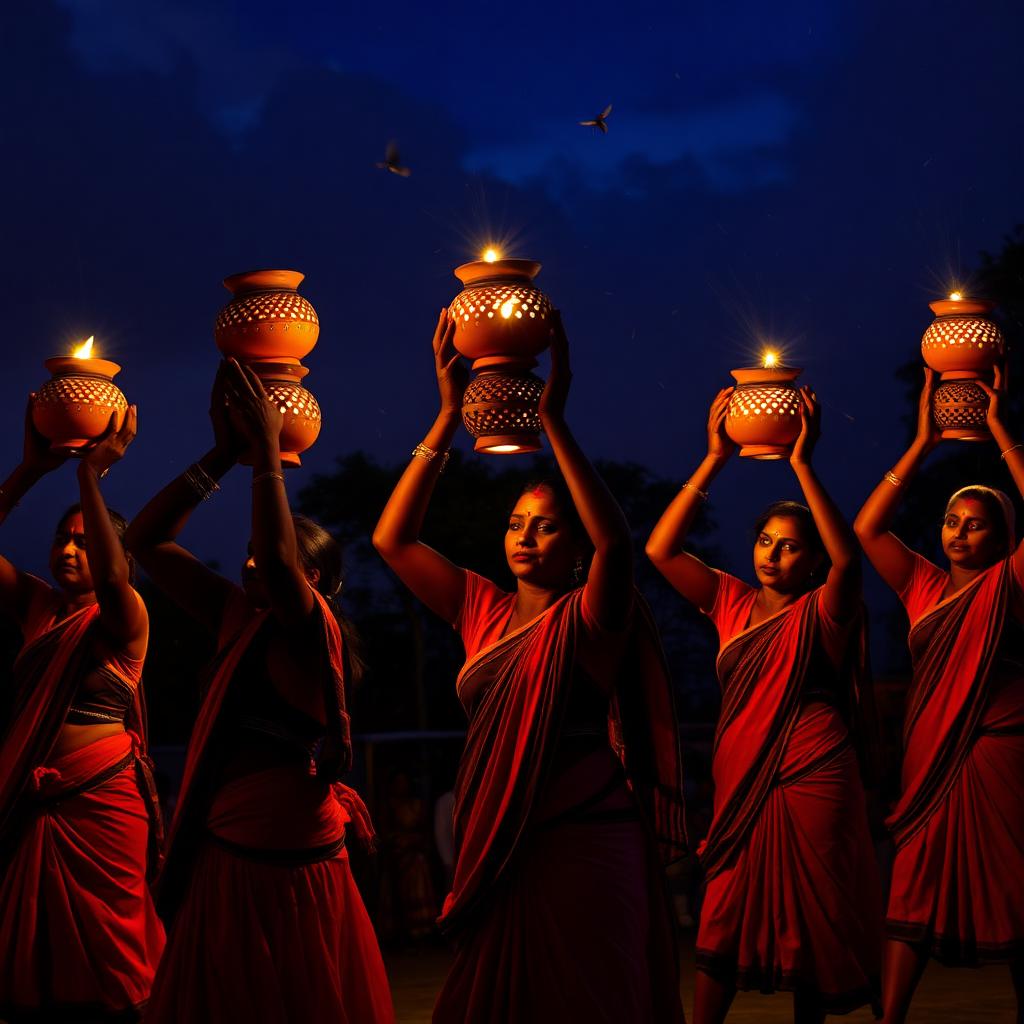
Jhijhia and Kajari: Bihar's Dances of Rain, Prayer, and Seasonal Truth
In Bihar, the monsoon is never just weather. It is the difference between a harvest and a debt, between staying and leaving, between a family that eats and one that does not. When the first clouds gather over the Gangetic plains and the…
Folk Editorial
Folk Experience
Meet your AI Story Guide
Turn this field note into a one-minute brief with the essential places, people, and traditions.
In Bihar, the monsoon is never just weather. It is the difference between a harvest and a debt, between staying and leaving, between a family that eats and one that does not. When the first clouds gather over the Gangetic plains and the earth begins to soften after months of heat, something happens in the villages of North and Central Bihar that no meteorological event alone can explain. Women gather. Lamps are lit. Songs begin. Two folk traditions emerge from this seasonal turning point, each rooted in a different district, each carrying a different emotional register, but both speaking to the same essential truth: that in agrarian Bihar, faith, survival, and the monsoon are the same conversation. Jhijhia is a ritual prayer, performed during Ashwin and Kartik when the monsoon is ending and the harvest approaches, with women balancing earthen lamps on their heads as they move in slow circles, petitioning Goddess Durga for protection, fertility, and rain. Kajari is a seasonal celebration, performed during Sawan when the monsoon arrives, with women gathering near rivers and fields to sing of renewal, of the earth drinking its first rains, and of the loneliness that the season of migration always brings alongside its abundance. They are not the same tradition. But they belong to the same world, and understanding them together gives you something closer to the full picture of what the monsoon means to Bihar's women, its communities, and its land. "In Bihar, folk dance is not performed for audiences. It is performed for the divine, for the rain, for the harvest, and for each other."
Jhijhia: Prayer Made Visible
Jhijhia is performed primarily in the Mithila region, across districts like Darbhanga, Madhubani, and Sitamarhi, and in parts of the Bhojpur and Kaimur regions. It takes place after sunset, in open courtyards, temple grounds, and village squares, with no stage, no ticket counter, and no designated audience. The community witnesses or participates as part of the ritual rhythm of the season.
The defining image of Jhijhia is its physical demand: women balance earthen lamps or perforated pots filled with burning cotton wicks on their heads as they move in slow, deliberate circles. The act of balancing is not incidental to the prayer. It is the prayer, expressing discipline, devotion, and the precarious steadiness required to hold life together between abundance and scarcity. As they move, women sing devotional songs addressed to Goddess Durga, songs that are often improvised or passed on. down orally, asking for protection from illness, for safe harvests, and for the welfare of children and husbands who have migrated.
The three concerns at the center of Jhijhia, protection, fertility, and rain, are not abstract spiritual categories. They are the practical anxieties of communities where healthcare is limited, agricultural income is uncertain, and the monsoon determines whether families can repay their debts. When women petition Durga during Jhijhia, they are not performing a cultural tradition for its own sake. They are negotiating, with the same directness that one negotiates with any power whose decisions shape your survival.
Jhijhia is a women's ritual. Men do not participate in the dance, though they may observe or provide musical accompaniment. This gender specificity is not simply a restriction. It is a space of authority, one of the few in rural Bihar where women's collective voice leads, where older women transmit knowledge to younger ones through embodied participation rather than formal instruction, and where individual prayers for sick children, absent husbands, and delayed harvests are woven into communal song without requiring explanation or apology.
The tradition is under pressure. Migration pulls younger women away from the villages where Jhijhia is performed. Urbanization distances families from the agricultural cycles that once made rain rituals urgent. And as fewer families depend directly on farming, the material anchor of the prayer loosens. Yet in the regions where it persists, Jhijhia continues not because institutions mandate it but because communities still find in it something that modern life has not replaced: a space to collectively acknowledge vulnerability and to respond to it with devotion rather than despair.
Kajari: Joy That Carries Longing
Where Jhijhia is petition, Kajari is recognition. It arrives with the monsoon itself, during the months of Sawan in July and August, when the rains that Jhijhia prayed for have finally come and the fields that were parched begin to turn green.
Kajari is performed primarily in the Bhojpur, Rohtas, and parts of the Mithila regions, near rivers, ponds, and open fields, in the evenings after the day's agricultural labor is done. Women gather and sing, their voices building collectively from slow beginnings to intense, rhythmic crescendos that mirror the rain itself: sometimes steady, sometimes driving, sometimes tapering into quiet. The instruments are simple and locally available: dholak, manjira, and harmonium. The power of Kajari lies not in musical virtuosity but in collective voice, in the specific energy that forms when many women sing the same thing at the same time for the same reason.
The emotional register of Kajari is layered in a way that resists simple description. The songs celebrate fertility, the earth awakening, seeds germinating, rivers swelling, and the relief of heat finally broken. Women sing of abundance, of dark clouds and cool breezes, of the land's transformation. This is real joy. the joy of a community whose survival depends on rain and which knows, in its bones, what it means for the rain to finally arrive.
But Kajari also carries sorrow, because the monsoon season is also the season of separation. It is when many men migrate for work, leaving wives to manage farms and households alone. The same rains that bring life to the fields mark the departure of the people those fields were supposed to sustain. Kajari holds both truths simultaneously: the monsoon as a blessing and as a reminder, as renewal and as loneliness. The songs move between celebration and lament without apology, because that is the emotional reality of the season, and Kajari is honest enough to carry it whole.
Like Jhijhia, Kajari faces the pressure of ecological disruption alongside social change. Climate change has made the monsoon unpredictable, with rains arriving late or in destructive floods and droughts more frequent than they once were. When the monsoon itself becomes unreliable, a tradition built around its arrival loses its ecological grounding. For communities still performing Kajari, this adds another register to the songs: what was once primarily gratitude becomes increasingly petition, celebration shading into plea.
What the Two Traditions Share
Jhijhia and Kajari are rooted in different moments of the seasonal cycle, serve different ritual purposes, and carry different emotional tones. But they share the qualities that make both worth seeking out as a traveler in Bihar.
Both are women's traditions, spaces of collective authority and expression in a social landscape that offers women few such spaces. Both are transmitted through embodied participation rather than formal instruction, absorbed by younger women through years of watching and eventually joining, and disappear whenever migration or urbanization breaks that chain of presence. Both are under pressure from the same set of forces: the loosening of agricultural dependence, the migration of younger generations, and the substitution of urban entertainment for seasonal ritual.
And both are honest. It neither romanticizes rural life nor offers the kind of tidily resolved narrative that cultural tourism tends to prefer. Jhijhia acknowledges that the forces determining your survival are beyond your control and responds with disciplined devotion rather than denial. Kajari acknowledges that joy and longing coexist in the same season and holds both without choosing between them.
For a traveler in Bihar, these two traditions offer something that monuments and heritage sites cannot: access to the emotional and spiritual interior of the people who live here, to the specific ways they have developed, across many generations, for managing the anxieties and marking the moments that agriculture, weather, and community survival produce.
How to Engage as a Traveller
Jhijhia is performed during Ashwin and Kartik, September through November, in the Mithila and Bhojpur regions. Kajari is performed during Sawan, July and August, in the Bhojpur, Rohtas, and Mithila regions. Neither is staged for tourists. Both happen when the season calls them forth, in open community spaces, after dark, as part of the living ritual calendar of the communities that maintain them.
Finding either tradition requires the right timing and the right introduction. Folk organizations working with Bihar's performing communities can facilitate genuine encounters. Travelling with a culturally grounded guide who has relationships in these communities is the difference between witnessing something real and arriving at the wrong time in the wrong village with no one to explain what you are or are not seeing.
If you attend a performance, understand what you are witnessing before you witness it. The prayers embedded in Jhijhia, the specific anxieties about rain and protection and family welfare that each circling woman carries inside the communal ritual, are only visible if you know to look. The emotional complexity of Kajari, joy and longing held in the same song, is only felt if you understand the specific seasonal reality it reflects.
Why Choose Folk Experience to Travel Bihar
Travelling in Bihar is not about ticking destinations off a list. It is about understanding people, practices, and the everyday lives shaped by seasons, agriculture, and faith. That is where a folk-led travel approach makes the difference.
Folk Experience takes you into villages during Sawan and Ashwin, when Jhijhia and Kajari are performed as living rituals rather than cultural displays. These are not performances arranged for visitors. They are practices that communities continue because they meet spiritual, emotional, and communal needs that modern life has not replaced. Your presence, when it comes with genuine curiosity and respect, is not tourism. It is participation in an act of cultural continuity.
Understanding these traditions offers deeper insight into Bihar's relationship with rain, agriculture, survival, and women's lives than any monument or guidebook can provide. Folk Experience designs journeys that are timed not just logistically but seasonally, aligned with the moments when places and practices reveal their deepest meaning.
Bihar reveals itself slowly, honestly, and with lasting impact to those patient enough to let it.
Traveling
At Folk Experience, we do not simply take you to Bihar. We help you understand why it matters.
" Bihar's seasonal dances do not ask you to be moved by their beauty. They ask you to be present enough to understand what they are carrying. That presence is the beginning of understanding Bihar as it actually is. "
Subscribe to our newsletter
Folk Experience © 2026 – All Rights Reserved