Jumari and Paika: Bihar's Dances of Collective Spirit and Martial Memory
Bihar's folk traditions do not speak in a single voice. Some speak softly, in the domestic interiors of homes where women gather around newborns or sing at wedding thresholds. Some speak in the seasonal language of rain and harvest, in…
Folk Editorial
Folk Experience
Meet your AI Story Guide
Turn this field note into a one-minute brief with the essential places, people, and traditions.
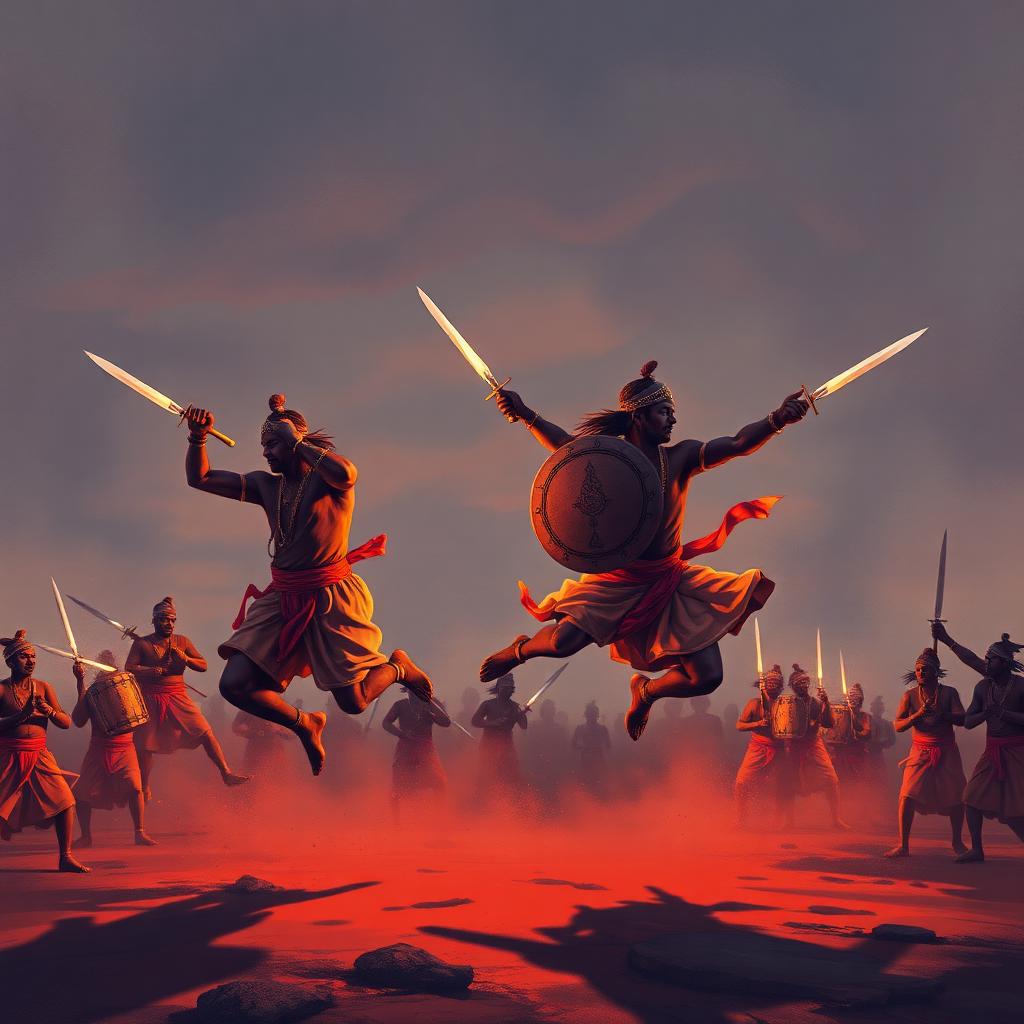
Bihar's folk traditions do not speak in a single voice. Some speak softly, in the domestic interiors of homes where women gather around newborns or sing at wedding thresholds. Some speak in the seasonal language of rain and harvest, in circles of women petitioning the monsoon or celebrating its arrival. And some speak in registers that surprise the visitor who arrives expecting only the spiritual and the agrarian: the sharp crack of a sword handled with martial precision, the thunder of war drums, the collective stamping of feet that once trained men for combat. Two traditions sit at opposite ends of this spectrum, and understanding both gives you something closer to the full complexity of what Bihar's folk culture actually contains. Jumari is a circle dance, performed at festivals and seasonal celebrations across rural Bihar, in which men and women join hands and move together in formations that have no hierarchy, no lead dancer, no soloist, only the collective rhythm of everyone present moving as one. Paika is a martial dance, performed almost exclusively by men from communities historically associated with soldiering, in which swords flash in controlled arcs, shields are handled with combat precision, and the movements preserve the physical memory of warfare in a state that has largely forgotten it had warriors. One tradition creates equality through collective movement. The other preserves discipline through martial memory. Both are genuine expressions of Bihar, and neither fits the simplified cultural portrait that most travel narratives offer. "Bihar's folk traditions range from the gentlest circle of hands to the sharpest edge of a sword. Both are honest. Both deserve attention."
Jumari: The Circle That Makes Everyone Equal
There are no lead dancers in Jumari. There are no soloists, no performers and audience, and no hierarchy of skill or status that determines who stands where. There is only the circle, and within it, a form of equality that Bihar's social structure rarely produces anywhere else.
Jumari is performed during festivals, harvest celebrations, and community gatherings across rural Bihar, particularly during Holi, Diwali, and the seasonal transitions that agrarian communities mark with collective expression. Men and women join hands or link arms, forming circles that expand as more participants enter. The steps are simple and repetitive; the songs are familiar enough for everyone to sing without instruction. The rhythm is created not by instruments alone but by the collective clapping, stomping, and voices of everyone in the formation.
The simplicity is the point. Unlike classical or semi-classical traditions that reward years of training, Jumari requires nothing that any member of the community does not already possess. The circle opens to everyone, which means it draws everyone in, and within it the landlord moves beside the laborer, the elder beside the child, and the wealthy beside the poor, not because social hierarchies have been dissolved outside the circle but because the circle's logic demands that they be set aside within it. The formation cannot function if one person breaks rhythm or refuses to hold the hand of the person beside them. Interdependence is structural, not aspirational.
This egalitarian ideal is imperfectly realized, as all ideals are. In practice, caste segregation can influence participation, gender norms can separate circles into male and female formations, and the pressures of social hierarchy find ways to persist even within communal dance. But the ideal itself matters. Jumari articulates a vision of social relations based on participation rather than position, and it enacts that vision with enough regularity and enough joy that the vision remains alive in the communities that maintain it.
The experience of sustained Jumari, a circle that has been moving for an hour or two, in which the repetitive rhythm has moved past conscious effort into something more automatic and more collective, is described by participants across generations in similar terms: a sense of belonging that daily life rarely provides, a temporary dissolution of individual self-consciousness into collective awareness, and an exhaustion that somehow energizes rather than depletes. Elder participants describe it as a connection to childhood memories of community that urban and migrant life has eroded. Younger participants, even those who claim indifference, often find themselves pulled into the circle by the specific gravity that collective rhythm creates.
Jumari faces the pressures common to participatory traditions in a world increasingly organized around individual and passive consumption. Urbanization removes the community spaces where large circles can form. Migration depletes the demographic base that substantial circles require. Festivals increasingly feature stage performances and professional entertainment rather than participatory traditions. The circles that form today are sometimes smaller, the performances shorter, and the occasions fewer. But in the villages of rural Bihar, where community bonds remain strong, Jumari continues because the need it serves, the need to be part of something larger than oneself and to experience equality through movement rather than just aspire to it through principle, is a need that no modern alternative has yet found a way to replace.
Paika: The Physical Memory of Bihar's Warrior Past
The word 'Paika' means 'foot soldier,' and the tradition that bears the name was not always a cultural performance. It was military training, the daily drill of infantry communities who served under regional chieftains and small kingdoms across Bihar in the centuries before British colonial consolidation, men who trained from childhood in swordsmanship, shield combat, formation fighting, and the physical conditioning that warfare demands.
When the military function of these communities diminished, when modern armies replaced local warrior groups and the need for foot soldiers in regional conflicts faded, the training did not disappear. It transformed. The combat drills became ritualized performances.
The formations developed narrative and theatrical dimensions. What was military preparation became folk art, though folk art of an unusually physical and unambiguously martial character that has never fully resolved its relationship with its own violent origins.
A Paika performance is unlike any other folk dance in Bihar. The soundscape is dominated by percussion, the dholak and nagara drums beaten at tempos that mimic battle rhythms, slow and deliberate during defensive formations; rapid and intense during attacking sequences; and thunderous at climactic moments. Performers enter carrying actual swords and shields, and the weapons are handled with precision that reflects genuine training: the sword work involves wide arcs stopped with controlled exactness, complex patterns demonstrating both strength and discipline, and combat postures that retain their functional military logic beneath the performance structure. Facial expressions are fierce. Battle cries punctuate the action. The atmosphere is one of tension and urgency rather than celebration.
The communities that maintain Paika understand it as the preservation of an identity that the broader society has largely stopped valuing. Bihar's cultural narrative emphasizes the spiritual, the agricultural, and the artistic. Its warrior heritage, the centuries of regional conflict, the communities whose identity was built around martial discipline and physical courage, and the role of Paika warriors in resistance against colonial authority sit awkwardly in a state that prefers its folk traditions gentle and its history peaceful.
Paika communities performing their tradition at cultural festivals sometimes find that audiences appreciate the spectacle without understanding the claim being made: that Bihar has not always been what its dominant self-image suggests and that these communities' specific form of knowledge and identity deserves the same recognition as any other.
The physical demands of Paika are substantial and deliberate. Training begins in childhood, is conducted with the seriousness appropriate to skills whose original context was life and death, and cultivates not just physical capability but also the specific psychological qualities of martial culture: discipline, courage, readiness, and the capacity for controlled aggression. Whether these qualities find productive expression in contemporary Bihar, where the social functions they were developed for no longer exist, is a question that Paika communities navigate individually and collectively, with varying results. The tradition's honest complexity includes this difficulty: the recognition that cultivating specific capacities and values in a society that no longer needs or fully understands them creates tensions that cultural performance alone cannot resolve.
What Paika preserves, at its most essential, is the physical memory of a history that written records have incompletely captured. The movements encode knowledge about how these communities trained, fought, organized, and understood themselves across centuries of political turbulence. When that knowledge exists only in bodies and in the transmission from one generation of practitioners to the next, its survival depends entirely on the continuation of the practice. When the practice stops, the knowledge does not retire into an archive. It disappears.
Two Traditions, One Bihar
Jumari and Paika represent something important about Bihar's cultural complexity when considered together.
A state whose folk traditions include both a circle dance of radical inclusivity and a martial tradition of disciplined aggression is a state whose cultural life cannot be reduced to a single narrative. The gentleness and the fierceness, the collective and the combative, the egalitarian and the hierarchical—all of these coexist within the same geography, within the same communities that produce both the harvest celebrations that Jumari accompanies and the martial memory that Paika preserves.
Both traditions face the same structural pressures: migration depleting the community base; urbanization removing the occasions and spaces for practice; and younger generations choosing modern entertainment over forms that require sustained commitment and communal participation. Both are maintained by communities that understand their traditions as essential to identity rather than optional as cultural decoration. And both offer a traveler something that Bihar's monuments and heritage sites cannot: direct access to the living social values of the people who inhabit this landscape.
Jumari shows you how Bihar creates belonging through the specific act of joining hands with whoever is beside you and finding a common rhythm. Paika shows you how Bihar has defended itself and remembered its defenders through the specific act of training the body to hold knowledge that would otherwise be lost.
How to Engage as a Traveller
Jumari is most accessible during major festivals and seasonal celebrations in rural Bihar. Holi and Diwali, harvest festivals, and community gatherings in the Bhojpuri and Mithila-speaking regions are the most likely contexts for encountering the tradition. Unlike many folk performances that require advance arrangement, Jumari's participatory and open character means that a respectful visitor in the right place at the right time may simply be invited to join the circle. Accepting that invitation, imperfectly and self-consciously, is more meaningful than any amount of observation.
Paika is less casually accessible. It is performed at specific community festivals and cultural events in the regions where its practitioner communities are concentrated, and finding it requires either knowing when and where those occasions occur or having a guide with genuine community connections. Watching Paika attentively requires some preparation: understanding the martial logic of the movements, the community identity behind the performance, and the historical context that gives the swords and shields their meaning beyond spectacle.
Both traditions reward the visitor who arrives with genuine curiosity rather than a documentation agenda, who is willing to put the camera down and simply be present, and who understands that what they are witnessing was not arranged for their benefit but is happening because the communities involved still find it necessary.
Why Choose Folk Experience to Travel Bihar
Traveling in Bihar is not about ticking destinations off a list. It is about understanding a state whose cultural complexity resists simplification, whose folk traditions range from the most inclusive circle to the most demanding martial discipline, and whose people express through dance, song, and movement things that no guidebook or heritage tour has adequately captured.
Folk Experience takes you into Bihar, where Jumari circles form at dusk during harvest festivals, where Paika communities train and perform with the seriousness of people preserving knowledge they understand to be irreplaceable. Culture here is lived rather than staged, and the journeys Folk designs reflect this: aligned with the occasions when traditions are most fully themselves, facilitated by guides with genuine relationships in the communities they introduce you to.
Understanding Jumari offers insight into how Bihar creates and maintains social bonds through collective participation. Understanding Paika offers insight into a martial heritage that dominant cultural narratives have marginalized but that specific communities continue to carry with pride and discipline. Together, they offer a more complete Bihar than either alone could provide.
Bihar reveals itself slowly, honestly, and with lasting impact to those patient and attentive enough to receive it.
At Folk Experience, we do not simply take you to Bihar. We help you understand why it matters.
" To see Bihar fully, you must be willing to both join the circle and face the sword. One teaches belonging. The other teaches what belonging has sometimes required people to defend. "
Subscribe to our newsletter
Folk Experience © 2026 – All Rights Reserved