Lucknow’s Nawabi Heritage: Bara Imambara, Rumi Darwaza & the Labyrinth of Bhul Bhulaiya
There are cities that you visit, and there are cities that receive you. Lucknow belongs to the latter. As the cultural heart of Awadh, it carries the soft fragrance of a bygone era,an age when poetry shaped conversations, architecture shaped identity, and grace (tehzeeb) shape...
Meet your AI Story Guide
Turn this field note into a one-minute brief with the essential places, people, and traditions.
Historical Context: Rise of the Nawabs of Awadh
Lucknow's grace has particular roots. The rulers who shaped it were not ordinary governors. Awadh started as a province under the Mughals, but as that empire began losing its hold across the 18th century, Awadh moved toward something of its own. What grew there was a Nawabi kingdom with a personality unlike anywhere else: Mughal bones, Persian detail, and an Awadhi warmth that belonged entirely to this landscape and its people.
The Nawabs themselves were an unusual breed of ruler. Nawab Shuja-ud-Daula kept the kingdom stable politically. His son, Nawab Asaf-ud-Daula, built Lucknow into something people still come to see: a city of great arches, carefully considered gardens, and monuments that have stood for over two centuries. Ghazi-ud-Din Haidar added a theatrical dimension to royal life, with new coins, coronation ceremonies, and a taste for ornament that extended into public space.
Lucknow attracted poets, musicians, craftsmen, and scholars from Persia because the courts here genuinely rewarded their work. Kathak found its most refined expression in the Lucknow gharana. Urdu poetry produced some of its deepest voices here. Tehzeeb, the etiquette of Awadh, became a whole philosophy of how to move through life: with intention, consideration, and care.
What set the Nawabi period apart, though, was something less visible than its art. Hindu and Muslim craftsmen built the same monuments side by side. Embroiderers, masons, poets, and musicians moved through the same courtyards. The cultural inheritance this mixing created has never fully dissolved. Historians call it Lucknow's golden age. What they mean is that something rare happened here: art became the language through which the city understood itself as one.
Bara Imambara: The Architectural Marvel
In 1784, a famine hit Awadh hard. Nawab Asaf-ud-Daula's response to it turned into one of the most unusual stories in Indian architecture. Rather than simply distributing relief, he commissioned the construction of Bara Imambara to keep people employed over an extended period. During the day, ordinary workers built the structure up; at night, the nobility took turns carefully undoing parts of the work, so that the building never finished and the wages never stopped. It was an act of dignity, not just charity.
The result is a monument that continues to confound engineers and delight visitors. The central hall is vast and soaring, and it was raised without a single beam or piece of metal inside the structure. Lakhauri bricks and lime plaster hold the whole thing up through a system of interlocking arches that has lasted for more than two centuries. Architects who study it still come away shaking their heads.
But what strikes a visitor is not only the structural feat. There is something in the scale and quietness of Bara Imambara that feels like an act of generosity made permanent in stone. The building was never meant to be a private statement; it was built for the city and for history, and it carries that intention in every arch and corridor.
Bhul Bhulaiya: The Legendary Labyrinth
Above the main hall of Bara Imambara, tucked into the upper reaches of the structure, is one of the stranger things you will encounter in any Indian monument: the Bhul Bhulaiya. It is a labyrinth of over a thousand passages, corridors that turn without warning into dead ends, staircases that surface in unexpected places, and narrow alleys that loop back on themselves. It was designed originally to reduce the weight pressing down on the central hall below and to allow air to move through the structure, but over time it became something else entirely.
The maze gathered folklore the way old buildings do. Stories circulated of visitors who stepped in for a look and came out hours later, turned around and slightly dazed. Tales of hidden rooms and buried passages moved from generation to generation. What is genuinely remarkable, and can be verified, is the acoustics: a whisper on one side of the labyrinth can travel through the walls to an entirely different area, a design detail that speaks to the sophistication of the craftsmen who built it.
Walking through the Bhul Bhulaiya with a guide is one of those experiences that is difficult to describe after the fact. Each turn is a small puzzle. Each window opens onto a different angle of the old city below. And when you come out onto the rooftop at the end, Lucknow spreads out in every direction, a landscape of domes and minarets and courtyards that looks exactly as layered as its history.
Rumi Darwaza: The Iconic Gateway of Lucknow
If Bara Imambara is the heart of Nawabi Lucknow, Rumi Darwaza is its face. Built in 1784 by Nawab Asaf-ud-Daula, the same ruler who commissioned the Imambara, it stands as an enduring emblem of the city's identity. Rising nearly 60 feet, this gateway is sometimes called the Turkish Gate for the Ottoman quality of its design. It reflects Lucknow's ability to absorb influences from far beyond its borders and turn them into something new and specific to this place.
The decoration on the arch is intricate: floral patterns, scalloped edges, carved motifs that take the weight out of the stone and give the structure a quality closer to lacework than masonry. Old accounts mention that lanterns were placed in the niches at night, so that anyone approaching the city would see this lit gateway as the first mark of Lucknow's character. That image, of a city announcing itself with beauty rather than force, says something true about the Nawabi period as a whole.
Rumi Darwaza still stands at the entrance to this older part of Lucknow. To pass through it now is to enter a part of the city that has kept much of its original character, and to feel, briefly, what it might have been like to arrive here when it was new.
Chota Imambara: The Palace of Lights
A short walk from Bara Imambara stands Chota Imambara, commissioned by Nawab Muhammad Ali Shah in the early 19th century. From the outside, its white facade catches light and gives it a quality that is almost luminous. Step inside, and the scale of the ornament can stop you mid-stride.
The interior is filled with Belgian chandeliers, mirror-work, polished metal, and tazias, the detailed miniature mausoleums constructed for Muharram observances. The chandeliers were originally lit by candles, and the effect gave the building its popular name: the Palace of Lights. During the festival season, when the entire complex is illuminated, the reflections move across calligraphy and stucco in a way that makes the building feel almost alive.
Chota Imambara is a serious devotional space. It holds Lucknow's Shia traditions in physical form, a place where grief and beauty sit together in the way that Muharram itself requires. The annual ceremonies that take place here, the processions, the chanting, the mourning, carry an emotional weight that the building seems built to hold. It is not a place you walk through quickly. It asks for time and a certain quietness.
Architectural Aesthetics & Craftsmanship of Nawabi Lucknow
The real accomplishment of the Nawabi era was not only the monuments. It was everything that went into them: the craft, the labour, the accumulated skill of the people who worked on them.
Nawabi architecture brings together Mughal structure, Persian detail, and something that belongs to Awadh alone. Stucco carvings move across walls in bands of flowers and vines. Calligraphy lines the doorframes. Jaali panels break sunlight into geometric shadows that change through the hours. Mirror-work and enamel detailing make whole buildings glitter during festivals. The ornament is not decoration for its own sake; it is part of a visual language that runs through the city.
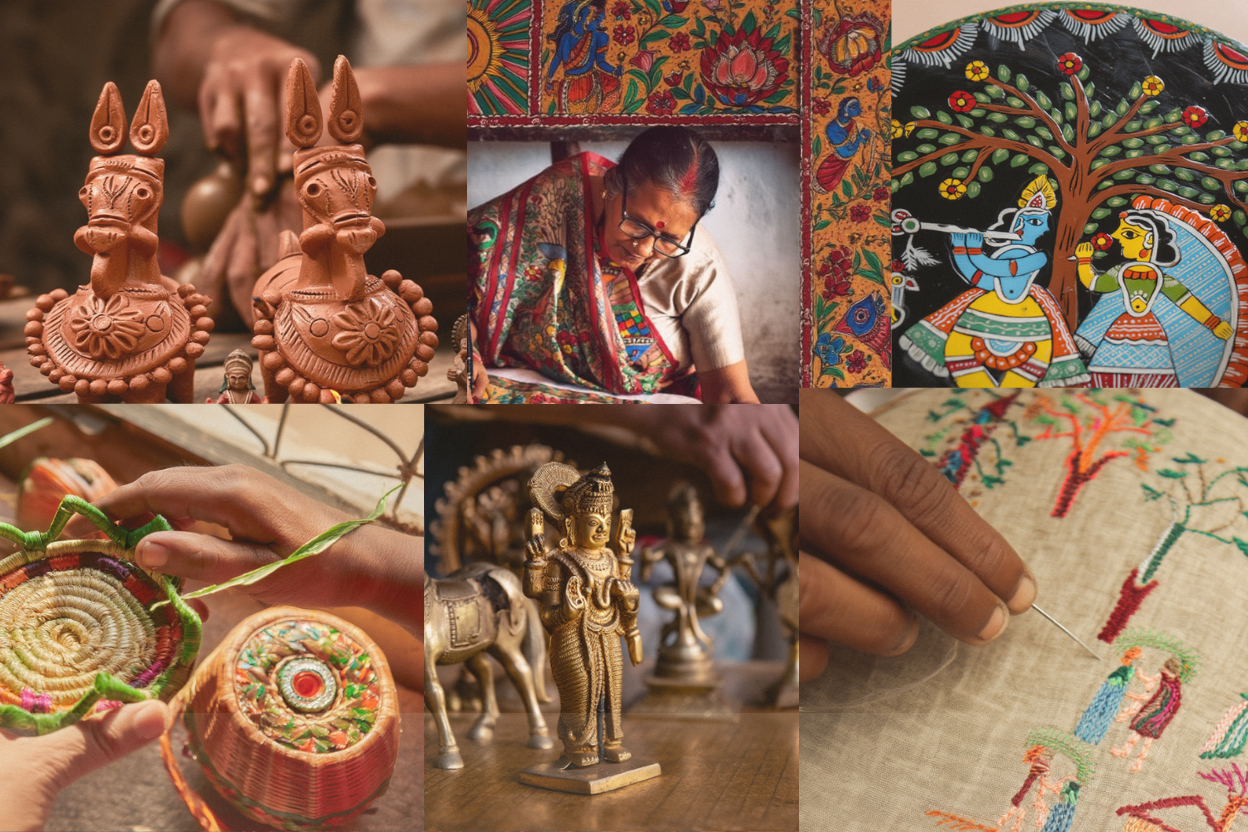
The people who made this were thousands of artisans working across disciplines. Metalworkers produced lanterns so detailed they looked like small architecture. Woodcarvers created doors that have more in common with tapestry than with timber. Chikankari embroiderers worked the same floral vocabulary into cloth that architects were carving into plaster a few feet above them. The same visual idea, expressed in different hands and different materials.
The result is a city where the parts feel connected, where looking carefully at any element begins to reveal its relationship to everything else. Lucknow was not designed in pieces. It was composed like a piece of music, each element contributing to something that works as a whole.
Folklore & Tales of Old Lucknow
Every corner of Lucknow holds a story, and some of the most persistent ones come from the monuments themselves. The claim that secret tunnels once ran beneath Bara Imambara, linking it to the Gomti River, the Residency, and distant forts, has been repeated for generations. Some say these were escape routes; others say they held royal treasure. No one has settled the question. But the stories keep circulating, and they make the old buildings feel inhabited in a way that purely factual accounts do not.
Local caretakers and guides carry this knowledge separately from the official history. They speak of hidden rooms, political intrigues, and the actual texture of Nawabi court life as it was experienced by people inside it. These accounts have passed through families over a long time, picking up imagination along the way without entirely losing what they originally described.
History in Lucknow is not kept only in books or on plaques. It lives in the people who are still part of it, in the voices that tell these stories to anyone who will slow down long enough to listen.
Cultural Milieu of the Nawabs
To step into Nawabi Lucknow is to step into an age where art was a way of life. Kathak reached a particular depth here, producing what became known as the Lucknow gharana, a school of classical dance celebrated for its expressive storytelling, subtle gesture, and intricate footwork. Evenings in the court unfolded in lamp light: musicians played ghazals, thumri, and dadra; poets gathered in mushairas where verse became a form of intellectual sport and emotional truth.
Tehzeeb, the etiquette of Awadh, was more than polite behavior. It was a way of moving through the world with care: how you greeted someone, how you walked into a room, how you offered food or accepted it. This manner of living is still visible in how Lucknow conducts itself today.
The food that came out of these courts is inseparable from the culture. Kebabs that dissolve in the mouth, biryanis fragrant with saffron and slow cooking, sheermal brushed with ghee: these were not merely meals but achievements, born in royal kitchens where cooks treated their work as devotion. The flavours carry something of this city's Ganga-Jamuni character, the long mingling of Hindu and Muslim culinary traditions that gave Awadhi cooking its particular depth and generosity. Lucknow became, and remains, a symbol of India's syncretic identity.
Traveller Experience: Walking Through Nawabi Lucknow
Nawabi Lucknow is best explored on foot and without hurry. The early morning and late afternoon hours are when the light sits well on the monuments: long shadows pick out the carved details on Bara Imambara and Rumi Darwaza in a way that midday light flattens out.
Those who come with cameras will find the geometry rewarding: arches set inside arches, doorways lined up across courtyards, rooftops that offer long views across domes and minarets toward where the sky changes colour.
Religious and heritage sites ask for modest dress and quiet movement. These are not dead monuments; they are places that continue to be used by the communities whose traditions they hold.
A walk that starts at Bara Imambara, moves through the Bhul Bhulaiya, passes under Rumi Darwaza, and finishes inside Chota Imambara covers the essential sweep of Nawabi architecture in a single route.
Chowk and Aminabad bazaars make a natural continuation, with chikankari stalls and ittar shops and zardozi workshops that let you see the same decorative sensibility expressed in entirely different materials.
Walking through this part of Lucknow is not exactly tourism. It is spending time in a place that was built to be experienced with attention, and that still rewards it.
Experiencing Nawabi Lucknow with Folk Experience
With Folk Experience, travelers don't just see Lucknow's monuments; they enter its stories. Each curated trail is designed to reveal the city the way a court historian might have described it centuries ago: through narrative, architecture, food, and lived culture.
Your journey begins inside Bara Imambara, where a heritage interpreter explains not only how the structure was built but why: the famine, the employment scheme, and the Nawab's belief that dignity could be offered through work. From there, the walk leads into the Bhul Bhulaiya, where the engineering and the folklore are given equal weight.
Standing beneath the arch of Rumi Darwaza, your guide unpacks the gateway's Ottoman connections, its symbolic meaning for the city, and how it has changed in public memory over time. At Chota Imambara, the stories move from architecture into devotional life: Shia traditions, Nawabi piety, and the artistry of those who served the courts.
The experience includes conversations with local artisans, including zardozi workers, chikankari embroiderers, and metal engravers. There are tasting stops in old Chowk for sheermal, kebabs, and Nawabi desserts. Musical interludes bring in classical musicians or Kathak students who share their lineage. And access to hidden courtyards and havelis takes you past what most casual visitors ever see.
Every walk supports traditional craftspeople, heritage workers, and families who sustain Lucknow's cultural heartbeat. The goal of Folk Experience is simple: to give you enough of the city's story that when you leave, you carry something of its tehzeeb with you.
In Lucknow, the past does not fade,it bows gently, invites you in, and teaches you how to walk with grace.