Madhushravani: Seasonal Rituals and Family Well-Being in Mithila
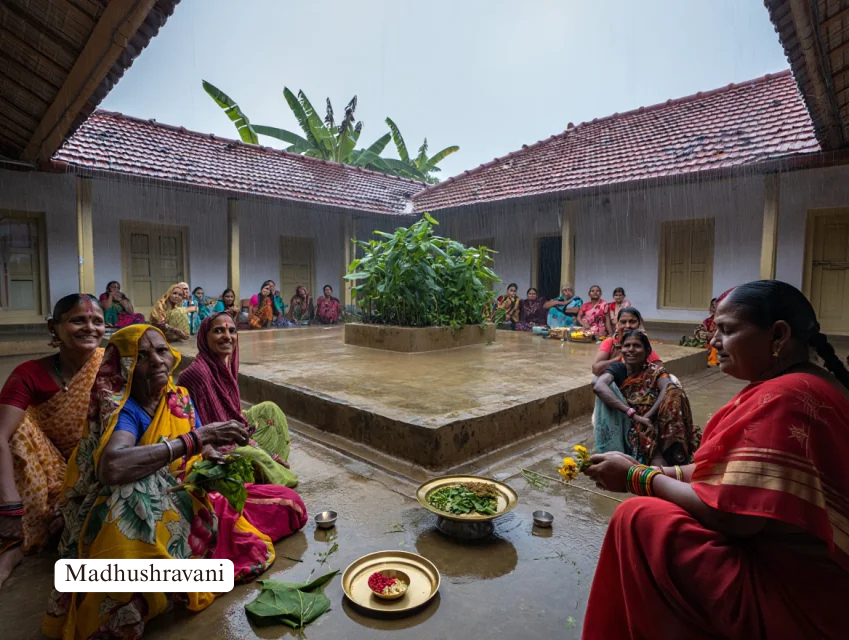
The monsoon in Mithila does not arrive only as rain. It arrives as a season of stories. Across the Mithila region of Bihar, as the fields turn green and the rivers fill and the waterlogged soil begins to push snakes out of their burrows, homes begin observing Madhushravani. Th...
Meet your AI Story Guide
Turn this field note into a one-minute brief with the essential places, people, and traditions.
Why the Monsoon and Why the Snake
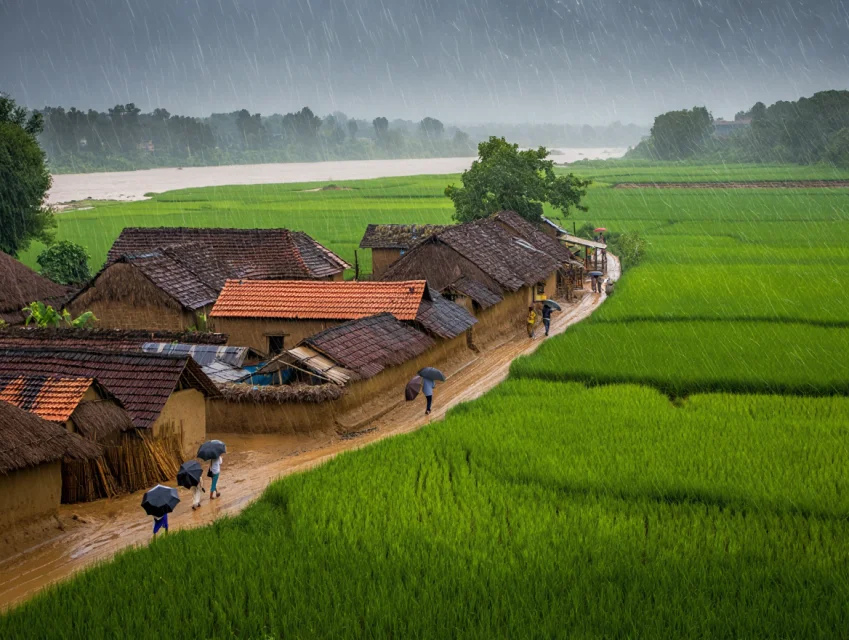
The timing of Madhushravani is not arbitrary. The monsoon in Mithila's agrarian landscape is a period of genuine ambiguity: the rains that fill the rivers and make the crops grow also spread waterborne disease, make travel unreliable, and drive snakes out of flooded ground into the paths of people moving through fields and village lanes.
The snake worship at the centre of Madhushravani, the daily prayers offered to Nag deities, guardians of water and fertility in Mithila's folk religious tradition, is a direct response to this ecological reality. The ritual does not approach the snake as an enemy to be driven away. It approaches the snake as a presence to be acknowledged and respected because, in a landscape where monsoon snake encounters are a genuine hazard, acknowledgement and respect are more useful than fear.
FACT: The Nag Panchami festival, observed across India on the fifth day of the bright fortnight of Shravan, falls within the Madhushravani observance period and is understood in Mithila as one of the ritual peaks of the longer practice. In the Mithila tradition, snake deities are closely associated with water sources, fertility, and the protection of household thresholds, reflecting an understanding of the snake's ecological role in agrarian communities that predates the Hindu temple tradition's codification of serpent worship.
The household deities worshipped alongside the Nag deities during Madhushravani extend the ritual's protective logic from the external environment to the internal one: the health of the family, the harmony of the marriage, the balance of the new domestic space that a recently married woman is still learning to inhabit.
Newly Married Women and the Ritual of Adjustment
Madhushravani is observed across a broad demographic in Mithila, but its most concentrated form is among newly married women in their first three to five years of marriage. This specificity is not incidental. It reflects what the ritual is doing for the women who observe it most seriously.
Marriage in Mithila has historically meant relocation: a woman leaves her natal family and moves into her husband's household, often in a different village, where she is the newcomer in an established family structure. The emotional and social adjustment this requires is real and substantial, and Madhushravani addresses it directly.
The prayers for the husband's long life and well-being that the ritual centres on are not simply devotional expressions. They are a way of investing in the new relationship through daily practice, of building a habit of care and attention toward the marriage in the months when that care is still being established. The fasting and dietary restraint are forms of self-discipline that the tradition understands as strengthening the body during the monsoon's health vulnerabilities while also marking the seriousness of the ritual commitment.
"The newly married woman observing Madhushravani in her first monsoon in her husband's household is doing several things simultaneously: performing a religious obligation, building relationships with other women in the household and neighbourhood through shared practice, learning the stories that constitute the tradition's knowledge base, and establishing herself within a community of care that will sustain her through subsequent monsoons."
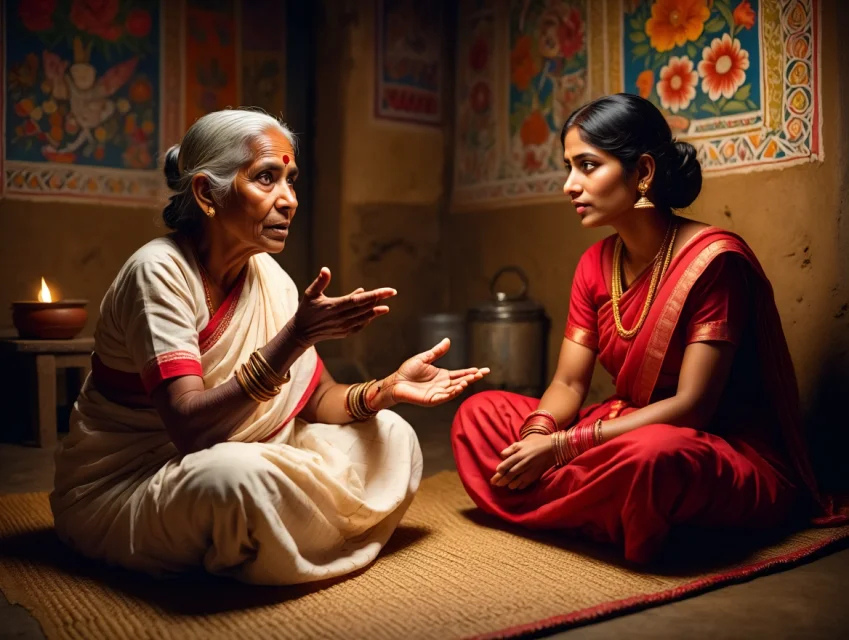
The storytelling that runs through the entire ritual period, one or more stories told each day, is the mechanism through which knowledge is transmitted. The stories involve snakes, deities, devoted wives, moral tests, and the consequences of observance or neglect. They are not allegories that require interpretation. They are direct transmissions of how the tradition understands the relationship between household behaviour and household well-being.
How the Stories Work
The stories of Madhushravani are told aloud, from memory, by women who learnt them the same way. There are no authoritative texts to consult. There are no priests who hold the canonical versions. The stories exist in the voices of the women who carry them, which means they are alive in the way that oral traditions are alive: adapting slightly across tellers and regions but maintaining their essential structure and their essential teachings.
FACT: Ethnographic research on Mithila's women-led domestic rituals, including work by scholars such as Vijaya Rani Jha and documentation by the Mithila cultural organisations, consistently identifies oral storytelling as the most resilient form of knowledge transmission in the region, surviving periods of significant social disruption, including mass migration, flooding, and the collapse of traditional patronage systems that affected other art forms. Madhushravani's storytelling tradition has remained intact in communities where other oral traditions have fragmented, partly because its domestic setting insulates it from the economic pressures that affect publicly performed traditions.
The communal dimension of Madhushravani emerges through this storytelling. Women from neighbouring households gather to listen. The story is not a private transaction between the teller and the listener but a collective experience, with multiple women hearing the same narrative and absorbing it together. Advice passes through the gathering. Younger women watch how older women navigate the ritual's requirements. The knowledge the tradition holds circulates through the room, which is how it has always circulated.
The Domestic Scale and Why It Matters
Madhushravani is not observable from outside the household in the way that public festivals are. There is no gathering at a ghat, no procession, no moment when the ritual makes itself visible to the street. It happens inside homes, in the spaces where daily life happens, folded into the rhythm of cooking and cleaning and childcare in a way that makes the boundary between ritual time and ordinary time difficult to locate.
This domestic scale is not a limitation of the tradition. It is what has sustained it. Women-led household rituals in Mithila have survived periods of social disruption that destroyed more publicly visible cultural forms, precisely because their survival does not depend on institutional support, public patronage, or the continued availability of specialised practitioners. The knowledge required to observe Madhushravani is held by the women in the household and the neighbourhood. It passes between them as long as there are women willing to pass it.
FACT: Regional cultural surveys of the Mithila belt estimate that over 60 percent of rural households continue to observe Madhushravani in some form, with the highest rates of observance among households with newly married women in their first five years of marriage. The ritual's continued prevalence in communities where other folk traditions have significantly declined is attributed by researchers to its domestic setting, its oral rather than material transmission, and its direct relevance to the health and social concerns of the monsoon season.
The monsoon's practical pressures reinforce the ritual's continued relevance. Waterborne illness, dietary disruption, reduced mobility, and the particular vulnerabilities of a season that is simultaneously productive and dangerous for agricultural communities: Madhushravani addresses these through the combination of dietary restraint, daily prayer, communal gathering, and the grounding of the household's attention in care rather than in the anxious waiting that monsoon uncertainty can otherwise produce.
What the Visitor Can Access
Madhushravani is not a gathering that accommodates casual observation. It happens inside homes, in domestic spaces, as part of the private life of families who have no particular reason to include an outside visitor in their ritual practice.
What a visitor to the Mithila region during July or August can access, with appropriate introduction and sensitivity, is the world around the ritual: conversations with women who have observed Madhushravani across decades, who can explain the stories and what they mean, who can describe how the ritual has changed within their own lifetimes and what pressures are affecting its transmission to younger generations. The experience of hearing a Madhushravani story told by a woman who learned it from her mother-in-law who learned it from hers is not available in any other form, and it requires the kind of trusted community relationship that cannot be arranged on short notice.
Folk Experience has built those relationships in Mithila over time, which is what makes it possible to facilitate conversations with women practitioners of Madhushravani rather than simply directing visitors toward the region during the monsoon months and leaving them to observe from the outside.
The Mithila visit that Folk Experience designs during the monsoon season connects the Madhushravani tradition to the wider context of Mithila's domestic cultural life: the Madhubani painting tradition that is also transmitted through women in domestic spaces, the Saurath Sabha that organises the marriages within which Madhushravani subsequently operates, and the agricultural calendar that sets the rhythm against which the ritual unfolds. These traditions are not separate. They are the same community's way of sustaining itself across seasons, and understanding one of them is the beginning of understanding all of them.
Folk Experience will make sure you arrive at the right door.
keep wandering