Meha Ji Mangaliya: The Hero Who Became a Legend of Rajasthan
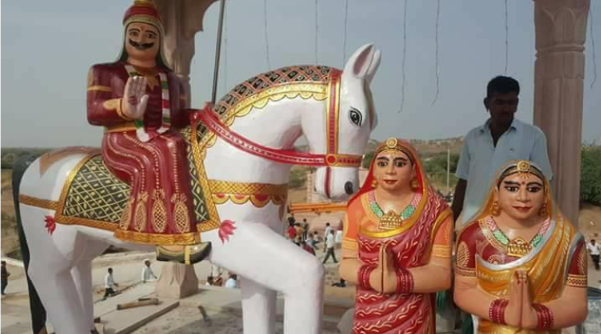
There's a shrine in Bapini, a small village near Jodhpur, where a warrior sits on horseback. Not in person, in stone, in paintings, or in the prayers of people who've been coming here for centuries. His name is Meha Ji Mangaliya. And if you haven't heard of him, that's probabl...
Meet your AI Story Guide
Turn this field note into a one-minute brief with the essential places, people, and traditions.
The Birth of a Hero
Meha Ji was born in Tapu village, near Jodhpur, on Krishna Janmashtami, the day that celebrates Lord Krishna's birth. People around here don't consider that a coincidence. It set the tone for everything that followed.
He came from the Gohil clan of the Mangaliya lineage. His father, Kelu Ji, was the Zamindar of Tapu, a man of authority and local respect. The family valued bravery and righteousness the way other families might value wealth or education. Meha Ji grew up in an environment that fostered these values.
His name actually came from his mother's side, the Mangaliyas, and it's from them that he's said to have inherited his moral backbone. Even as a kid, people noticed something about him. A directness. A sense of fairness that was difficult to ignore. Leadership qualities that didn't need a title to show up.
Avenging His Father's Death
Meha Ji was fourteen when the defining event of his early life happened. His father, Kelu Ji, had been killed. He was not killed by an enemy clan or a rival kingdom, but by his brother, Uda. A family dispute that ended in blood. The kind of betrayal that doesn't heal easily, if it heals at all.
For years, Meha Ji bore that burden. He was a boy, and what could a boy do? But he wasn't a boy forever. When he came of age, he put together a group of loyal fighters and went after the people responsible for his father's death. He rode his horse Kiran Kabra, an animal that shows up in every version of his story, famous for its speed and its bond with Meha Ji.
He won. And in Rajasthani folklore, that victory isn't framed as revenge. It's framed as dharma. A stand for justice. The moment where a grieving boy became someone the entire region would remember. That distinction is important because it separates a vendetta from a principle, and every Marwar storyteller will make sure you know which it was.
The Promise to Pana Gujari: Protector of the Helpless
This is the story that defines Meha Ji's character more than any battle does. During a pilgrimage to Pushkar, Meha Ji met Pana Gujari, a woman who connects you with various people from different walks of life. She was poor. Struggling. Caught in the grip of a famine that was making an already hard life unbearable.
Meha Ji didn't just feel bad for her and move on. He made her his Dharam Behn, his spiritual sister. And with that title came a vow: if she ever needed help, he would come. No conditions. No expiry date.
Years passed. Then drought hit again, and this time bandits came with it. They went after Pana Gujari's cattle, which was essentially a matter of survival for her. She called out to Meha Ji. And he came. He rode out to defend her livestock, fought the bandits, and ultimately lost his life in the process.
Think about that. He died protecting his spiritual sister's cows. Not a kingdom. Not a treasure. The cattle belonged to a poor woman to whom he had made a promise years earlier. That's the act that turned Meha Ji from a respected warrior into a folk deity. Because in Rajasthan, keeping your word, especially when it costs you everything, is the highest form of honour.
A Royal Connection: Meha Ji and Rao Chunda
Meha Ji's influence reached into royal circles too. Before Rao Chunda, the ruler of Marwar, set out to conquer Mandore, he went to Meha Ji for blessings. Not unusually, in this part of India, warriors and kings regularly sought the favour of saints and holy men before major campaigns.
Meha Ji gave him a sword. Not just any sword, but one that carried his blessing, his spiritual weight behind it. That weapon became a talisman in Marwar's military history. A symbol of divine backing. And the moment got recorded in the royal chronicles, weaving Meha Ji's name permanently into the political and spiritual history of the region.
It's a detail that shows something important about who Meha Ji was. He wasn't just a village hero. His reputation was big enough that the ruler of an entire kingdom consulted him before going to war. That kind of influence doesn't come from fighting skill alone. It comes from something people trust on a deeper level, such as his wisdom, integrity, and the values he represented that resonated with the people.
Martyrdom: The Warrior's End
Meha Ji's last fight was against Rao Ranagdev Bhati of Jaisalmer. The details vary depending on who's telling the story, but the core stays consistent: Meha Ji wasn't fighting for territory or personal gain. He was defending people who couldn't defend themselves.
He fought with everything he had. And he fell. But in Rajasthani tradition, falling in a battle fought for dharma isn't defeat. It's ascension. Meha Ji's death elevated him from a mortal warrior to a lok devta, a folk deity. A permanent protector of the land and its people, worshipped not out of obligation but out of genuine love and gratitude.
Temples, Fairs & Eternal Faith
The main shrine, Bapini, in Jodhpur, is where most of the devotional activity centres. The temple shows Meha Ji astride his horse, the image that everyone in this region associates with him. Every year, on Krishna Janmashtami's birth anniversary, thousands of pilgrims pour into this little village and turn it into something unrecognisable.
The celebrations are full-spectrum Rajasthani devotion. Folk songs. Bhajans that go late into the night. Storytelling sessions where bards recount his life from beginning to end. The temple priests called Bhopa belong to the Mangaliya lineage, but there's an intriguing twist: the tradition isn't maintained through biological inheritance. The Bhopas are adopted sons, chosen specifically to carry the legacy forward. It's a system that prioritises commitment over bloodlines, which feels very consistent with everything Meha Ji stood for.
Folklore and Oral Legacy
Meha Ji's story doesn't live in textbooks. It lives in the mouths of Charans and Bhats, the traditional bards of Rajasthan who've been singing his ballads for generations. These aren't casual retellings. They're poetic, structured, emotionally charged performances that can last hours. The songs cover his battles, obviously. But they also dwell on his compassion. His wisdom. The quiet moments are just as significant as the dramatic ones.
Every time someone sings one of these ballads around a fire in the Marwar desert, Meha Ji comes alive again for another audience. Another generation hears about Shaurya's bravery. Satya is truth. Seva service. His life keeps distilling into three pillars: love, loss, and longing, song after song, retelling after retelling.
The Literary Chronicle: Veer Meha Prakash
His story also made it into written form. "Veer Meha Prakash", an epic poem by Jasdan Bithu, chronicles Meha Ji's life in verse: his devotion, his sacrifices, and his leadership. It's considered one of Rajasthan's most treasured folk epics. Not widely known outside the region, but within it, the text carries serious weight. It ensures that Meha Ji's legend persists not only in song and oral performance but also in literature that can be passed down, studied, and preserved in a more permanent form.
Legacy Beyond Time
Meha Ji Mangaliya went from a boy in Tapu with a murdered father to one of Rajasthan's most beloved folk deities. That journey covers almost every theme this land cares about: honour, justice, sacrifice, loyalty, and keeping promises even unto death.
His story bridges Rajasthan's royal history and its rural present. Kings sought his blessing. Poor women sought his protection. And he gave both. Without ranking one above the other. That kind of equality – practised, not just preached – is why his devotees still light lamps and sing for him in times of hardship. They believe he's out there. He is believed to be riding with Kiran Kabra across the desert winds, guarding the righteous and guiding people who have lost their way.
Whether that's literally true isn't really the point. The belief is real. The community it creates is real. And the values his story reinforces – courage, compassion, and keeping your word no matter what – those are as relevant now as they were when he was alive.
Experience the Legend with Folk Experience
Meha Ji's story is one of those Rajasthani legends that you can't fully appreciate until you're standing where it happened. The shrine at Bapini. The desert around Tapu. The faces of the Bhopa priests who've dedicated their lives to maintaining his memory.
At Folk Experience, we take you into that world. Temple visits where you're not a tourist but a guest. Storytelling sessions with local Bhats who perform Meha Ji's ballads the same way their fathers and grandfathers did. You stroll through Marwar's sacred landscapes, where the distinction between history and legend becomes beautifully blurred.
It's not a history lesson. It's not a performance for outsiders. It's a chance to spend time with people who live inside this tradition every day and to understand even just a little why a warrior who died protecting a poor woman's cattle became one of the most loved figures in Rajasthan's spiritual life.
In Rajasthan, legends don't fade; they become the desert wind that whispers through eternity.