Pitrapaksha Mela (Gaya): Ancestor Worship and Pilgrimage Traditions
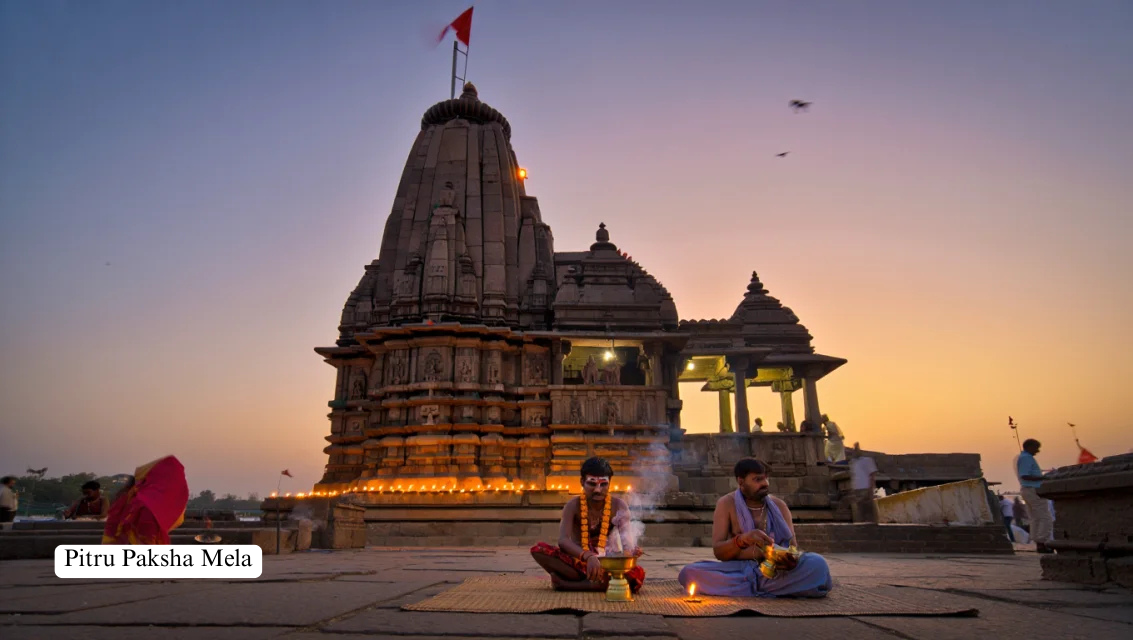
Gaya does not dress up for Pitrapaksha. There are no lights strung across the ghats, no stages erected for cultural programmes, and no banners announcing the occasion to arriving pilgrims. The city simply fills with families, quietly and across fifteen days, each one carrying ...
Meet your AI Story Guide
Turn this field note into a one-minute brief with the essential places, people, and traditions.
Why Gaya
The belief that makes Gaya the centre of Hindu ancestral ritual is ancient and specific. According to the Vayu Purana and the Agni Purana, Pind Daan performed at Gaya carries a spiritual efficacy that the same ritual performed elsewhere does not. The ancestors who receive offerings here attain moksha, release from the cycle of rebirth, in a way that is not guaranteed by offerings made at other sacred sites.
FACT: The Vishnupada Temple in Gaya, where a footprint of Lord Vishnu is enshrined in stone, is the ritual centre of the Pitrapaksha observances. The temple is mentioned in the Vayu Purana and the Mahabharata, and the Gaya Mahatmya sections of multiple Puranas describe in detail the spiritual merit of performing Pind Daan at the 45 ritual sites, known as Vedis, within the Gaya Kshetra. Families typically perform Pind Daan at multiple Vedis across the fifteen days of the mela.
The pilgrimage to Gaya is often multigenerational in the most literal sense. Families return to the same ghats and the same priestly families that their fathers and grandfathers visited before them. The pandas, the priestly families who guide pilgrims through the Pind Daan ritual, maintain records of the families they have served, sometimes extending back several generations. A family arriving in Gaya for the first time in twenty years may find that the panda who receives them knows which ghats their grandfather visited, which rituals he performed, and what his family lineage is called in the panda's records.
This continuity is not coincidental. It is the purpose of the pilgrimage: to maintain the connection between the living and the dead across time, in a place that the tradition has designated as the point where that connection can be most effectively renewed.
Pind Daan: What the Ritual Actually Involves
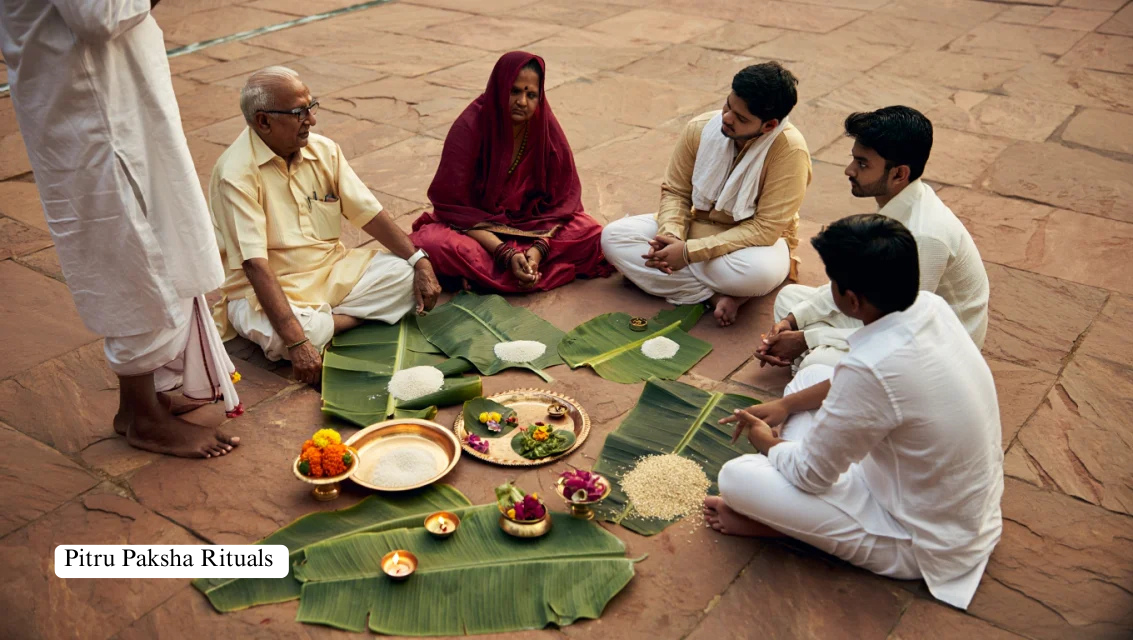
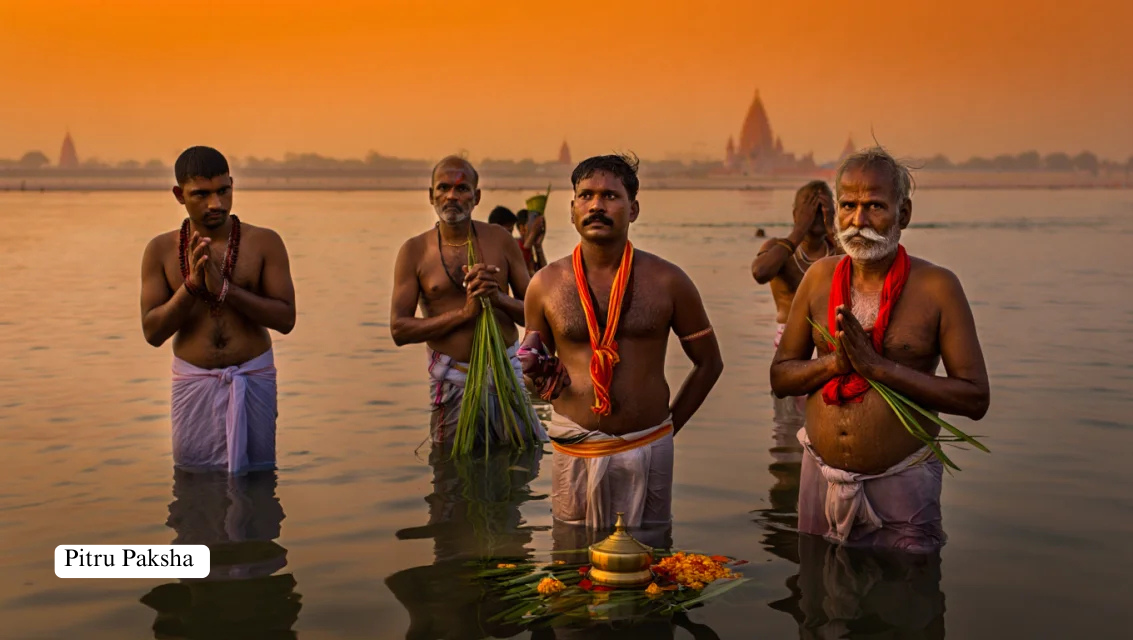
Pind Daan is the offering of rice balls mixed with sesame seeds, barley, and water to the ancestors. The ritual takes place at the water's edge, most commonly at the Vishnupada ghat and the Phalgu River, with the officiating panda guiding the family through a sequence of prayers, offerings, and final release into the water.
The act is more precisely understood as a duty than as a devotional gesture. The Sanskrit concept of rna, debt, is central to how the ritual is framed: every person is born into a debt to their ancestors, and Pind Daan is one of the ways that debt is acknowledged and partially discharged. Not performing it, in the traditional understanding, leaves the ancestor without the nourishment that allows them to rest and leaves the living with an obligation unfulfilled.
"The family that arrives at Gaya for Pitrapaksha is not arriving to express emotion. They are arriving to complete a transaction that their tradition understands as necessary for the well-being of both the living and the dead. The restraint of the ritual, its precision and its lack of ornamentation reflect the seriousness with which the obligation is held."
The sequence of the ritual is learned through participation rather than instruction. Children brought to Gaya by their parents observe what is done and absorb the knowledge of where to stand, when to pour the water, how to hold the grass, which mantras the panda recites and which responses the family offers. The transmission is embodied rather than textual, which is why families return across generations rather than consulting a manual.
FACT: The Phalgu River at Gaya is sacred in the Ram tradition as the river on the banks of which Sita performed Pind Daan for King Dasharatha, Ram's father, during the period of exile described in the Ramayana. The story is locally significant because Sita is said to have performed the ritual without Ram's knowledge, using sand when the prescribed ritual materials were unavailable, a precedent that local tradition uses to establish the legitimacy of improvisation within the ritual's essential structure.
The Fifteen Days and Their Rhythm
Pitrapaksha does not have a single climactic day. It has fifteen of them, each associated with the lunar date on which family members who died on that tithi in any year are specifically remembered. A family whose patriarch died on the fifth day of the dark fortnight would perform his Pind Daan on the fifth day of Pitrapaksha. This structure spreads the pilgrimage across the full fortnight rather than concentrating it at any single point, which is both a practical management of the crowd and a ritual acknowledgement that the dead do not all require attention on the same day.
The daily rhythm of the mela is consistent: early morning rituals at the river before the heat builds; the mid-morning visit to the Vishnupada Temple; and the afternoon preparation of the offerings for the next day. Families who stay for the full fifteen days develop a routine around these stages that comes to feel, by the second week, less like an imposed religious schedule and more like the natural tempo of a particular kind of attentiveness.
The restraint that characterises the mela extends to what families eat during the period. Many observe a partial fast, avoiding certain foods, eating once a day, or eating only specific combinations of grain and vegetables that the tradition associates with the observance. The body's appetite is restrained in parallel with the spirit's attention being directed outward toward the ancestors rather than inward toward the individual's own comfort.
The City That Adjusts Without Reinventing Itself
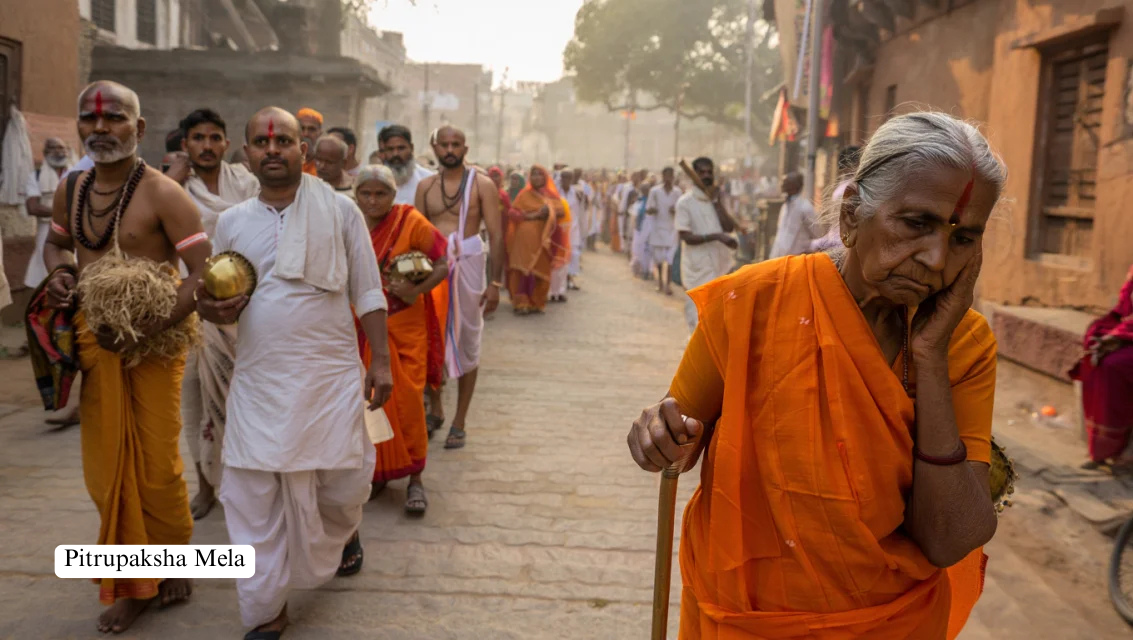
Gaya has been hosting this pilgrimage for long enough that its infrastructure for doing so is not temporary but permanent. The pandas live in the city year-round and are available throughout the year for families who cannot make the Pitrapaksha journey but wish to perform Pind Daan at other times. The markets that supply ritual materials operate continuously. The accommodation that fills during Pitrapaksha serves pilgrims across the entire year.
What Pitrapaksha does to Gaya is not transform it but intensify it. The city's existing character as a pilgrimage centre is amplified for fifteen days and then returns to its normal pitch. Local families whose livelihoods depend on the pilgrimage, the pandas, the flower sellers, the suppliers of ritual materials, and the cooks who operate the simple vegetarian kitchens near the ghats experience the mela as the annual peak of a year-round business rather than as an exceptional event.
FACT: Gaya is also significant in the Buddhist tradition as the site of the Mahabodhi Temple at Bodh Gaya, approximately 12 kilometres from the city centre, where the Buddha attained enlightenment. The proximity of two of the most sacred sites in two of the world's major religious traditions, within the same district of Bihar, is a feature of the Gaya landscape that is historically significant and that continues to shape the city's character as a place where different traditions of seeking have converged.
What Pitrapaksha Asks of the Visitor
Pitrapaksha is not a gathering that positions the outside visitor comfortably. There are no viewing platforms. There is no programme to attend. The ritual is conducted by families for their own ancestors, at their own ghats, with their own pandas, and the presence of an observer who is not participating in any of this is tolerated rather than welcomed.
Understanding what is happening at the ghats during Pitrapaksha requires the prior knowledge that no amount of time at the ghat will supply on its own. Why these specific offerings? What is the significance of the Phalgu River? Who are the pandas and what records do they hold? What does it mean that a family has been coming to the same ghat for four generations? These questions cannot be answered by watching. They require conversation, and conversation requires the kind of trusted introduction that a locally embedded operator can provide.
Folk Experience approaches Gaya during Pitrapaksha with the understanding that the visitor's role is observation with context, not participation. The conversations that Folk Experience facilitates with panda families whose records go back several generations, with pilgrims who have made this journey before and are willing to explain what they are doing and why, give the experience a depth that the ghat itself cannot provide to an unprepared visitor.
The economy that sustains the pilgrimage, the panda families, the ritual material suppliers, the cooks, and the accommodation providers is also part of what Folk Experience makes visible, not as background colour but as the material reality that keeps a fifteen-century tradition operational in the present.
Gaya during Pitrapaksha is a city doing something it has always done, in the way it has always done it, for reasons that have not changed in fifteen centuries. The visitor who arrives knowing this receives more than the visitor who arrives expecting to be shown something remarkable.
Folk Experience will make sure you arrive knowing.
keep wandering