Rajgir: Where Sacred Time Meets Living Culture
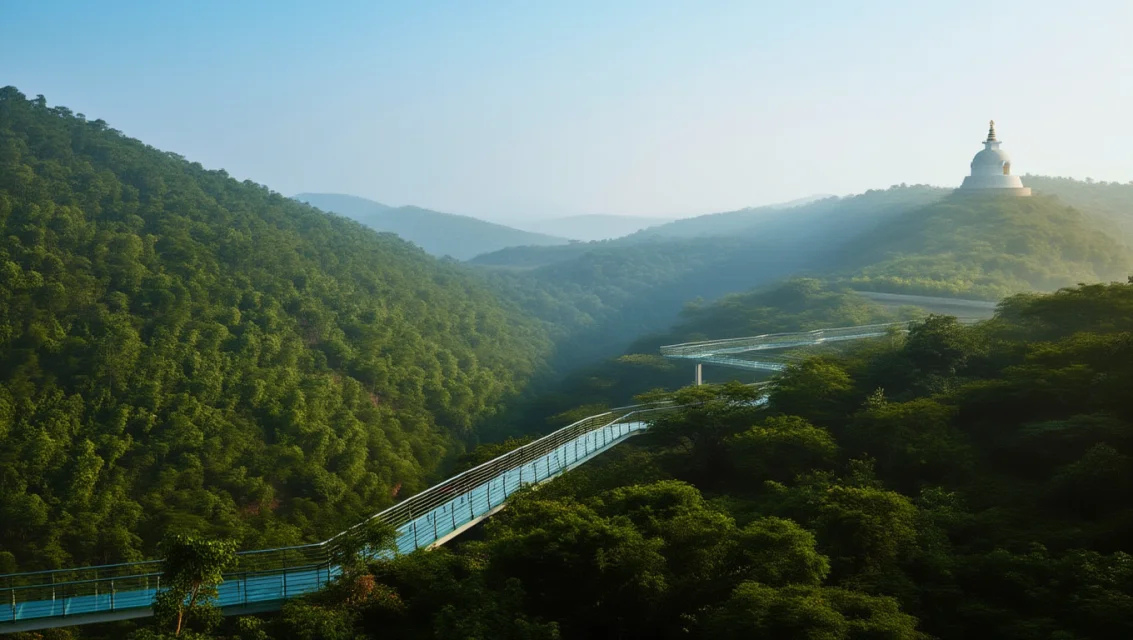
There are places that exist for one reason, and there are places that exist for many reasons simultaneously, holding different kinds of human need within the same landscape without any of them diminishing the others. Rajgir is the second kind. Encircled by five hills in the Na...
Meet your AI Story Guide
Turn this field note into a one-minute brief with the essential places, people, and traditions.
The Place Before the Events
Before the festivals and the pilgrimages, the place itself.
Rajgir, known in ancient texts as Rajagriha, meaning the house of the king, served as the capital of the Magadha empire in the 6th and 5th centuries BCE. The five encircling hills, Vaibhava, Ratna, Chatha, Sona, and Udaya, created both a natural defensive perimeter and a landscape of unusual stillness that drew seekers as powerfully as it drew rulers.
Gautama Buddha spent several rainy seasons here, teaching on Gridhrakuta, the Vulture Peak. The first Buddhist council after his passing convened in the Saptaparna Cave on the slopes of the Vaibhava hill. Mahavira, the 24th Tirthankara of the Jain tradition, was equally drawn to Rajgir, spending extended periods here during his years of wandering and teaching.
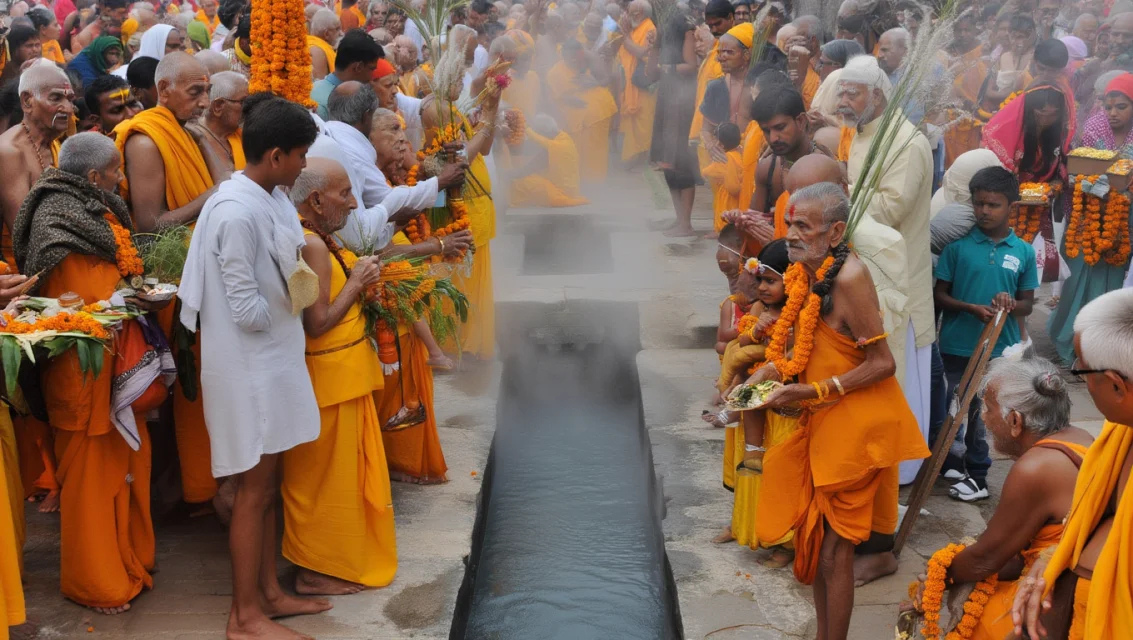
The hot springs flowing through the center of the town have been in continuous use since at least the 7th century CE, when the Chinese traveler Xuanzang recorded monks bathing here for healing and purification. Flowing at 45 to 47 degrees Celsius from geothermal sources, they carry a quality of continuity that predates every religious and political structure built around them.
This layered landscape—hills shaped by meditation, springs flowing through centuries of pilgrimage, ancient pathways connecting sacred sites—is not a backdrop for what happens here. It is the primary fact. Everything else follows from it.
Malmas Mela: When Time Hesitates and Pilgrims Gather
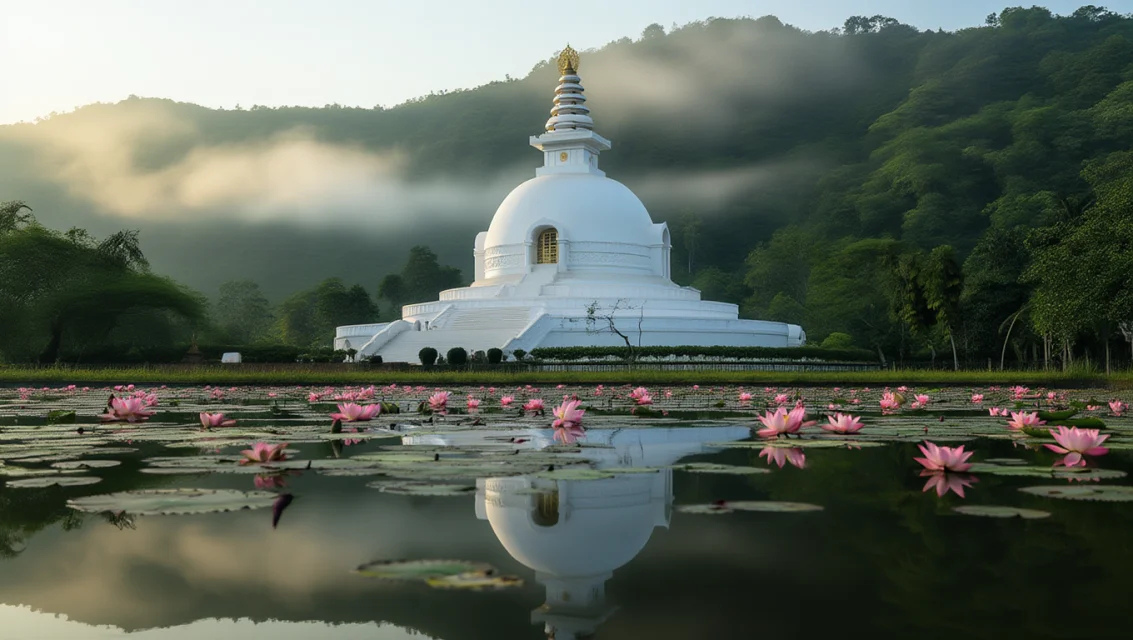
Every 32 to 33 months, the Hindu lunar calendar inserts an additional month called Malmas or Adhik Maas to correct the eleven-day annual gap between the lunar and solar years. Unlike the other twelve months, Malmas is assigned to no presiding deity. No marriages, inaugurations, or new ventures are encouraged. It is deliberately left open, a month outside ordinary time.
Hindu thought treats this pause with seriousness. When the calendar acknowledges its own irregularity, human ambition is expected to slow in response. Malmas becomes a time for charity, fasting, ancestor remembrance, and inward reflection rather than outward expansion.
And when time becomes uncertain, the instinct is to seek grounding in something that does not depend on dates. That is where Rajgir becomes indispensable.
Rajgir is understood as a tapobhoomi, a landscape sanctified by centuries of penance and spiritual discipline rather than by auspicious celestial alignment. Its sacredness does not fluctuate with planetary positions. In a month where time hesitates, Rajgir offers certainty.
The Malmas Mela that forms around this understanding is not a festival in the conventional sense. There is no single day of peak celebration. What there is, across the full duration of the intercalary month, is a steady intensification of pilgrimage: a 30 to 40% increase in visitors coming primarily from Bihar, Jharkhand, eastern Uttar Pradesh, and Bengal to perform the rituals that Malmas specifically calls for.
Ritual bathing in the hot springs is the most immediate of these, the immersion in continuously flowing sacred water understood as both purification and correction. Pind daan for ancestors, charitable giving of food and grain, and extended fasting complete the picture of a gathering whose mood is unlike any other pilgrimage in the region: unhurried, inward, and quietly purposeful.
The pilgrims who come are predominantly older families fulfilling long-held vows and ascetics for whom Rajgir is a regular destination made more significant by the Malmas context. They arrive and spend days rather than hours. There is no urgency here, no narrow window of auspiciousness to seize. The auspiciousness belongs to the place rather than the moment, which means it is available to anyone who comes with the right intention.
Rajgir Mahotsav: When the Hills Become a Stage
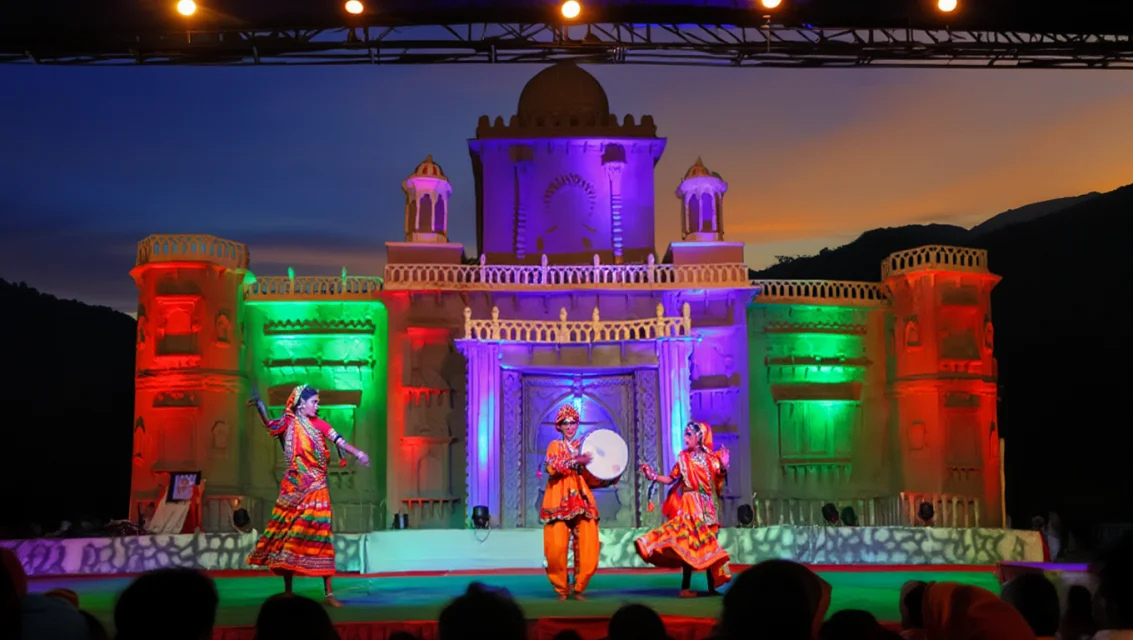
Set against the same hills that receive Malmas pilgrims with such quiet intensity, the Rajgir Mahotsav arrives each year as an entirely different kind of gathering, one organized not around ritual but around music, dance, and the cultural expressions of a state whose artistic traditions are among the richest and least recognized in India.
The Mahotsav is an annual state-supported cultural festival, but it was conceived with an intention that distinguishes it from the category of government programming that produces events more notable for their official character than their artistic quality. It was designed as a platform: a space where Bihar's own musicians, dancers, and folk performers could be heard in their rhythm without pressure to transform their art into spectacle.
The choice of Rajgir as the venue is not incidental. The encircling hills create a natural acoustic environment. Evening performances set against Vaibhava Hill, in the specific quality of light that the Rajgir valley holds at dusk, produce a listening environment that no purpose-built auditorium can replicate. The place is not a neutral container for the art. It participates in it.
Programming spans classical traditions, semi-classical forms, and the diverse folk expressions of Bihar's various regional cultures. Maithili music from the north, Bhojpuri traditions from the west, Angika forms from the northeast, and the specific Magahi cultural expressions of the Rajgir region itself all find space on the same stage. Folk performances carrying oral traditions, songs, and narratives passed down without written scripts remind audiences that much of Bihar's culture survives through voice and repetition rather than documentation.
What makes the Mahotsav distinctive is its consistent emphasis on local artists. Nationally recognized performers appear, but the festival foregrounds Bihar's own cultural practitioners, giving them a platform that the mainstream circuit rarely provides without requiring them to change what they do. For many artists, Rajgir Mahotsav represents recognition that does not demand transformation.
The festival's restraint in production is a philosophical choice. No overwhelming installations, no constant amplification, no spectacle-driven atmosphere. The focus remains on sound, movement, and the quality of attention that live performance in an intimate setting generates. Audiences sit longer and listen more closely. Attention replaces excitement.
Two Gatherings, One Landscape
The Malmas Mela and the Rajgir Mahotsav are distinct events with different purposes and audiences. One is a pilgrimage. The other is a performing arts festival. One happens every 32 months. The other happens every year.
But both are expressions of the same quality of Rajgir as a place: its capacity to receive human aspiration, whether devotional or cultural, with the specific gravity that a landscape shaped by millennia of serious human engagement can provide.
The pilgrim who comes during Malmas and the cultural traveler who comes for the Mahotsav are seeking different things. But both choose Rajgir rather than somewhere else, and that shared choice reflects something real. The place offers continuity, the sense that what you are doing here connects you to a very long chain of human beings who have done something similar in this same landscape across a very long time.
A song performed on the Vaibhava hill is not just a song. A ritual bath in the springs during Malmas is not simply a bath. The place adds something that cannot be manufactured or staged, the accumulated presence of centuries of serious human attention directed at the same ground.
How to Visit
Rajgir is approximately 100 kilometers from Patna, accessible by road in roughly two and a half hours. It can also be combined with Nalanda, 12 kilometers away, whose ancient university ruins are among the most significant archaeological sites in Asia. A two-day visit covering both sites gives you the fullest picture of the region's depth.
The Rajgir Mahotsav typically takes place in October or November. The state cultural authorities announce specific dates annually, and planning your visit around those dates requires some advance coordination but rewards the effort.
The Malmas period is determined by the Hindu lunar calendar and occurs once every 32 to 33 months. Visiting during Malmas without knowing its significance means missing the meaning of what you are witnessing. Coming with that understanding changes the encounter entirely.
The hot springs are accessible year-round. Going early in the morning, before the day's pilgrimage traffic builds, gives you the springs in their most contemplative state, the steam on the water, the quality of dawn light, and a quality of quiet in which the long history of the place is most directly felt.
Accommodation ranges from modest guesthouses to state tourism properties. Eating where locals eat, rather than seeking familiar options, rewards the traveller with the specific character of Bihar's everyday food culture, which is honest, unfussy, and quietly satisfying.
What Rajgir Teaches
A place that has held the capital of an empire, the teachings of the Buddha and Mahavira, centuries of pilgrimage, and an annual celebration of Bihar's living cultural traditions, all within the same encircling hills, teaches something that is difficult to articulate and easy to feel.
It teaches that the sacred and the cultural are not separate categories that require separate spaces. It teaches that time has texture, that some moments are for action and others for correction. And it teaches that Bihar, whose historical and cultural significance is systematically underrepresented in the national conversation, contains within its landscape experiences of depth that reward the traveler who seeks them out.
Come for the Mahotsav, and you will carry Bihar's music in your memory. Come during Malmas and you will leave with something harder to name but no less real. Come for both, if the calendar allows, and you will understand something about how a place can hold time, culture, and the sacred in the same hands without dropping any of them.
Why Choose Folk Experience to Travel Bihar
Traveling in Bihar is not just about checking off destinations. It is about understanding a landscape that has been shaped by philosophy, faith, and living culture across more than two millennia, and doing that requires a kind of travel that most standard itineraries are not built for.
Folk Experience approaches Bihar differently.
Every journey is grounded in historical and cultural context before it begins. A visit to Rajgir with Folk is not simply a trip to a hill town with hot springs and a festival. It is an encounter with the specific ideas, the Magadha empire, the Buddhist councils, and the philosophy of sacred geography that made this landscape what it is. History is not narrated from a distance. It is felt in the places where it happened.
Culture in Bihar is lived rather than staged, and Folk Experience designs journeys that reflect these realities. You do not observe from outside. You engage with belief systems, seasonal rituals, and community practices that continue to shape daily life in the villages and towns of this state. The Malmas pilgrims you sit beside at the hot springs, the musicians you listen to at the Mahotsav, and the families you share food with in a local dhaba—these are not cultural exhibits. They are Bihar, present and continuing.
Some places reveal their deepest meaning only at certain moments. Folk Experience aligns travel with those moments, whether it is the specific stillness of Rajgir during Malmas, the performance culture of the Mahotsav in October, or the quiet of Nalanda's ruins in the early morning. The timing of a journey is not only logistical. It is the difference between seeing a place and understanding it.
Folk Experience is built on the conviction that meaningful travel does not rush or consume. It values restraint as much as movement, listening as much as looking, and the kind of respect that leaves places as they were found. Bihar rewards exactly this approach. Its most significant experiences are not loud or immediately legible. They unfold slowly for those patient enough to let them.
Every journey with Folk is framed as a narrative where land, time, and human experience intersect. Hills are not simply terrain. Calendars are not simply dates. People are not subjects. They are the story, and the traveler's role is to listen carefully enough to understand it.
At Folk Experience, we do not simply take you to Bihar. We help you understand why it matters.