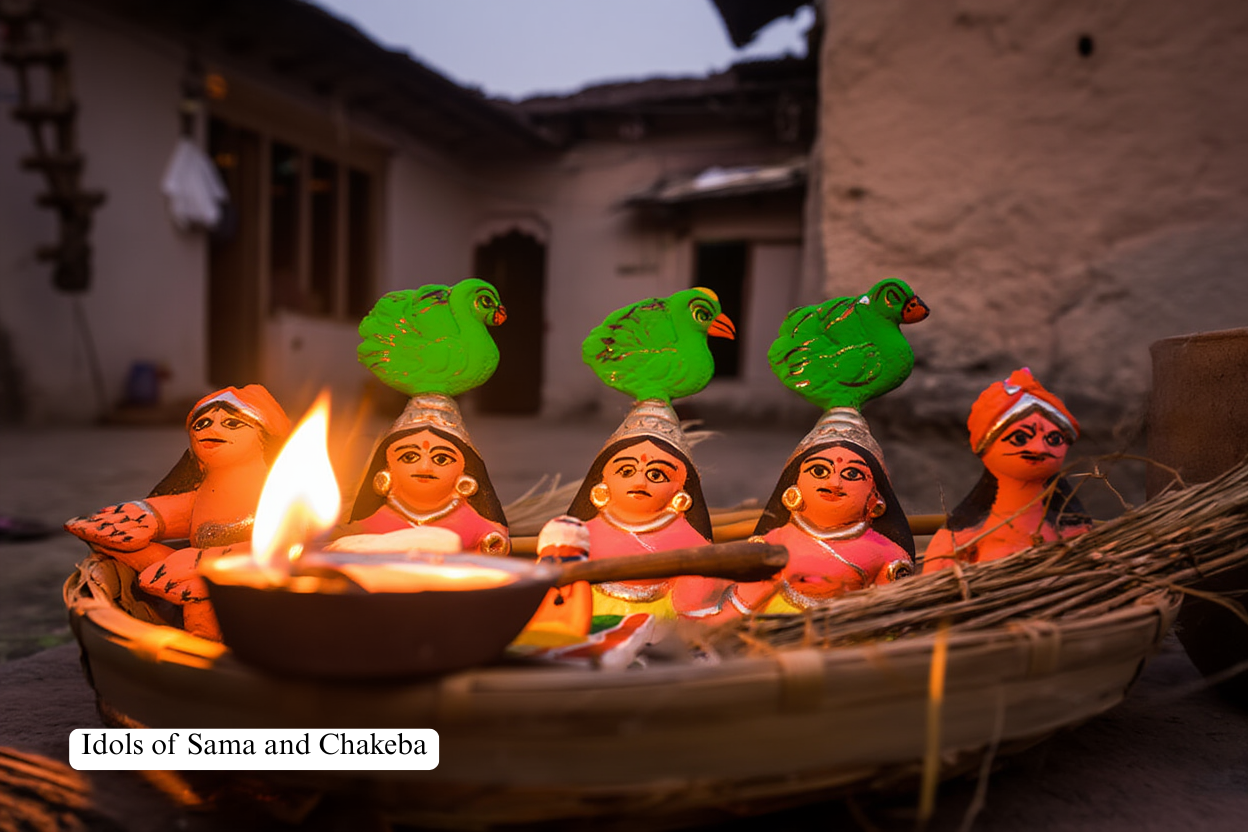
Sama Chakeva: Celebrating Sibling Bonds in Mithila
In a region where festivals are often measured by crowds, lights, and scale, Sama Chakeva survives without any of them. There are no stages, no public processions, and no officially announced dates. Yet, across the Mithila region of Bihar, an estimated 1.5 2 lakh villages and ...
Meet your AI Story Guide
Turn this field note into a one-minute brief with the essential places, people, and traditions.
Why Sama Chakeva Matters to Mithila’s Cultural Identity
Mithila keeps its culture close to home. Music, art, and ritual grow from courtyards and kitchens, not from public stages or organised events. Sama Chakeva fits that pattern exactly.
The festival is held together by women and children, not priests or organisers. What gets passed down moves through listening and doing, not through written texts. Studies on Mithila's folk traditions have long noted that women-run domestic rituals have kept cultural memory alive in the region, particularly where formal support never existed.
Sama Chakeva keeps going because everyday life carries it, not separate institutions.
Origins of Sama Chakeva in the Mithila Region
The story behind Sama Chakeva comes from Mithila's oral traditions. There is no single scripture backing it. The festival exists almost entirely in song and spoken narrative. Details shift from one village to the next, shaped by local memory and geography.
The timing does not change. Once the monsoon ends, the pace of farm work drops, and families find themselves with more evenings to spend together. Songs, stories, and shared time find their way into that space.
Staying regional has kept it intact. Sama Chakeva never spread across India, and because of that, it held onto something intimate.
The Story of Sama and Chakeva
The festival's story turns on Sama and Chakeva, two siblings caught in injustice and separation, held together by a bond that does not break.
The details shift across tellings, but the shape stays the same: a sister wronged and changed, a brother who stays devoted and sees things through. What matters in this story is not conquest but faithfulness, patience, and right action.
The story keeps resonating because it reflects things people know: being away, waiting, trusting that a relationship will hold across distance.
Clay, Song, and Story: The Living Core of Sama Chakeva
Across Mithila, Sama Chakeva keeps going not through organised events but through participation at the household level. Field research and surveys confirm that most Sama Chakeva observances happen inside homes and in neighbourhood courtyards, mainly in rural North Bihar, with women and children at the centre. Running at a small scale and inside domestic spaces is what lets the festival keep going from one generation to the next.
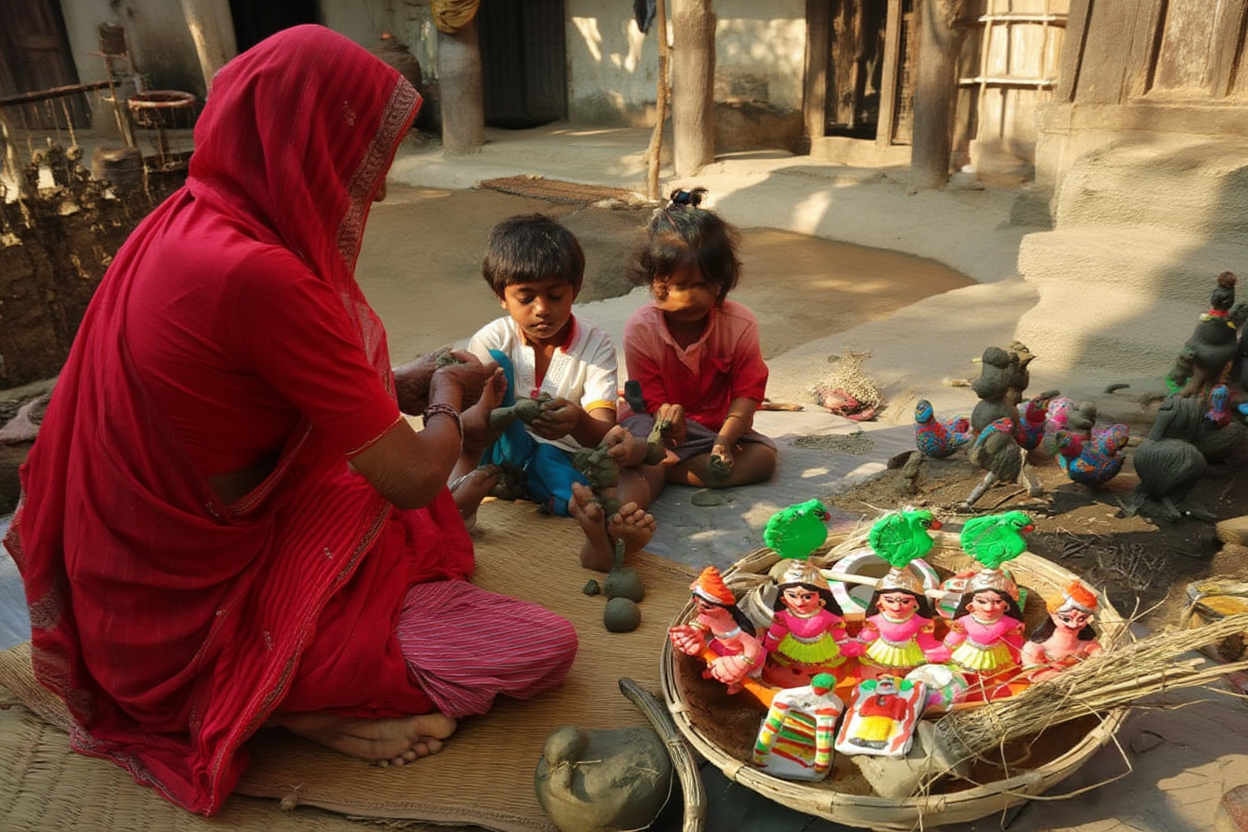
Clay figures at the centre: Inside the home, someone always makes the figures. Sama, Chakeva, and the other characters, all shaped from clay, are all set outside in the courtyard or a nearby shared spot. Those places feel different during the festival. The figures give them a purpose.
Learning through making: A child sitting down to shape a figure is not being taught the story. They are entering it. Grandmothers or aunts are nearby, and something passes between them not through words but through hands doing the same work side by side.
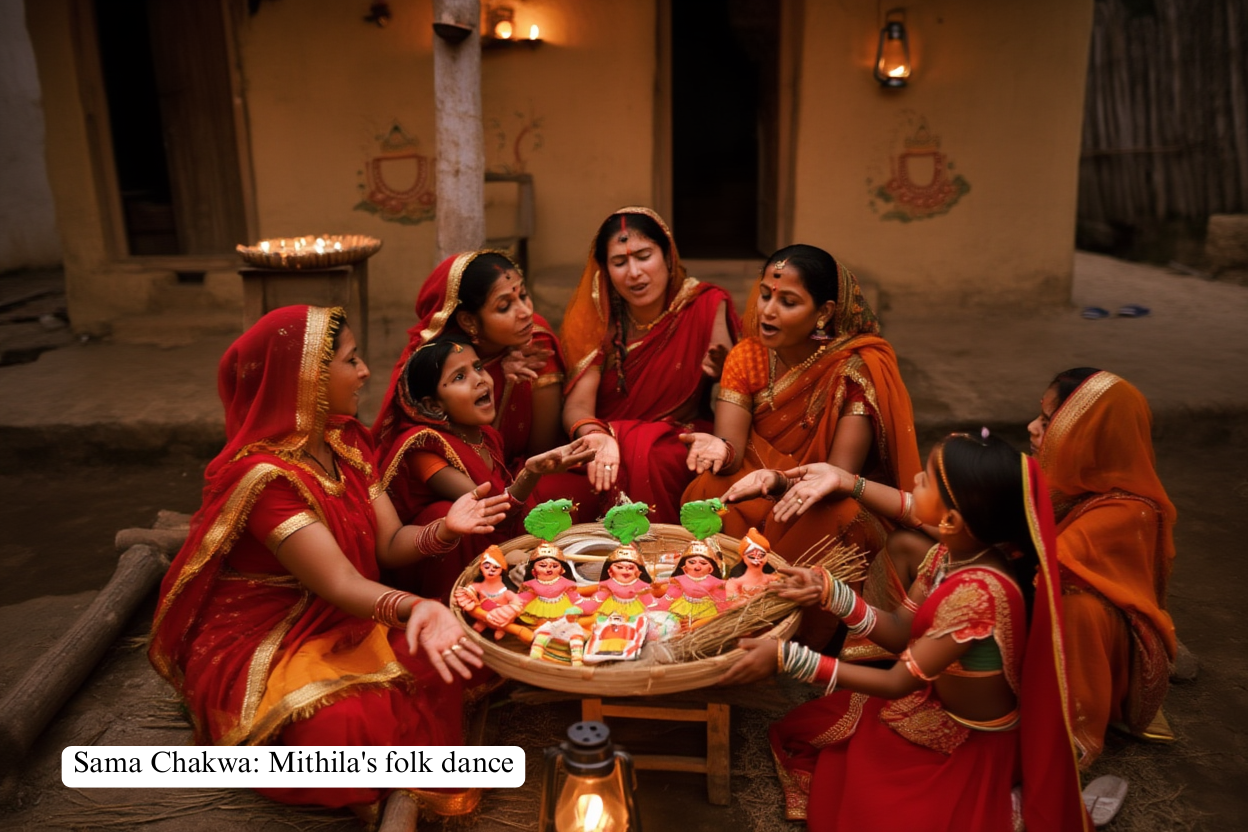
Folk songs as oral storytelling: Come evening, women and children gather to sing the Sama Chakeva story, learning the songs by ear and through repetition, never from a written source.
Local variation and women's leadership: Those who have studied Mithila up close have found that the songs change slightly from one village to the next, with women doing the singing, the narrating, and the remembering.
Collective participation: Nobody just watches. Everyone present joins in, which reflects what Sama Chakeva actually is, something lived rather than performed.
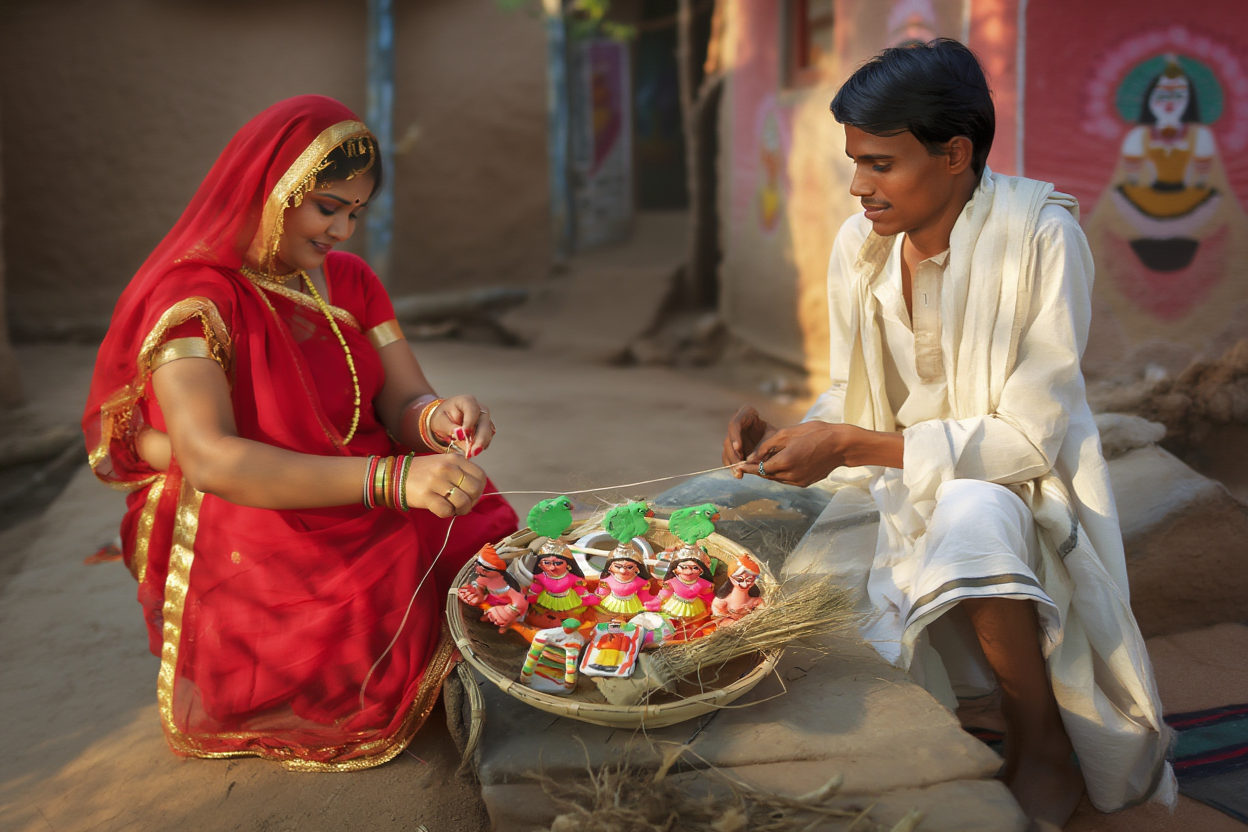
Celebration of the brother-sister bond: Clay work, singing, and shared ritual all keep the sibling relationship at the centre, pointing to what it means to protect, to stay loyal, and to remain connected across distance.
Endurance in a migratory context: Migration is a regular part of life here, and returning to these domestic practices each year helps keep emotional bonds alive across the distance, so relationships do not fade just because families are geographically apart.
Put it all together and you can see why Sama Chakeva has lasted. No institutions, no public platform, no formal support. It moves from one generation to the next through clay being shaped, songs sung quietly, and bonds renewed in the ordinary moments of home life, year after year.
Sama Chakeva in Domestic and Community Life
Sama Chakeva does not pull away from daily life. It runs through it. Courtyards, kitchens, the narrow spaces between homes, these are where it unfolds, the same places where everything else already happens.
Figures sit near doorways, songs come up while food is being cooked, and children pass between houses carrying bits of stories. Elders are close by, catching a wrong line and quietly correcting it or adding something forgotten without breaking the rhythm of the evening.
There is nothing that separates ritual time from ordinary time. Cooking, cleaning, singing, and telling stories happen together, which reflects something Mithila's culture holds to: culture is not a scheduled event; it runs through daily life.
Sama Chakeva lives mainly inside homes, but it reaches outward to the neighbourhood. People gather without planning, songs drift from one courtyard to the next, and stories pick up new voices as others join in. No one needs an invitation, and no one is left out. Participation is just assumed. That is how belonging works here.
Because of this, Sama Chakeva holds communities together without saying so. It refreshes trust, shared memory, and emotional ties in places where migration has long been a fact. The festival does not announce connections. It just quietly builds it, through songs and courtyards and evenings spent together.
Why Sama Chakeva Remains a Quiet but Enduring Tradition
Sama Chakeva has lasted because it has never tried to become a spectacle. It does not need money, promotion, or visual impact to survive. What keeps it going is closeness.
Researchers studying folk culture often point out that small domestic rituals led by women are among the hardest to displace, partly because they resist being turned into products.
What stands to be lost here is not just a festival. It is a whole way of passing culture on, rooted in homes and the relationships inside them.
Why Understanding Sama Chakeva Changes the Way You Travel Bihar
Once you understand Sama Chakeva, you start noticing domestic culture differently: songs in the evening, quiet stories, rituals that never show up on any public calendar.
Travel shifts. Seeing matters less. Listening matters more.
Where Chhath asks for public commitment and collective effort, Sama Chakeva asks for something quieter: patience, presence, and care for the things that connect people over time.
In Mithila, culture is not announced.
It gets sung, shaped, and passed along, one courtyard at a time.
Why Choose Folk Experience to Travel Bihar
Bihar travel is not about moving between destinations. It is about getting close to people, their habits, and the life they actually live. A folk-led approach is the only way in.
Here is what Folk Experience offers:
Because culture is lived, not staged: you go into homes and courtyards where festivals like Sama Chakeva unfold on their own terms.
Because relationships matter more than rituals alone: looking at sibling bonds tells you more about Mithila's social life than any monument could.
Because living traditions deserve support: Folk-led travel takes seriously the practices that survive through memory and participation, not institutions.
Because stories outlast images: You come away knowing something real, not just holding photographs.
Because travel works best when it slows you down: folk experiences put you in the position of listening, waiting, and paying attention.
Because understanding builds respect: When you travel through songs, stories, and domestic rituals, you do not just see Bihar. You begin to understand it.
A folk experience trades distance for depth, places for people, and movement for meaning.
That is how Mithila shows itself: not loudly, but gently, through the songs sung in its courtyards.
keep wandering