Saurath Sabha: The Field Where Mithila's Marriages Are Made
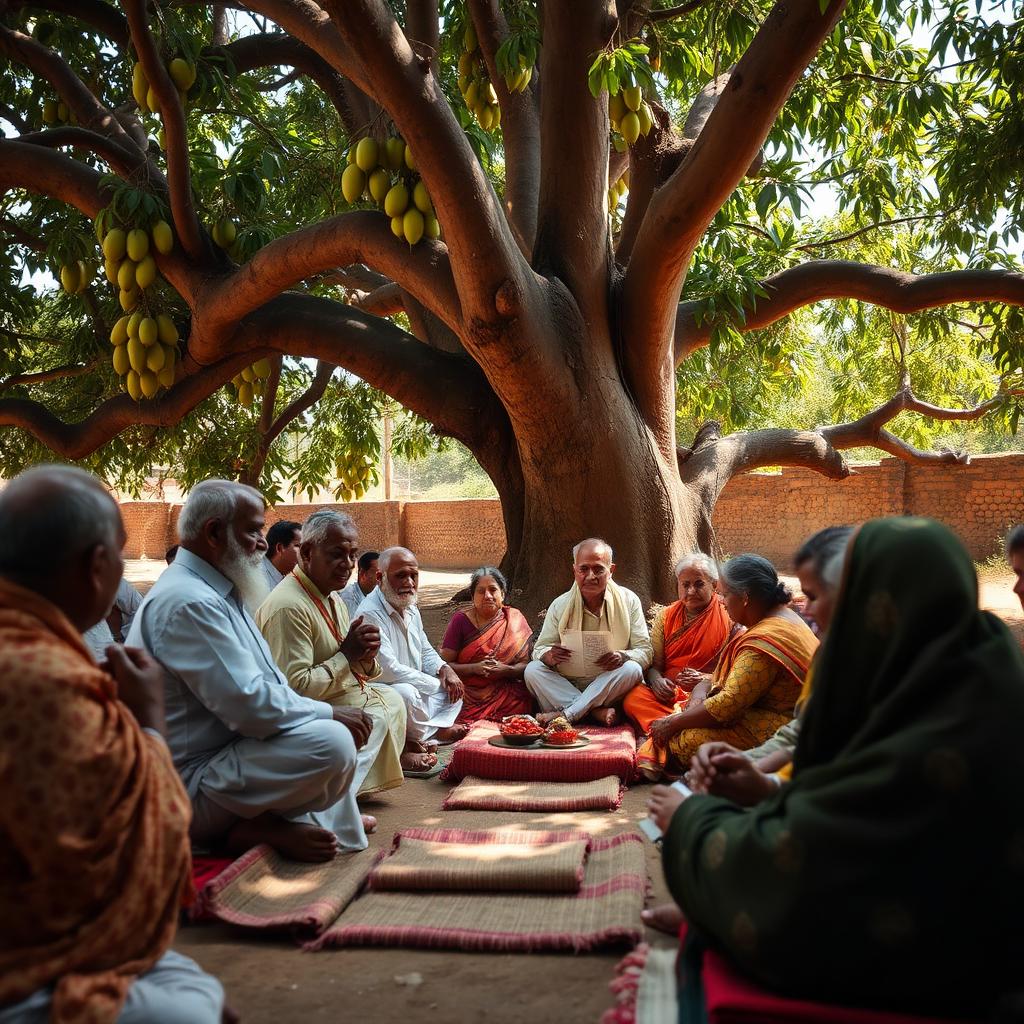
Six kilometres northeast of Madhubani, in a 22-acre mango orchard that the Maharaja of Darbhanga donated for this specific purpose, men sit on rugs and carpets in the June heat with their fathers, their uncles, and their panjikars.…
Folk Editorial
Folk Experience
Meet your AI Story Guide
Turn this field note into a one-minute brief with the essential places, people, and traditions.
Six kilometres northeast of Madhubani, in a 22-acre mango orchard that the Maharaja of Darbhanga donated for this specific purpose, men sit on rugs and carpets in the June heat with their fathers, their uncles, and their panjikars. Prospective grooms on one side. The fathers and brothers of prospective brides are moving between groups, consulting, enquiring, and comparing genealogical records. Vendors selling local snacks on the margins. Elders speaking in Maithili, the language of this specific stretch of the Bihar-Nepal corridor, discussing lineages that go back seven generations on the father's side. This is Saurath Sabha. It has been happening here, in this orchard, in some form, for over seven hundred years. Before the matrimonial app. Before the biodata. Before the newspaper advertisement. Before any of the mechanisms that contemporary India uses to organise the most consequential social transaction in most families' lives. FACT: Saurath village was originally named Saurastra, meaning a cultural and intellectual centre associated with the ancient Mithila king Janaka, whose daughter Sita's Swayamvara is said to have taken place here. The Sabha that now convenes annually in the village's mango orchard takes its name and its legitimacy from this mythological origin. Archaeological surveyor Alexander Cunningham visited Saurath in the 1870s and documented a copper plate inscription of Raja Shiva Singh from the 14th century, confirming the village's historical significance.
What the Sabha Actually Does
Saurath Sabha is not a wedding fair. There are no banners, no microphones, no sponsored stalls. It is a functional gathering of the Maithil Brahmin community convened for a specific purpose: arranging marriages within the kinship rules that the community has maintained for centuries.
Those rules are strict. A marriage must avoid blood relations for seven generations on the father's side and five generations on the mother's side. In a region where families have been intermarrying within the same caste community for centuries, across a relatively contained geography, this is not a simple calculation. It requires records. It requires people who know how to read those records. It requires the panjikars.
The panjikars are hereditary genealogists, men from families whose specific function has been to maintain the Panji, the genealogical record of Maithil Brahmin families, across generations. These records, maintained on cloth, paper, and in some cases palm leaf, document births, deaths, marriages, and migrations within the community. A panjikar does not merely hold a record. He holds the social memory of the community, updated continuously and consulted at every Sabha.
When a family approaches a panjikar at Saurath, the process begins with the panjis being cross-referenced for both families. If the genealogies are compatible, the families can proceed with discussions. If not, the conversation ends there, without rancour, because the rule is understood as protecting the community rather than obstructing individual preference.
FACT: Two decades ago, the Saurath Sabha Gachhi, the orchard where the event is held, attracted more than 100,000 people from across India and Nepal during the Jyeshtha-Ashadha gathering. Participation has declined significantly since then, with migration, urbanization, and digital matchmaking platforms drawing younger generations away from the tradition. The Mithilalok Foundation has been working to revive the Sabha, organizing walks from Madhubani to Saurath and intellectual gatherings alongside the matchmaking.
The Honest Account
Saurath Sabha is not a tradition that can be described without its contradictions.
The process is structured around male agency. Prospective grooms sit on display. The fathers and brothers of prospective brides do the selecting and negotiating. Women are largely absent from the visible proceedings, their preferences filtered through male family members. The dowry system, which the Sabha historically accommodated and in some cases reinforced, has been a source of significant criticism. The Sabha's exclusivity to Maithil Brahmins means its function is inseparable from the caste structure that has organized social life in this region for centuries.
These are not peripheral critiques. They are central to what the Sabha is. A traveler who visits Saurath during the Sabha and sees only the ethnographic interest of an ancient institution is missing half the picture.
What the Sabha also is, alongside its contradictions, is one of the most sophisticated community-managed social systems in India. The panjikars' genealogical knowledge constitutes a form of data management that predates the printing press and has maintained accuracy across centuries through oral transmission and continuous updating. The community's ability to enforce kinship rules without any formal legal structure, relying entirely on shared knowledge and social accountability, is a governance achievement of genuine interest.
FACT: The panjikars who maintain the genealogical records at Saurath face a succession crisis. Younger members of Panjikar families are less invested in learning the genealogical documentation that their predecessors maintained. Digital databases have been proposed as a preservation solution, but many panjikars resist, arguing that the trust that makes the system function depends on personal transmission rather than algorithmic matching.
What Mithila Reveals at Saurath
The orchard at Saurath is six kilometres from Madhubani, which means a visitor to one of the most famous Madhubani painting centres in Bihar is six kilometres from one of the most unusual social institutions in India. Most visitors to Madhubani do not make the connection.
For a traveller who arrives in Mithila during the Jyeshtha season, which is May and June, the Sabha offers something that no museum or heritage site can replicate: the sight of a community conducting its social business through the mechanisms it has built and maintained across seven centuries. The elders are consulting records on the ground. The panjikar moves between family groups with the specific authority of someone whose family has held this function for generations. The conversations in Maithili that are not for the visitor's benefit but are happening because this is the work the community comes here to do.
This is not a performance. It is a living institution in the process of deciding whether it will survive the next generation, and attending it with that understanding in mind is a different experience from attending it as a colourful cultural curiosity.
Why Folk Experience for Saurath Sabha
Saurath Sabha requires context that no guidebook provides and that most local guides are not equipped to give. The difference between observing the Sabha and understanding it is the difference between watching people talk in a field and seeing how a community's social memory, kinship rules, and collective accountability converge in a specific place at a specific time of year.
Folk Experience facilitates the Saurath Sabha visit as a cultural encounter rather than a heritage sighting.
Meeting panjikars before the Sabha and understanding the Panji system, what records they maintain, how they verify lineage, and why the community trusts their authority over centuries of accumulated knowledge
The Sabha visit with context, with guides who can explain what the different groups on the ground are doing, what stage of the matchmaking process specific conversations represent, and what the genealogical consultation looks like when it happens
Conversations with participants, facilitated with sensitivity and appropriate permission, including families who continue to find the Sabha valuable and younger Maithils who are navigating the tension between community expectation and individual preference
The wider Madhubani connection, combining the Saurath Sabha visit with the Madhubani painting tradition that comes from the same cultural world, giving the visit the depth of a community encounter rather than a single-site stop
Mithila does not reveal itself quickly. But the orchard at Saurath, during the Jyeshtha gathering, is one of the places where it reveals itself most honestly.
Folk Experience will take you there, prepared to receive what it offers.
Subscribe to our newsletter
Folk Experience © 2026 – All Rights Reserved
keep wandering