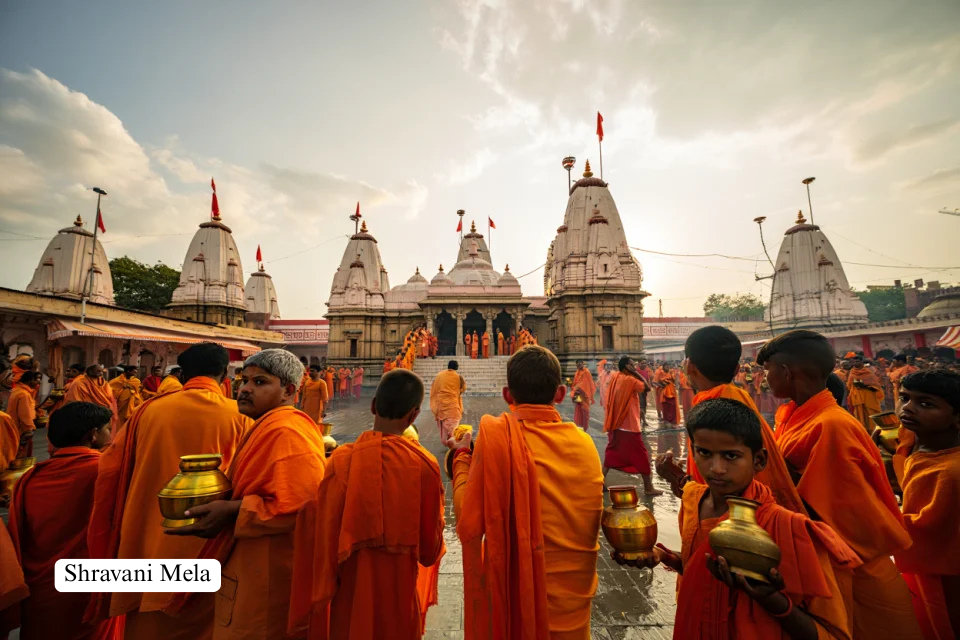
Shravani Mela: Devotion, Movement, and Endurance
In Bihar, devotion is not always expressed by standing still. Occasionally, it is expressed by walking slowly, repeatedly, and together. The Shravani Mela is one such expression of faith, where belief is carried not in symbols alone, but in bodies in motion. Observed during th...
Meet your AI Story Guide
Turn this field note into a one-minute brief with the essential places, people, and traditions.
Why Shravani Mela Matters to Bihar’s Cultural Life
What Shravani Mela does to the idea of worship is significant. It takes faith off the altar and puts it in the body. The devotee does not offer prayers from a fixed point. The devotee walks. The act of moving, fasting, restraining yourself, carrying water for days across difficult terrain: these are the offering. The distance covered is not incidental. It is the point.
The mela draws people across caste, class, and region, and while they walk, those distinctions largely fall away. Everyone walks the same roads. Everyone follows the same discipline. The social equality this produces is not symbolic. It is lived, hour after hour, on the same road.
In Bihar, a state shaped by agricultural labour and seasonal migration, there is a kind of familiar logic to this. Progress comes through sustained effort. That understanding runs through the culture, and Shravani reflects it.
Shravan Month: Monsoon, Time, and Ritual Rhythm
Shravan, the month when the mela takes place, is the heaviest part of the monsoon season. Humidity is high, roads are often waterlogged, and the physical conditions make everything harder. That is not an accident. Shravan is traditionally a period of restraint and fasting, and the conditions of the season reinforce that. Nature participates in the ritual by making the journey demanding.
The Kanwariya Journey: Walking as Worship
The Kanwariya pilgrimage begins at the Ganga, most often at Sultanganj, where pilgrims collect holy water in containers balanced on their shoulders. They then walk to offer that water at Shiva shrines, above all at Deoghar. The most common route covers roughly 105 kilometres. Many walk barefoot. Along the way, chanting replaces conversation. Fasting replaces meals. Movement replaces rest. The journey is its own form of prayer.
Distance, Discipline, and the Body
Shravani is physically hard. Pilgrims typically cover 15 to 25 kilometres a day. Blisters, dehydration, and fatigue are expected rather than exceptional. They are absorbed rather than dramatised. The body becomes an instrument of devotion here rather than an obstacle to it.
Collective Movement and Shared Discipline
Walking alone is rare. Groups form organically from friends, neighbours, or strangers who happen to share the same pace. The stronger help carry things. First-timers get guided. Nobody is left behind. Discipline is maintained not through authority but through quiet, collective correction. The group holds the standard without any single person having to enforce it.
Routes, Ghats, and Sacred Geography
The route is lined with ghats, small shrines, and rest points that punctuate the journey. These are not scenic stops. They are markers in a landscape that has been made sacred by the accumulated movement of millions of pilgrims over generations. The land is not a setting for the ritual. It is part of it.
Temporary Settlements and Living Infrastructure
For the duration of the mela, a temporary city forms along the route. Food stalls, medical camps, water points and rest shelters are operational 24 hours. Local people provide services and earn seasonal income. When the mela ends, this infrastructure disappears without a permanent trace. The economy it created, and the devotion it supported, carries on in other forms.
Shravani Without Spectacle
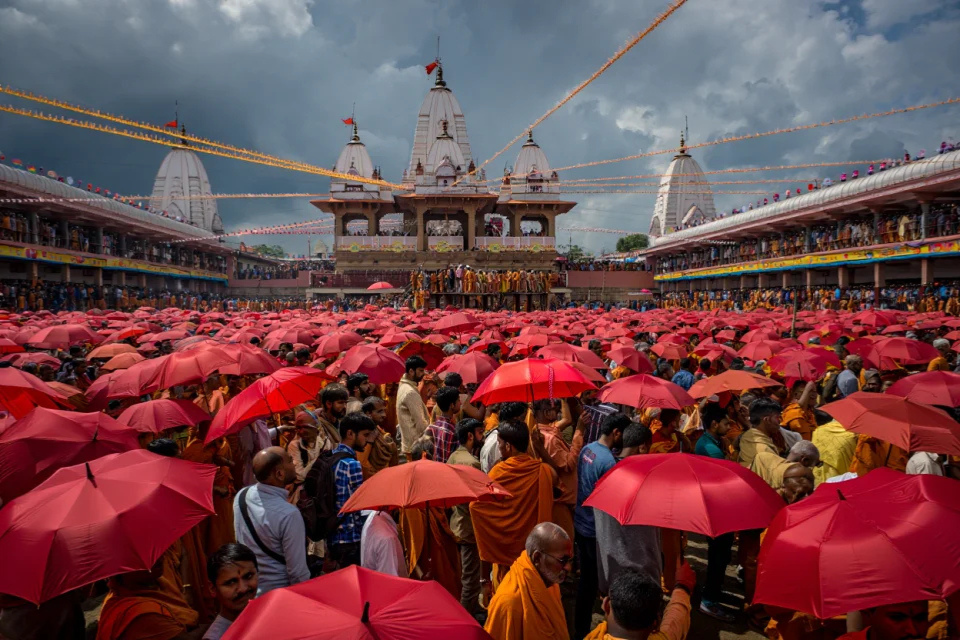
Shravani Mela happens at an enormous scale: millions of pilgrims on the road at the same time, spread across hundreds of kilometres. What is striking is how completely that scale fails to produce spectacle. There are no stages, no performances, no viewing areas. There is nothing to watch from the outside. The only way to engage is to participate. You walk, or you wait on the side of the road.
This is deliberate. The ritual is designed to keep attention directed inward: to the body, to the effort, to the act of carrying something sacred across difficult terrain. The moment Shravani is set up for an audience, it stops being Shravani. Even the administrative infrastructure exists only to support the walking: medical care, water, sanitation. Nothing is there to create visual interest. The journey stays unmediated, which is what has kept it intact across generations.
What Shravani Reveals About Faith in Bihar
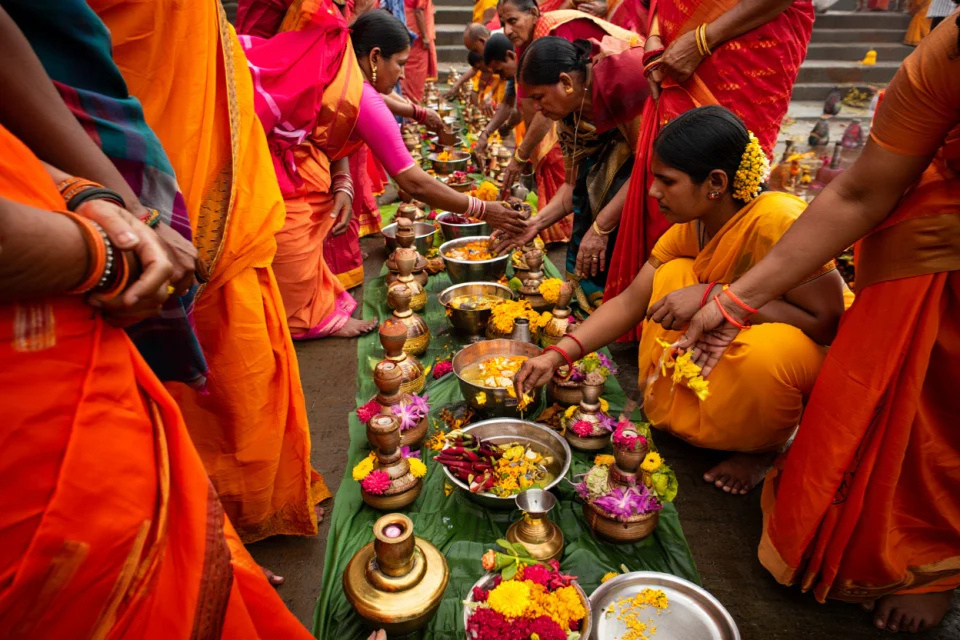
Shravani works from a specific understanding of what devotion is. It is not feeling. It is not declaration. It is a set of actions carried out consistently under difficult conditions. Walking, fasting, restraint, endurance: these are the practice. The belief is expressed through the body, not the tongue.
In Bihar, where agricultural labour shapes how people understand work, this kind of devotion feels familiar. Effort is not considered incidental to the outcome. It is often the point. Shravani reflects that ethic. You do not arrive at faith. You build it, step by step, over the course of the journey.
People walk together and hold the standard collectively. Nobody leaves anyone behind. That collective care is part of what makes individual devotion into community practice. In Bihar, faith often moves at walking speed, because that is the pace at which something real gets built.
Why Understanding Shravani Changes the Way You Travel Bihar
When you understand what Shravani is asking of its participants, the act of travelling alongside it changes. You learn to move carefully. You learn when stepping back is more respectful than stepping in. You learn that some journeys are not invitations to join, and that watching from a respectful distance is its own form of understanding.
Just as Sonepur shows how Bihar's economy is organised and Pitrapaksha shows how duty runs across generations, Shravani shows how endurance structures belief. It asks you to recognise effort as something sacred and movement as something with meaning beyond geography.
In Bihar, devotion does not always arrive somewhere. Sometimes the journey is the whole offering.
Why Choose Folk Experience to Travel Bihar
Travelling in Bihar is not about ticking destinations off a list. It is about understanding people, practices, and everyday life. That is where a folk-led approach makes all the difference.
Folk Experience lets you travel. Bihar differently:
Because culture is lived, not staged: Folk experiences respect journeys that are practised, not performed.
Because faith is felt through movement: Understanding Shravani means understanding the value of effort.
Because local livelihoods matter: Folk-led travel acknowledges the economies that sustain pilgrimages.
Because stories stay with you longer than images: You leave with real understanding.
Because travel should slow you down: Folk experiences encourage patience, care, and presence. Because knowing is respecting: When you travel with faith and work, you don’t just see Bihar. You begin to know it.
To choose a folk experience is to choose depth over distance, people over places, meaning over movement.
That is how Shravani reveals itself: not as a festival to be seen but as devotion on the move.
keep wandering