Sikki Craft: Bihar's Golden Grass Handicraft
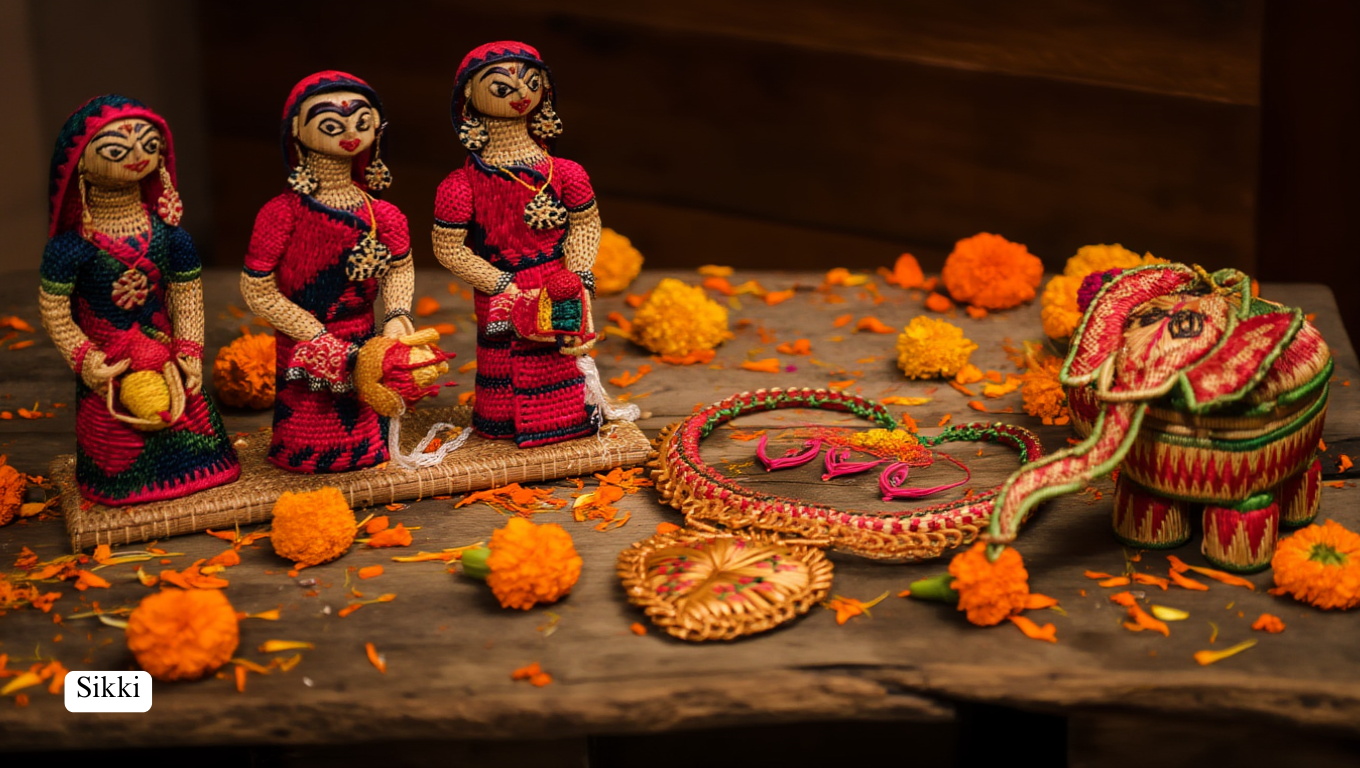
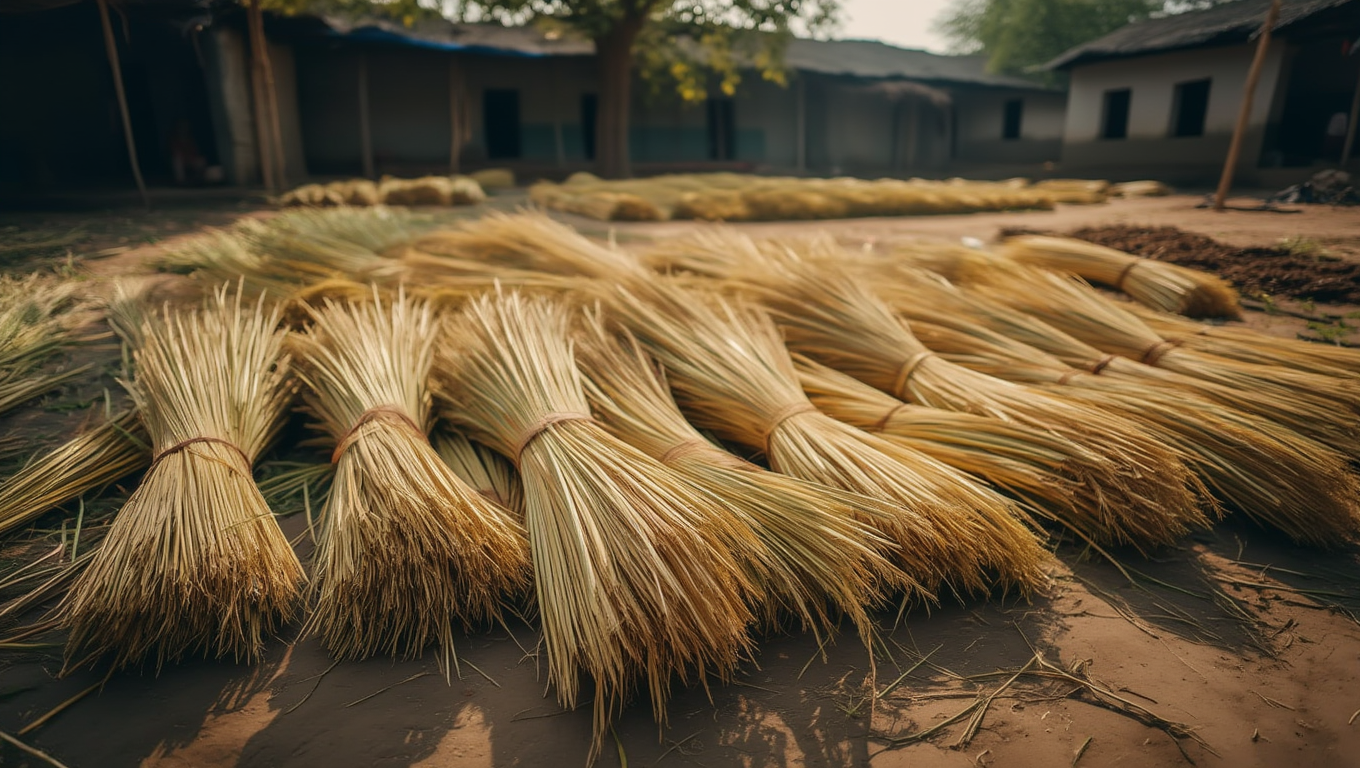
In the waterlogged fields of north Bihar, after the monsoon has receded and the ground is drying toward the winter season, women harvest Sikki grass. The grass is golden when dried, a warm amber that does not require dyeing to be beautiful, and it grows in the specific conditi...
Meet your AI Story Guide
Turn this field note into a one-minute brief with the essential places, people, and traditions.
The Grass and What It Becomes
Sikki, known botanically as Scirpus grossus, grows in marshy and waterlogged terrain, which is precisely the terrain that characterizes the northern districts of Bihar along the Nepali border: Sitamarhi, Darbhanga, Madhubani, and parts of Muzaffarpur. The grass reaches maturity after the monsoon, when the waterlogged conditions that allowed it to grow begin to recede. Harvesting happens in autumn; the cut grass is dried in the sun over several days, and the dried stalks are then split and prepared for weaving.
FACT: Sikki grass, Scirpus grossus, is a sedge species found primarily in the waterlogged terrain of north Bihar and parts of the Nepal Terai. Its natural golden color comes from the silica content of the dried stalks, which also gives the finished objects their characteristic smooth, slightly lustrous surface. The craft is concentrated in the Mithila region because the specific ecological conditions that produce Sikki grass in abundance are concentrated there, making the craft inseparable from the landscape that makes it possible.
The preparation of the grass for weaving involves splitting the dried stalks into fine strips, which are then soaked briefly to restore flexibility before use. Natural dyes, derived from plant sources, are used to color portions of the grass when the design requires it, but the natural golden tone of undyed Sikki remains the dominant color in most traditional objects. The dyeing, where it happens, is done with restraint: a few colored strips woven into a pattern against the golden ground, rather than an all-over color treatment that would obscure the material's own character.
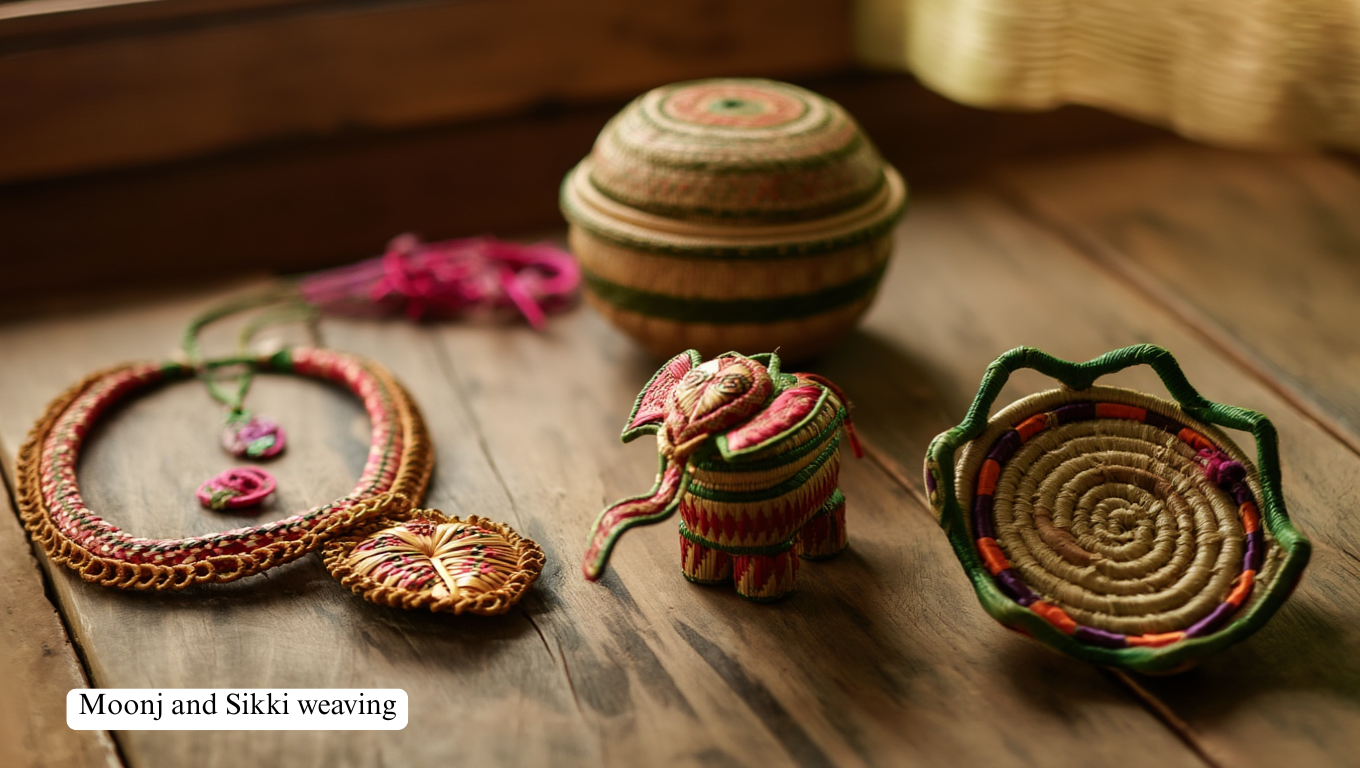
The weaving is entirely by hand, without any mechanical assistance. The technique is a coiling and binding method in which a core of grass is wrapped with binding strips and coiled into the intended form, with each new coil stitched to the previous one through the binding strip. The control required is entirely tactile: the tightness of the binding, the consistency of the coil diameter, and the evenness of the stitching all depend on the weaver's hands and their accumulated knowledge of how the material behaves.
What Sikki Makes and What It Is For
The objects that Sikki craft produces fall into the same two categories as Bihar's terracotta: the domestic and the ritual, with significant overlap between them.
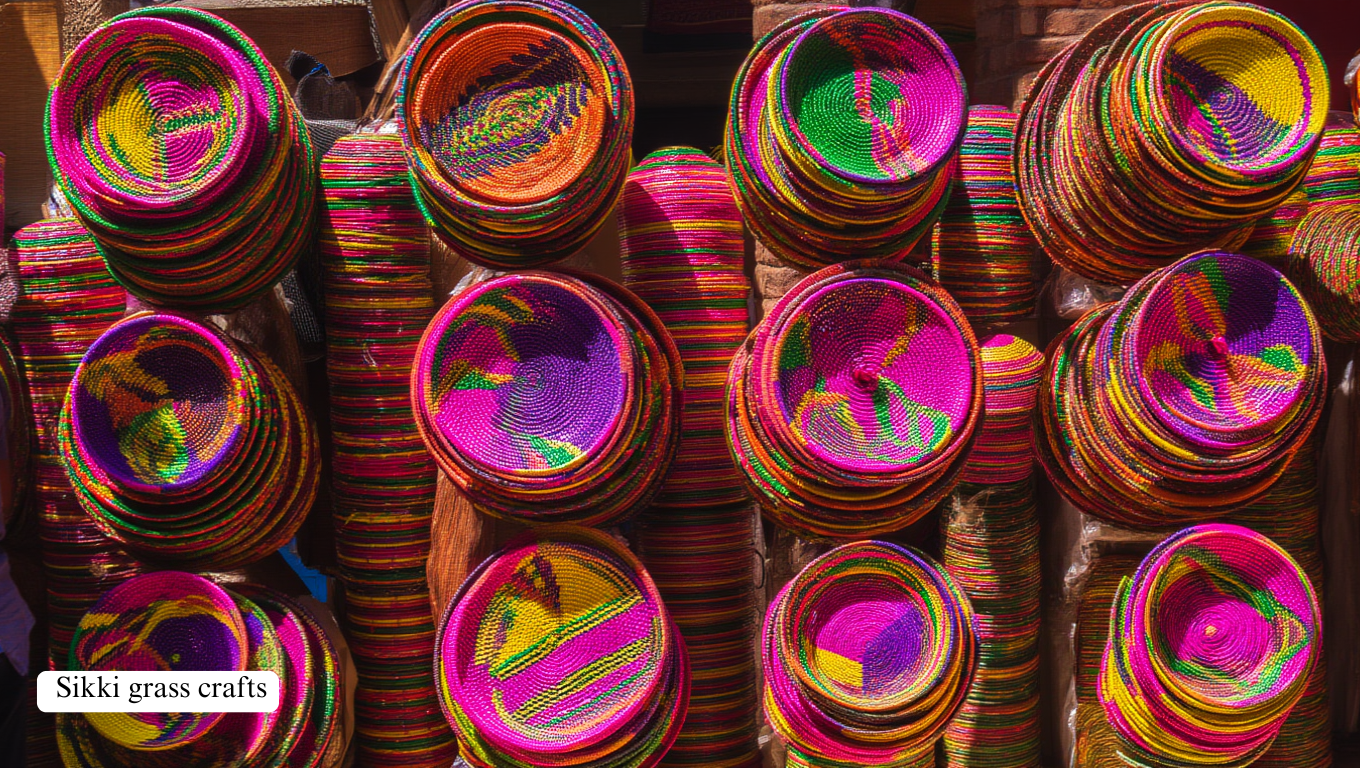
The domestic objects are primarily containers: baskets for storing grain or vegetables, boxes with fitted lids for keeping small valuables or paan ingredients, and trays for serving or carrying food. These are functional objects, made to be used daily, and their durability is one of the Sikki tradition's consistent virtues. A well-made Sikki basket, stored reasonably and used regularly, will last for years. The weave is tight enough to hold fine materials without spillage, and the natural properties of the dried grass make it naturally resistant to insects and moisture in the moderate conditions of a Bihar household.
The ritual objects are concentrated around the wedding tradition. Sikki items are considered auspicious gifts in Mithila's marriage culture, and the preparation of Sikki objects as part of a daughter's trousseau is a practice that connects the craft directly to the social institution that organizes Mithila's community life. The objects given at a wedding are not merely gifts. They are material expressions of care, skill, and the mother's wish that the daughter's new household will be one of abundance and continuity.
FACT: In Mithila's wedding tradition, Sikki craft objects are among the items included in the Daiji, the gifts from the bride's family that accompany her to her husband's household. The inclusion of handmade Sikki items in the daiji reflects the tradition's valuation of the bride's family's skill and care as much as their economic resources. A Daiji with beautifully made Sikki objects has historically been understood as evidence of the bride's own skill and the quality of her upbringing, since women in Mithila traditionally learn Sikki weaving within the family.
The Women Who Make It
Sikki craft is women's work in the specific sense that it has always been learned by women, practiced by women, and transmitted from women to women within family settings. The knowledge does not pass through formal training institutions or craft guilds. It passes between generations in the same way that most domestic knowledge passes in Bihar: through observation, through doing things alongside, and through the gradual acquisition of skill that happens when a child grows up in a household where the skill is practiced daily.
Most Sikki weavers work from their homes, fitting the craft into the spaces of the day that the agricultural work and the domestic responsibilities leave available: the early morning before the fieldwork begins, the midday rest period, and the evening after the cooking is done. The craft is not a separate professional identity that requires a separate space or a separate schedule. It is part of the texture of daily life in the same way that the agricultural work is part of the texture of daily life.
The income that Sikki generates for women artisans is typically supplementary rather than primary, which is both a limitation and a feature of the craft's position in the household economy. It is a limitation because it means the craft is economically marginalized, its labor undervalued relative to the skill and time it requires. It is a feature because it means the craft can be maintained even when the primary agricultural income is under pressure, providing a resilient supplementary income source through the same seasons when agricultural income is least reliable.
FACT: Sikki craft has been promoted through several state and national artisan development programs, including the Craft Development Institute in Srinagar, which has worked with North Bihar's Sikki artisans on design development and market access. Despite these interventions, the income of individual Sikki weavers remains substantially below what the retail price of their objects would suggest, reflecting the same structural middlemen economics that affect most traditional craft traditions in Bihar and across India.
The Market and Its Complications
The market for Sikki craft has expanded beyond the local weekly market and the wedding trousseau economy in recent decades, with urban design markets and craft fairs creating new demand for objects that are valued precisely for their handmade quality and natural material. This expansion has brought both opportunities and complications.
The opportunity is straightforward: higher prices in urban markets mean higher potential income for weavers if the supply chain between producer and buyer is short enough. The complication is equally straightforward: the supply chain is rarely short enough. Intermediaries who buy Sikki objects from weavers at the local market price and sell them in urban craft fairs at multiples of that price capture the value that the expanded market creates. The weaver's income does not increase proportionally to the increased price the object commands at its final point of sale.
The competition from machine-made alternatives affects the functional end of the Sikki market more than the ceremonial end. A plastic basket is cheaper than a Sikki basket and serves the same storage function for buyers who are making a purely economic calculation. For buyers who understand what the Sikki basket is, how it is made, what skill it represents, and what cultural tradition it belongs to, the comparison is not between a cheap basket and an expensive basket but between an object with a story and an object without one.
Engaging With Sikki as a Traveller
The Sikki craft is most directly accessible in the villages of the Mithila belt, particularly in the districts of Sitamarhi, Madhubani, and Darbhanga, where the craft is still practiced in domestic settings rather than in craft centers organized for visitor access.
The weekly markets in these districts include sections where Sikki weavers sell directly, and the prices at these markets reflect the actual economics of the craft rather than the premium that urban retail or craft fair contexts add. Buying Sikki at the source, from the weaver who made it, is both the most economically fair option for the weaver and the most culturally meaningful option for the buyer.
Folk Experience designs North Bihar itineraries that include time in Sikki weaving households, with the opportunity to watch the preparation and weaving process; to understand the seasonal availability of the material and how it structures the craft calendar; and to have the conversations with women weavers about the economics of the craft and about what their mothers taught them and what they are teaching their daughters, which give the objects their full meaning.
A Sikki basket bought at an airport craft shop is a different object from a Sikki basket bought from the woman who made it, in the village where she made it, with the understanding of what it cost her in time and skill and accumulated knowledge. Folk Experience makes the second kind of encounter possible.
Come to where the grass grows. The craft will make sense from there.