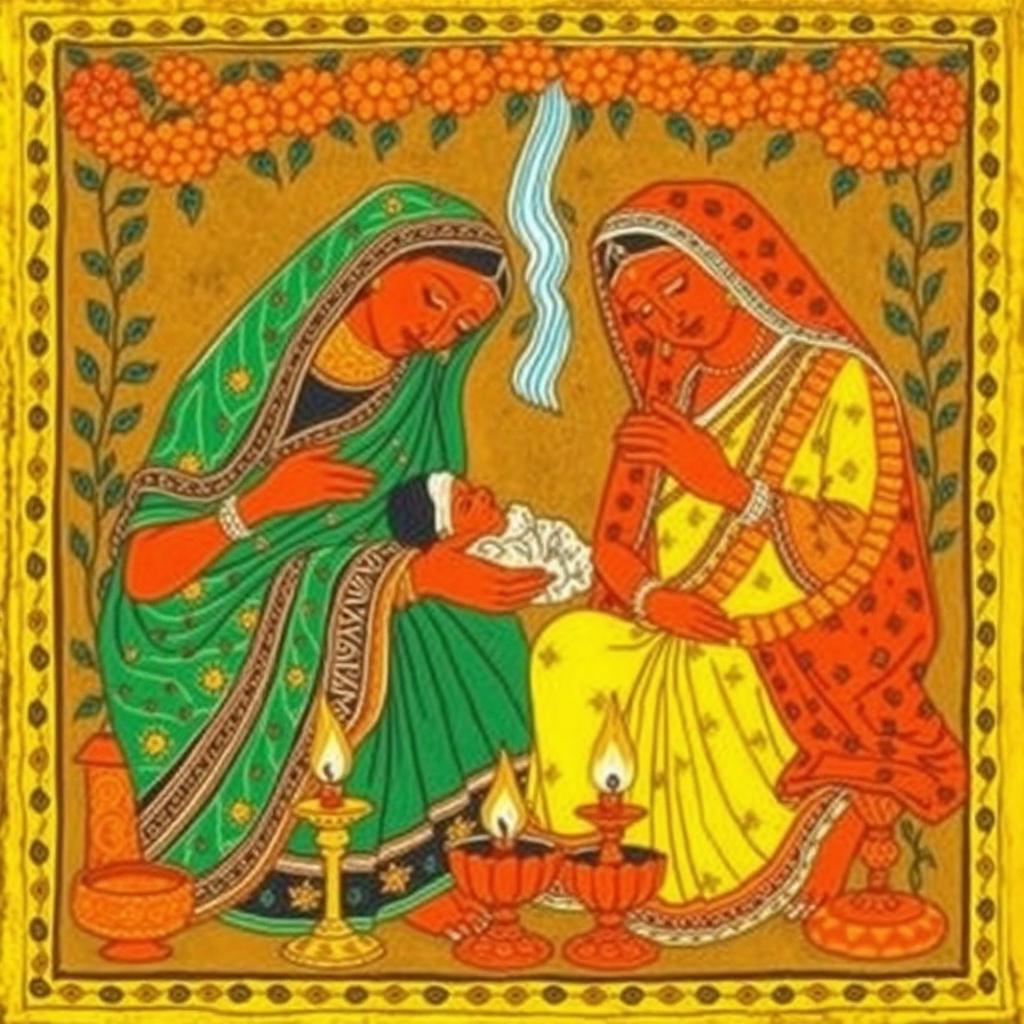
Sohar Khilouna and Domkach: Bihar's Women's Rituals of Birth & Marriage
They happen inside homes, in courtyards lit by oil lamps, and in rooms where women have gathered since before anyone can remember, their voices carrying the weight of what needs to be said at the moments when ordinary language is not…
Folk Editorial
Folk Experience
Meet your AI Story Guide
Turn this field note into a one-minute brief with the essential places, people, and traditions.
They happen inside homes, in courtyards lit by oil lamps, and in rooms where women have gathered since before anyone can remember, their voices carrying the weight of what needs to be said at the moments when ordinary language is not enough. A child arrives in the world. A daughter leaves her parental home. These are the transitions that define a life, and in Bihar, they are not marked with silence or clinical efficiency. They are marked with song. Two traditions carry this responsibility. Sohar Khilouna accompanies birth, women gathering around a newborn to sing blessings, invoke protection, and welcome the child into the web of family and community. Domkach accompanies weddings; women perform rhythmic clapping and singing that blesses the bride; teases the groom's family; negotiates new social relationships; and holds the multi-day ceremony together with a thread of collective female voice. Neither is a performance in the conventional sense. Neither requires a stage, a ticket, or a professional artist. Both require women who know the songs, women who know why the songs matter, and a community that still understands that some things cannot happen properly without them. "In Bihar, culture does not wait for an audience. It gathers when life requires it, in the rooms and courtyards where life's most important work is done."
Sohar Khilouna: Singing a Child Into the World
When a child is born in rural Bihar, the home changes character. It becomes, temporarily, a ritual space. Women arrive, not just to help but to perform a specific and necessary function: to sing the child into existence, to create around the newborn a sound environment of blessing and protection that the community understands as essential to the child's safe arrival in the world.
Sohar songs are devotional, domestic, and deeply personal simultaneously. The lyrics address the child directly, welcoming them, describing their beauty, and expressing the family's joy. They honor the mother's labor. They petition Shashthi Devi, the goddess associated with childbirth and child protection, for continued blessings. And they connect the newborn to the ancestors whose continuity the child represents, threading the new life into the long chain of the family's history.
The melodies are simple and repetitive by design. Sohar is not performed by trained singers. It is sung by whoever is present: elderly matriarchs who have witnessed dozens of births, young mothers experiencing their first, and neighbors who arrived to offer support. The simplicity allows everyone to join, transforming individual voices into a chorus and individual presence into collective care. The dance movements that accompany the songs are minimal and gentle, small swaying circles and rhythmic clapping that serve the ritual intention rather than any aesthetic ambition.
Sohar Khilouna is exclusively a women's domain. Men are typically absent from the birthing space and the rituals immediately surrounding it. This is not simply a restriction. It is a form of authority. Elder women lead, deciding which songs are sung and ensuring the ritual is performed correctly. The knowledge is transmitted entirely through oral participation, absorbed by young girls over years of attendance before they eventually join as singers themselves.
The tradition is under significant pressure from the medicalization of childbirth. As government health programs encourage institutional births, the extended domestic rituals that Sohar requires become harder to perform. Hospitals do not accommodate gatherings of women singing over newborns. For many families, Sohar is now performed when the mother and child return home, the ritual adapted to new circumstances rather than abandoned entirely. In rural areas where home births remain common, the tradition persists in its fuller form. In urban settings, it survives in abbreviated versions that maintain the intention, if not always the full ceremony.
What it protects, in either form, is something that institutional childbirth cannot provide: the sense that the child has arrived not just medically but socially, welcomed not just by their parents but by the community of women whose voices have created the sound of belonging.
Domkach: The Women Who Make a Marriage Real
A Bihar wedding without Domkach is considered incomplete. This is not sentiment. It is a social expectation, enforced by the communities that participate in weddings and noticed when it is absent.
Domkach is performed at multiple stages of the wedding process: during the Haldi and Mehendi ceremonies in the pre-wedding days, when the groom's procession arrives at the bride's home, during the bride's Bidaai departure, and in the post-wedding gatherings that continue the celebration. The tradition's presence throughout the entire sequence means it is not a standalone performance but the connective tissue that holds the wedding's various ritual moments together.
The physical form of Domkach centers on clapping, complex syncopated patterns in which women strike their own hands together and the hands of the women beside them, creating a collective percussion that drives the songs. The movements are simple but physically demanding and sustained over long periods, and the sound produced by a group of women clapping in coordinated rhythm has an energy that no instrument quite replicates.
The songs are what make Domkach distinctive within the landscape of Indian wedding traditions. They are not uniformly celebratory or reverential. They are frequently sharp, humorous, and satirical. The bride's family sings songs questioning whether the groom is worthy, whether his family will treat the bride well, and whether the gifts they have brought are adequate. The groom's family responds with songs defending their honor and dismissing the criticisms. This ritualized back-and-forth allows tensions and anxieties that formal wedding ceremonies cannot accommodate to be expressed and resolved through performance. It is conflict management through song, and it is extraordinarily effective.
The social bonding function of Domkach extends beyond the immediate wedding. For women who have married into other families and moved away from their birth homes, participating in Domkach at a wedding is a return, an opportunity to be recognized as still belonging to the family they came from. For women from different families who are now connected through the marriage, performing Domkach together is the beginning of a relationship that the formal ceremonies initiate but the songs make real.
Elder women hold central authority in Domkach. They know the songs, lead the performances, and adapt the lyrics to the specific families and circumstances involved. The improvisational quality that this produces means that no two Domkach performances are identical. The tradition is alive, responsive to the particular social situation in which it is performed, capable of incorporating contemporary references and current social commentary while maintaining its core structure and ritual function.
Domkach persists in urban weddings even as other traditional elements fade, because the need it serves, the need for women's collective voice to claim space in the celebration, to negotiate new relationships, and to bless the bride's departure with both joy and honesty, is a need that contemporary alternatives cannot adequately meet.
What the Two Traditions Share
Sohar Khilouna and Domkach are rooted in different life moments, birth and marriage, and carry different emotional registers. One is intimate and protective, gathered around a newborn in the quiet of a domestic interior. The other is assertive and communal, performed in courtyards and gathering spaces with the confidence of women who know their presence is necessary.
But both traditions share what makes them worth understanding as a traveller in Bihar.
Both are exclusively women's domains, spaces where female authority is not contested or conditional but structural and expected. Both are transmitted through oral participation rather than formal instruction, living in the bodies and memories of women who learned by being present and disappearing whenever that chain of presence is broken by migration, urbanization, or the substitution of professional entertainment for community practice.
Both resist the categories that cultural tourism tends to apply to folk traditions. They are not picturesque. They are not staged for appreciation. They are functional, serving specific social and spiritual needs at specific moments in people's lives, and their value is inseparable from their function. A Sohar performance that is not sung over an actual newborn by women who actually know the family is a demonstration of Sohar, not Sohar itself. A Domkach performance at a festival is an extraction of the form from the context that gives it meaning.
Both are also negotiating the same pressures: the breaking of extended family networks by migration, the substitution of hospital births for home births, the preference of younger generations for Bollywood and DJ culture over folk traditions, and the absence of institutional support for traditions that happen inside homes rather than on public stages.
traveler
What survives does so because women in rural Bihar continue to understand that these things need to happen, not because someone decided to preserve them, but because the occasions that require them, birth and marriage, continue to occur and continue to require the specific kind of collective attention that these traditions provide.
How to Engage as a Traveller
Both Sohar Khilouna and Domkach are domestic traditions performed at private family occasions. Neither is accessible through a tour booking or a cultural event listing. Encountering them requires either the right relationship or the right introduction.
Folk organizations working with Bihar's communities, or a culturally grounded guide with genuine connections in rural areas, can facilitate introductions to families willing to share these traditions with a respectful visitor. In some cases, it may be possible to attend a wedding where Domkach is performed, as Bihar's wedding culture has a tradition of community inclusion that can extend to well-introduced visitors. Sohar, being more intimate and more physically private, requires a deeper level of relationship and trust.
What you bring to either encounter matters more than how you found it. Understanding what you are witnessing, knowing what the songs are saying and why the ritual structure is built as it is, is the minimum preparation that respectful engagement requires.
Arriving with curiosity, maintaining appropriate restraint with cameras and devices, and recognising that you are a guest at something that was not arranged for you: these are not courtesies. They are the conditions under which a genuine encounter is possible.
Why Choose Folk Experience to Travel Bihar
Traveling Bihar is not about ticking destinations off a list. It is about understanding the people, practices, and everyday lives that unfold in this landscape, including the lives that unfold inside homes, in courtyards, around newborns, and at weddings where women's voices carry more of the ceremony than any official program acknowledges.
Folk Experience designs journeys that take this seriously. Not every significant cultural encounter in Bihar happens at a heritage site or a public festival. Some of the most important ones happen in domestic spaces, during life transitions, in the company of women whose cultural knowledge has never been formally recognized but without which the rituals they sustain would not exist.
Connecting you with these encounters, with the right preparation, the right introductions, and the right framework for understanding what you are experiencing, is what Folk Experience does differently. Culture here is lived, not staged. The women who perform Sohar and Domkach are not cultural practitioners in the sense that term is usually applied. They are mothers, grandmothers, aunts, and neighbors doing what their communities require of them. Your engagement with them is not tourism. It is an opportunity to understand something about Bihar that its monuments and its history books do not contain.
Bihar reveals itself slowly, honestly, and with lasting impact to those patient and respectful enough to let it.
At Folk Experience, we do not simply take you to Bihar. We help you understand why it matters.
" The most important cultural work in Bihar is often done by women whose names are not recorded, in rooms that are not photographed, at moments that are not publicised. Understanding that is the beginning of understanding Bihar. "
Subscribe to our newsletter
Folk Experience © 2026 – All Rights Reserved