Sohrai Mural Painting: Redefining the Art of Storytelling Across Generations
In the still mud-walled villages of Hazaribagh, where fog softly cloaks the ground and the woods are alive with ancestral tales, art is more than just an act; it is a legacy. Here, women create not for aesthetic appeal, but to pay homage to the land they walk, their tribes, an...
Meet your AI Story Guide
Turn this field note into a one-minute brief with the essential places, people, and traditions.
What Defines Sohrai Folk Paintings?
Sohrai runs deeper than a painting style. It is a whole way of living, built around a few key elements that have held their shape for generations:
Mud walls get replastered and repainted every year after the harvest season.
Women learn this art from their mothers and grandmothers, passing it on through matrilineal lines.
It ties directly to the winter harvest and to the cattle that sustain village families.
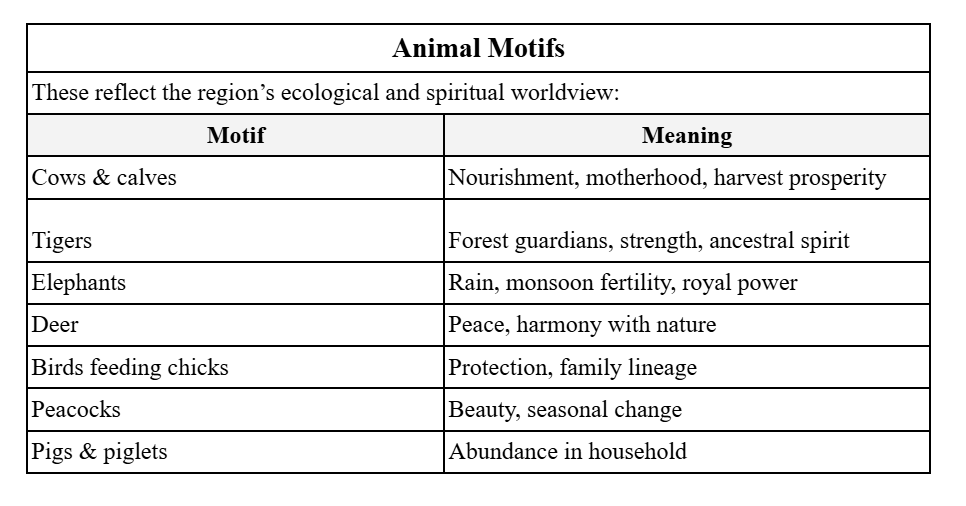
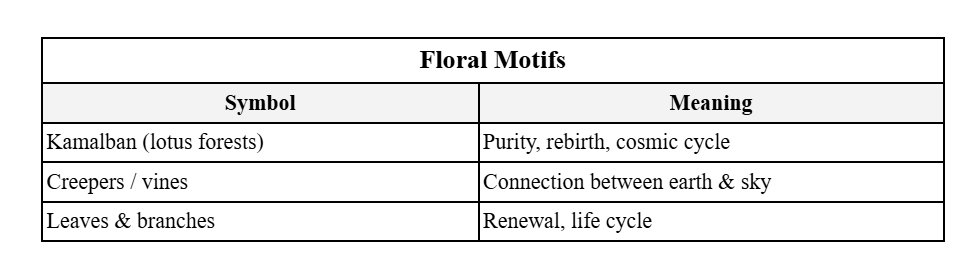
The motifs draw from the natural world: animals, plants, symbols of fertility.
Pigments come from the earth itself: red, black, white, yellow.
Each village has its own visual language, its own way of working.
Villages like Purninano, Isco, Saheda, Jorakath, Ango, Bhelwara, Oriya, Purnapani, Kharanti and more sit at the core of this living tradition.
Historical & Archaeological Context: A Tradition Rooted in Prehistory
1. Meaning of "Sohrai"
The name is thought to come from "soroi," a Mundari word for gently whipping cattle. That connection tells you something about how Jharkhand's tribes see the world:
Cattle are wealth.
Cattle are protectors.
Cattle are spiritual beings.
Cattle belong inside the household's moral world.
So Sohrai rolls together cattle, harvest, fertility, and thanksgiving into one seasonal moment.
2. Connection to Upper Paleolithic Rock Art
In the early 1990s, environmentalist Bulu Imam came across a rock-art site in Isco village. What he found were prehistoric engravings, humans, animals, and geometric shapes, that looked strikingly similar to the Sohrai patterns still being painted on village walls.
The Archaeological Survey of India (ASI) dated these to the Upper Paleolithic-Mesolithic period (10,000-30,000 years old).
That finding opened a remarkable possibility:
Sohrai may be one of the oldest continuously practiced art forms on the planet.
Not a copy of ancient art. The thing itself, carried forward.
3. Revival Through TWAC
Bulu Imam and his son Gustav were not content to let this tradition quietly disappear. They set up the Tribal Women Artists' Cooperative (TWAC), which gave Sohrai artists a path onto national and international stages, in France, Australia, Sweden, Japan, and Germany.
That kind of visibility put money in the hands of practicing artists and gave back something harder to measure: a sense that what they knew had value outside the village.
Sohrai Murals: Where Culture, Spirituality & Utility Meet
Sohrai does not get made. It comes around each year, tied to a seasonal rhythm nothing can fully replace.
Mud Houses as Living Canvases
The monsoon takes its toll on mud houses. By the time it passes:
Houses crack.
Walls soften.
Clay washes away.
Before anything else goes up, women repair the walls, replastering by hand. The murals that follow do not just decorate. They reinforce the structure against the weather. They mark the house as known, as inhabited, as belonging to someone. They say: death passed, and something new is growing.
That combination of practical and symbolic purpose runs through almost everything in tribal art.
The Painting Process: A Ritual of Memory and Earth
Sohrai painting works through four or five layers, each with its own meaning.
1. Black Stratum (Death / Primary Creation)
Drawn from manganese soil, charcoal, or coal. Linked to Pashupati, lord of animals and wilderness, sometimes compared to proto-Shiva. This layer holds the idea of original creation, the night sky, and the deep past of the ancestors.
2. White Layer (Light / Nourishment)
Dudhi mitti, a kaolin clay, is what goes on here. The color speaks of milk, nourishment, purity, light coming through.
3. Red Layer (Fertility/Bloodline/Life)
This comes from gerua, iron-rich earth pulled from the ground. Red speaks of blood, of womanhood, of agricultural fertility that runs generation to generation.
4. Yellow Layer (Godly / Sunshine / Ripening)
Pila mitti, yellow ochre, laid over what came before. This is the color of sun, harvest, and the divine.
5. Engraved Lines and Symbols
Using fingers, twigs, combs, and cloth, women work into the layered surface to reveal what is underneath. No stencils, no rulers, no preparatory sketches.
The wall holds the memory. The hand knows what to do.
Common Motifs & Their Cultural Meaning
Geometric Motifs
These may predate figurative art:
Dots: seeds or cosmic particles
Triangles: feminine energy
Diamonds: agricultural fields
Spirals: movement of seasons
Distinct Styles Among Tribes of Hazaribagh
Sohrai is not one unified style. It is a family of related styles shaped by community and history.
Kurmi Community
Known for kamalban, lotus forests painted in dense floral compositions.
Ghatwal & Agaria Tribes
Their walls show stencil-like divisions and repeated geometric blocks.
Munda Community
Deities here wear sindoor and are surrounded by white dotted markings.
Ganju Tribe
They work with a rare purple pigment, drawing on mineral-rich soils not everyone has access to.
Read across these variations and you can begin to trace which clan made what, and where the tradition's different branches grew.
Colour Formulation: A Science of the Earth
Sohrai's materials, pulled from soil, charcoal, and clay, are biodegradable by nature. There is no chemical waste, no imported synthetic pigment.
The Decline & Revival of Sohrai
Challenges
Concrete houses taking over from mud walls.
Mining pushing tribal families out of their villages.
Young people leaving for cities.
Artists going unrecognized financially.
Oral knowledge fading without being recorded.
Revival Milestones
Hazaribagh Railway Station was given Sohrai murals that caught national attention. In 2016, Prime Minister Modi spoke about the art in his "Mann Ki Baat" address. A GI Tag in 2019 locked in some legal protection for the practice. TWAC exhibitions took the work abroad. Filmmakers and photographers have been working to document the artists before the knowledge slips further.
The future of Sohrai sits with the women still practicing it. Supporting them matters more than any institution.
Experience Sohrai Art with Folk Experience
Step into Hazaribagh's painted villages and see walls that carry centuries on their surface.
At Folk Experience, we take you into the villages themselves, sitting with tribal women artists who work with colours pulled from the earth.
What makes this experience unforgettable:
Visit original Sohrai villages with local women artists
Learn natural pigment making and mural layering techniques
Visit the Isco rock-art site, home to prehistoric motifs
Participate in a hands-on Sohrai painting workshop
Listen to oral histories and legends from the women who keep the tradition alive
Learn how matriarchal knowledge is passed down through generations
Each Folk Experience journey stands with the artists who carry Jharkhand's cultural memory, not in books but on living walls.
In Sohrai villages, every wall is a storyteller and every visitor becomes part of the story
keep wandering