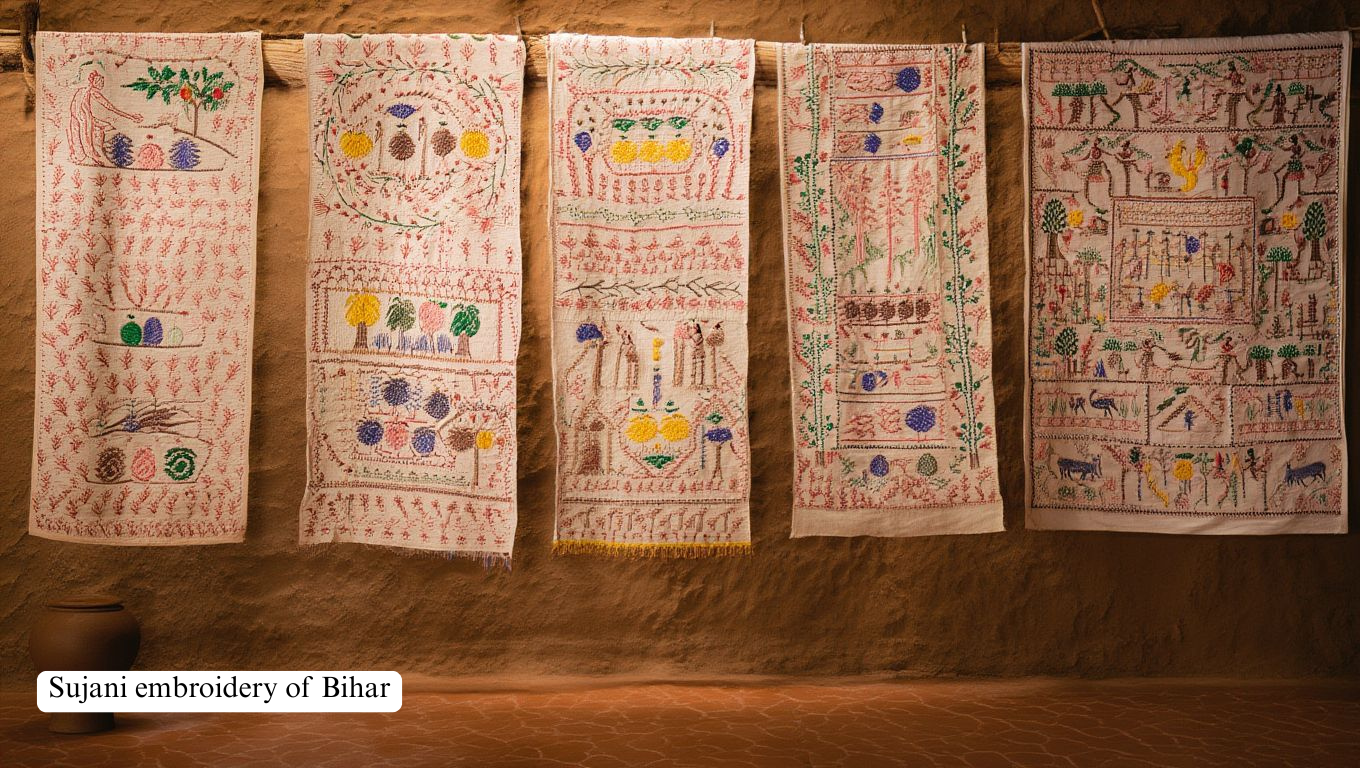
Sujani Embroidery: Stories Stitched into Bihar's Textile Tradition
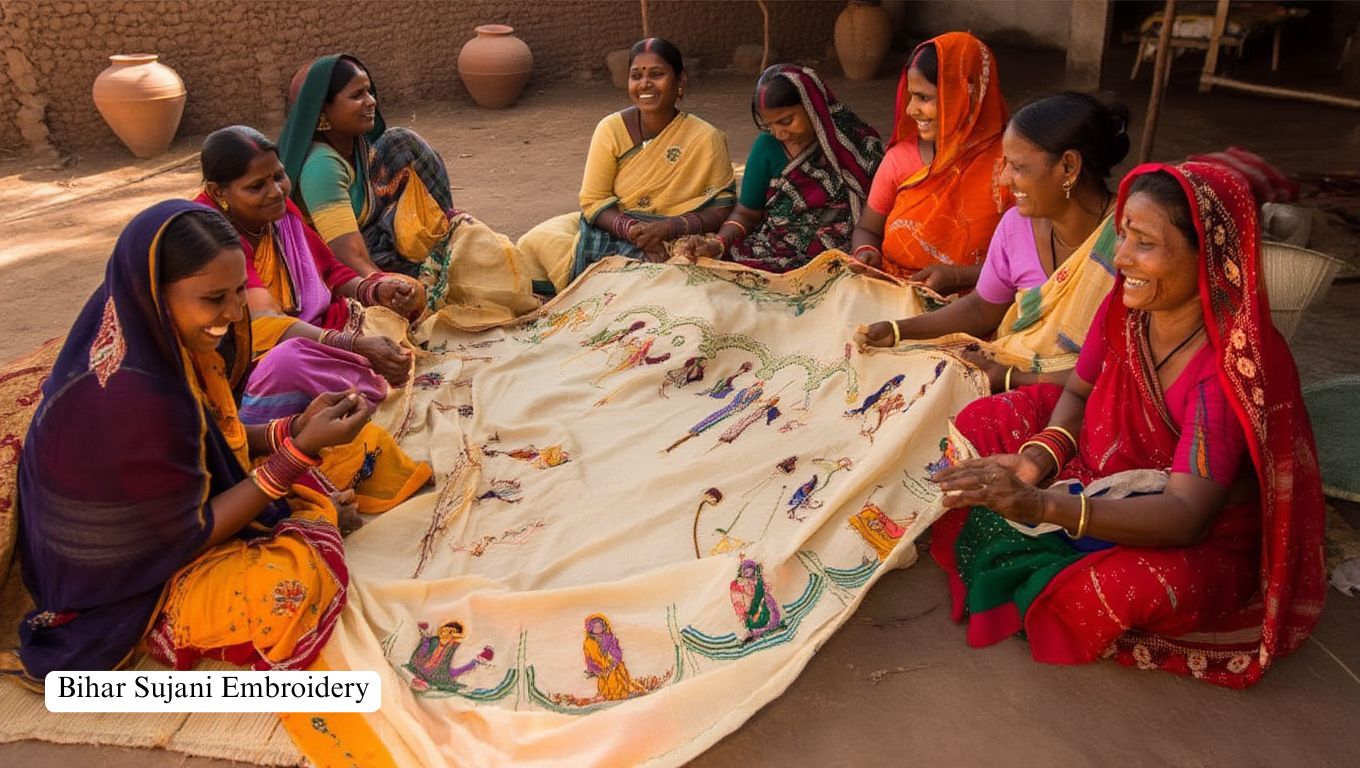
The cloth begins with what would otherwise be thrown away. Old sarees, worn to near-transparency by years of daily use, are layered over each other, three or four layers thick, and stitched together with a running stitch that simultaneously holds the layers and builds up the i...
Meet your AI Story Guide
Turn this field note into a one-minute brief with the essential places, people, and traditions.
What Sujani Actually Is
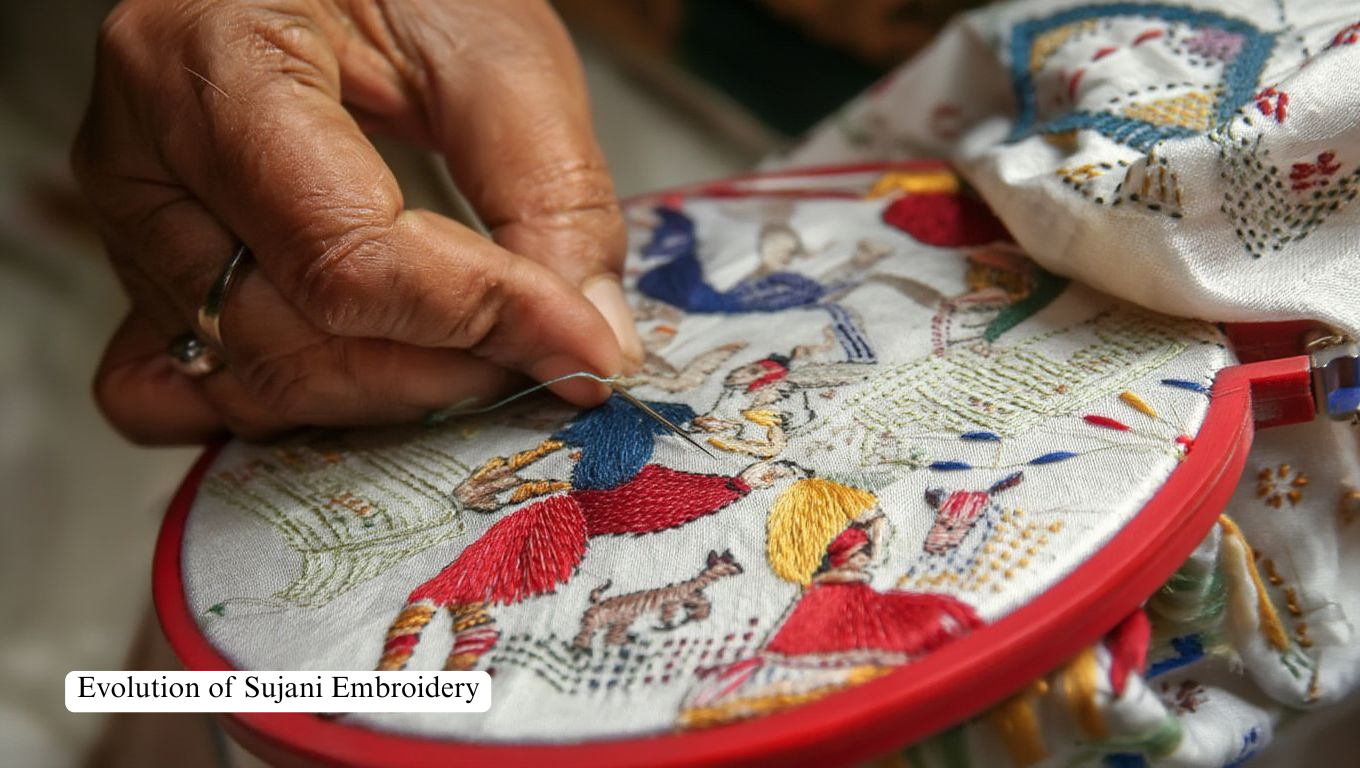
The technical structure of Sujani is simpler than its cultural significance suggests. The layered cloth base, made from worn sarees, provides both the material and the texture of the finished object. The stitching is a running stitch, not the complex surface embroidery of traditions like Kantha or Phulkari. The thread is pulled through the layers in a rhythm that the experienced Sujani maker maintains almost automatically, the needle finding its way through the cloth without the maker needing to think about the mechanics.
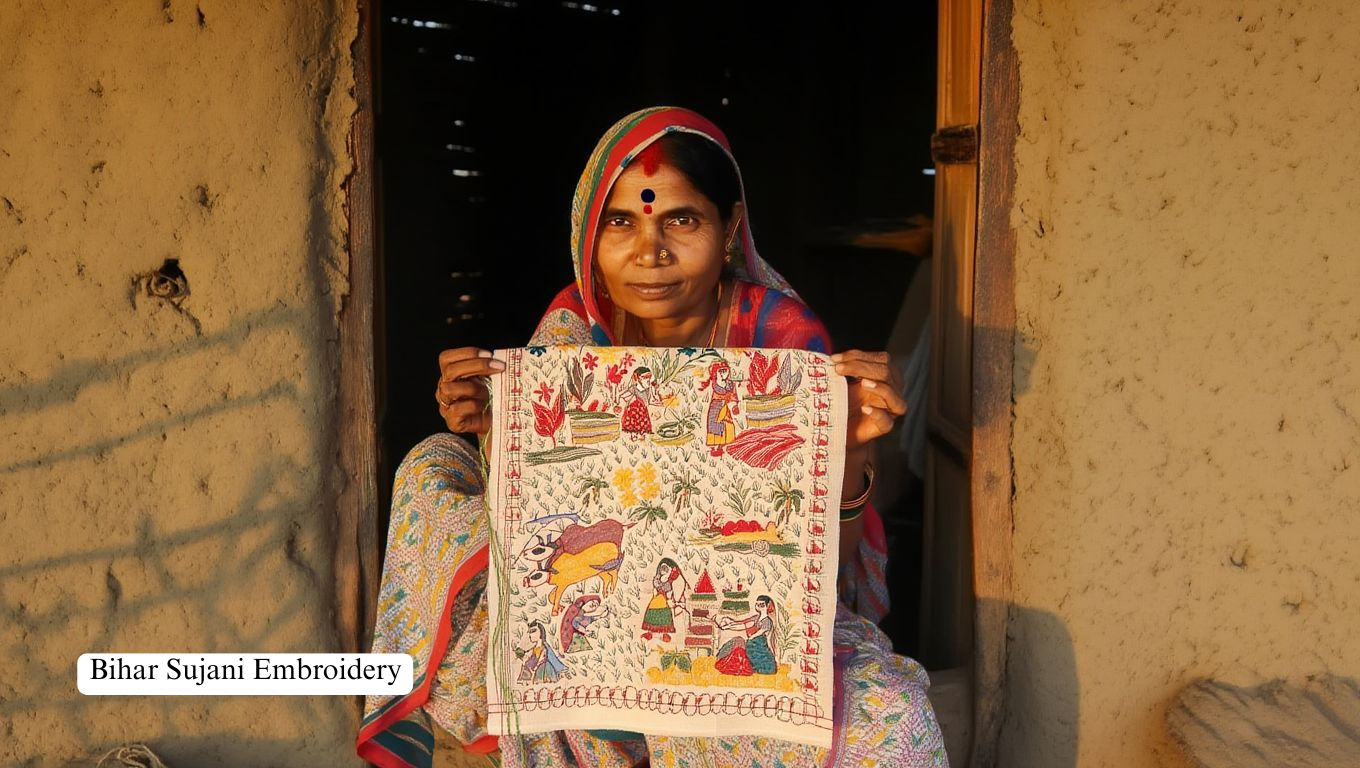
What requires thought is the image being built. The composition emerges from the maker's own understanding of what she wants to record, and the running stitch, which in other textile traditions might be a construction technique, becomes in Sujani the drawing instrument. The density of stitching creates the image's depth. The direction of stitches creates its texture. A woman stitching Sujani is simultaneously constructing a textile and composing a visual narrative.
FACT: Sujani embroidery is concentrated in the Muzaffarpur, Sitamarhi, and Vaishali districts of north Bihar, with practitioner communities also found in parts of Madhubani and Darbhanga. The tradition is documented as having existed in some form for several centuries, though the earliest written references to it are relatively recent. The craft's domestic and private character, made within households for household use rather than for trade or display, meant it was not recorded in the mercantile or administrative documents that preserve evidence of other craft traditions.
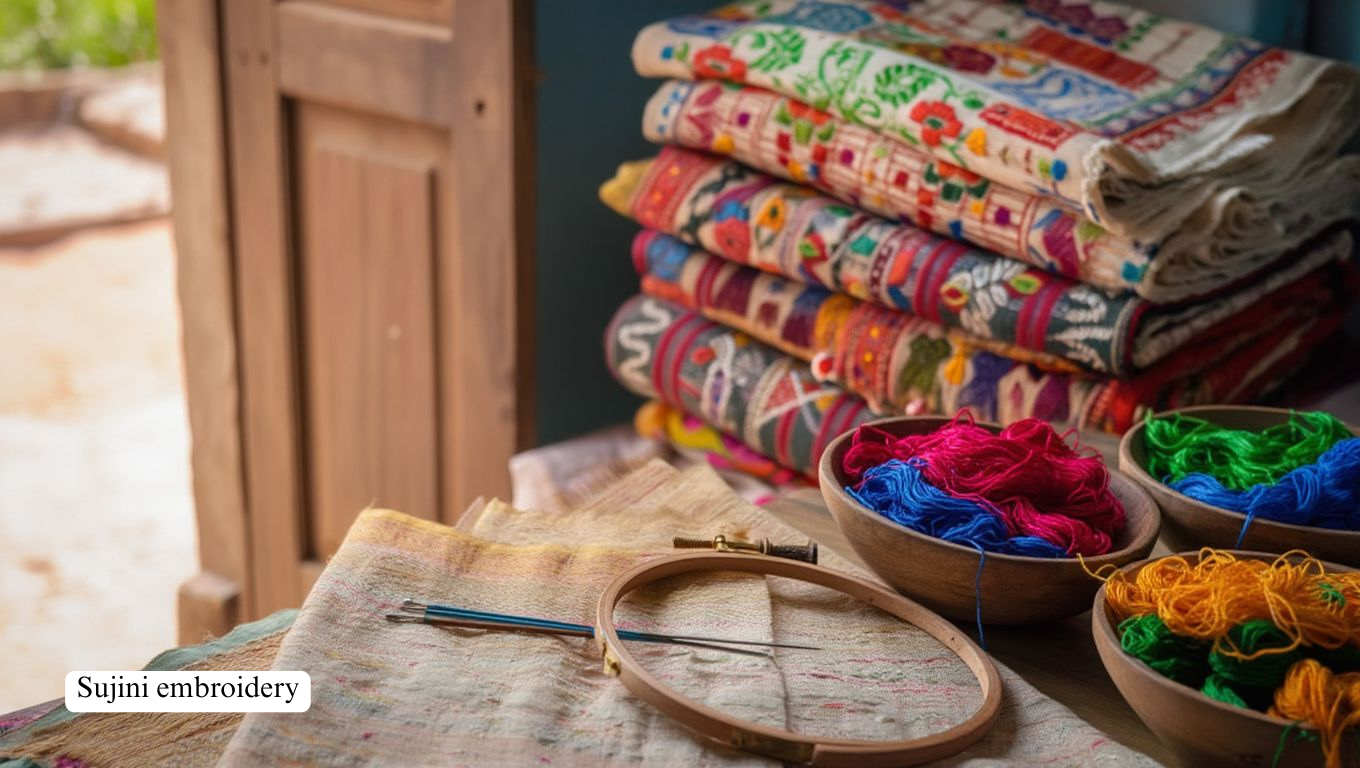
The materials of traditional Sujani are determined by availability rather than choice. The sarees used as the base are the oldest and most worn, those that can no longer be used as clothing. The thread is whatever thread is available in the household. The colors are what the thread happens to be. This is not poverty aesthetics or conscious minimalism. It is the natural result of a craft that developed inside household economies where resources were limited and where making use of what was available was not a design principle but a necessity.
What Sujani Records
The subject matter of Sujani is the subject matter of women's lives in rural Bihar, which is both more varied and more specific than the phrase suggests.
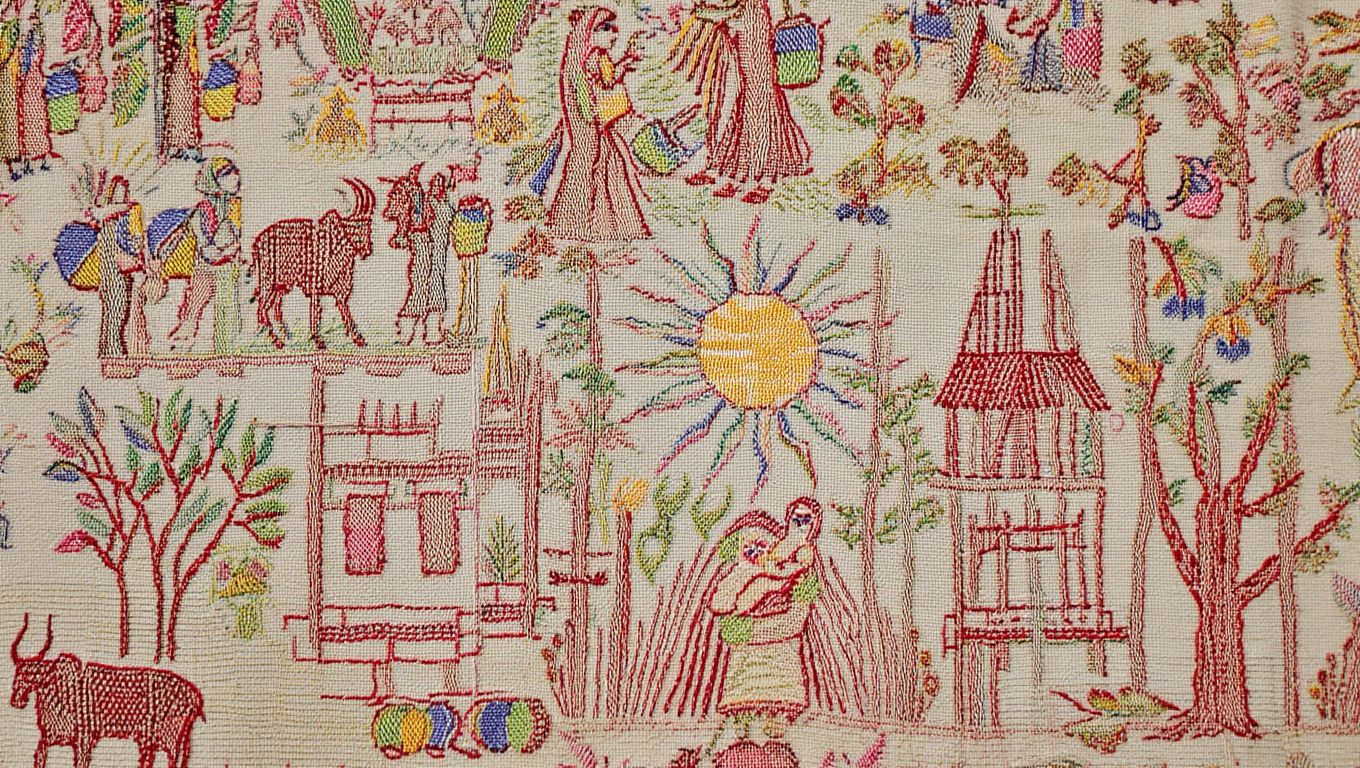
A Sujani made in the 1970s in a village in Muzaffarpur might show a woman transplanting rice, her back bent over the waterlogged field, the water indicated by wavy lines of blue thread running across the lower portion of the cloth. In another panel of the same textile, a birth scene: the mother on a low cot, the women gathered around her, and the baby held up. In another, the departure of a man from the village, his bundle on his shoulder, and the woman and children at the doorway behind him.
These images are not arranged according to any formal compositional logic. They are arranged according to the logic of what happened, placed on the cloth the way memory places events: not chronologically or hierarchically, but in the order and at the scale that their emotional significance warrants.
The subjects have evolved as the social circumstances of the women making Sujani have evolved. Contemporary Sujani, produced by women's collectives that were established in the late 20th-century revival of the craft, often addresses subjects that the earlier domestic tradition did not: caste discrimination, violence against women, the experience of dislocation and migration, the impact of development programs on village life. The needle has become, in these contexts, an instrument of testimony as much as documentation.
The Revival and What It Changed
Sujani was not continuously produced from its origins to the present. By the mid-20th century, the tradition had contracted significantly as the domestic conditions that had produced it, specifically the culture of reusing worn cloth rather than buying new material, changed under the pressure of the industrial textile economy and the availability of cheap new fabric.
The revival of Sujani as a conscious craft practice began in the 1980s through the work of activist and artist Shanti Devi of Bhusura village in Muzaffarpur, who recognized the tradition as both a cultural archive and a potential livelihood for rural women. The organization she founded, working with women from economically marginalized communities, including Musahar women who had not historically practised Sujani, reframed the craft as a medium for economic independence and social documentation.
FACT: The Sujani revival movement, initiated by Shanti Devi of Bhusura village in the 1980s and subsequently supported by NGOs and government artisan development programs,practiced brought Sujani into national and international art markets. Sujani textiles have been exhibited in museums and galleries in India, Europe, and the United States. The Crafts Museum in New Delhi holds a significant collection of Sujani textiles. The revival explicitly positioned Sujani as a medium for women's social commentary, expanding the traditional subject matter to include themes of social justice and community history.
The revival produced both expansion and transformation. The craft reached women who had not previously practiced it and gave them a medium for economic participation that was compatible with the constraints of their domestic lives. It also changed the craft's relationship to its material: revival Sujani often uses new cloth rather than worn sarees, which changes both the texture of the finished object and its relationship to the reuse ethic that characterized the tradition's origins.
These changes are neither entirely good nor entirely bad. They reflect the same dynamic that affects most traditional crafts when they enter the market economy: some things are gained, some things are lost, and the craft that emerges is related to but not identical with the craft that preceded it.
The Communities Making Sujani Today
The women who make Sujani today include practitioners of the older domestic tradition in the villages of the Muzaffarpur area, members of the women's self-help groups and cooperatives that the revival movement established, and individual artists who have developed personal bodies of work within the Sujani tradition and exhibit in contemporary art contexts.
These are not the same community, and the Sujani they make is not the same object, even when the technical method is identical. The Sujani made by an elderly woman in Bhusura village from the worn sarees of her household is connected to her domestic life and her community's specific history in a way that the Sujani made by a cooperative member working to a collective production schedule for an export market is not. Both are Sujani. The difference matters.
The income that Sujani generates is modest relative to the skill and time it requires. The running stitch that produces a finished Sujani panel requires hours of sustained, careful work. The price that the finished panel commands in the weekly market, or even in the craft fair, does not reflect that time adequately. The structural economics of the Indian craft market, with multiple intermediaries between the maker and the final buyer, apply to Sujani as they apply to every other traditional craft in Bihar.
Engaging With Sujani as a Traveller
Sujani is not immediately legible to a visitor who encounters it without context. The images are not arranged in ways that Western compositional conventions prepare a viewer for. The subjects are specific to social worlds that the visitor has not inhabited. The cloth itself, layered and stitched through, reads differently from the smooth, decorated textiles that most visitors' experience of Indian craft has prepared them for.
What context does is transform the encounter. A visitor who knows that the sarees layered in the base of the textile are worn-out clothing, that the choice of subjects reflects the maker's own life and social circumstances, and that the running stitch is both the construction method and the drawing instrument is encountering a different object from the visitor who sees only cloth and thread.
Folk Experience designs Sujani encounters in North Bihar as cultural rather than commercial experiences. The visit to a Bhusura area village where women from the domestic tradition still practice gives the craft its original context: the home, the layered cloth, and the images that emerge from one woman's understanding of what her life has looked like. The conversation with members of the revival cooperatives gives the craft its contemporary social context: what the economic opportunity has meant for women whose other income options were limited, and what has been gained and lost in the transition from domestic object to market product.
The Sujani textile is a more honest document of Bihar's social history than most of what Bihar's official heritage sites offer. It was made by people who were not making history in the formal sense, and it records the life they were actually living rather than the life that formal history finds worth recording.
Folk Experience will take you to where it is being made and help you read what it says.
keep wandering