Terracotta and Clay Traditions of West Bengal
There is a reason Bengal built its temples from clay rather than stone. It was not a poverty of ambition. It was an abundance of material. The Gangetic delta, the vast alluvial plain that Bengal sits upon, is among the most clay-rich landscapes on earth. Millennia of river flo...
Meet your AI Story Guide
Turn this field note into a one-minute brief with the essential places, people, and traditions.
Part One: Bishnupur, A City Built of Mythology
Why Clay, Not Stone
Due to the short supply of stone in Bengal, burnt-clay bricks came as a substitute, and architects of Bengal found a beautiful new craft known as 'terracotta.' This geological accident and the absence of accessible stone deposits in the Gangetic Delta became the creative condition for one of the most remarkable temple-building traditions in Indian history.
It is hard to imagine an entire holy city built of terracotta, but visit Bishnupur in West Bengal and feast your eyes on a temple town built purely of clay and brick. Bishnupur, 139 km from Kolkata, was built by the Malla kings who ruled a part of West Bengal between Burdwan and Purulia. The temples are dedicated to Lord Vishnu, hence the name Bishnupur, and were built across 700 years, from the 10th to the 17th centuries.
Seven hundred years. Not a single generation of builders, not a single dynasty's project, but an unbroken tradition of construction in fired clay that outlasted political upheavals, religious transitions, Maratha raids, and British annexation. The temples that stand today in Bishnupur are the survivors – extraordinary, worn, and still alive with narrative detail.
The Conversion That Changed a Kingdom
Bir Hambir, a powerful but tyrannical Malla ruler, had converted to Gaudiya Vaishnavism. Gaudiya Vaishnavism provided the primary impetus for terracotta art to flourish in the 16th and 17th-century temples of Bishnupur.
The story of that conversion deserves to be told. A Vaishnavite scholar named Srinivasa Acharya was traveling through Bishnupur carrying a cartload of sacred manuscripts. Bir Hambir, suspecting the cart contained valuables, had it seized. When the manuscripts were brought to him and he could not read them, he summoned Srinivasa, who proceeded to narrate and interpret the texts with such power that Bir Hambir was overwhelmed. He converted on the spot, returned the manuscripts, and spent the rest of his reign building temples to Krishna.
The temples those artisans built were not simply devotional structures. These temples are not just religious structures; they are canvases narrating episodes from the epics, the Ramayana and the Mahabharata, as well as the Puranas, particularly stories revolving around Krishna. The intricate terracotta panels depict scenes of courtly life, social customs, and even flora and fauna, providing invaluable insights into the cultural milieu of 17th- and 18th-century Bengal.
One detail is striking: the artists who worked on the temple complex were illiterate and had no access to the epics and stories associated with it, which were in Sanskrit. Their only access to this repository was through the works of local Bengali poets, who wrote dramas and ballads. The stories depicted on Bishnupur's temple walls are therefore not Sanskrit epics directly translated into clay; they are Bengali retellings of those stories, filtered through oral tradition, folk drama, and the creative interpretation of artisans who had heard the tales but never read them. The poetic license they enjoyed allowed them to weave in new episodes and interpretations based on local customs and traditions, thus bringing new facets to the stories of the Mahabharata and Ramayana.
The Architecture: Styles From an Unlikely Convergence
The temples of Bishnupur display an architectural vocabulary that is uniquely Bengali and uniquely hybrid. This distinctive terracotta art is largely confined to the alluvial delta of the Ganges River, since the supply of raw materials was limited to this region. Bishnupuri terracotta art is full of vitality and movement, and almost all the figures show action that has been arrested.
The architectural styles of the temples fall into several distinct categories. The Chala temples take their roof forms from the traditional Bengali thatched hut; the curve of the chala roof, designed to shed monsoon rainfall, was translated from bamboo and thatch into fired brick. The Ratna temples feature towers or pinnacles that borrow from the broader pan-Indian temple tradition. The Jor Bangla, literally "joined hut," reproduces, in permanent terracotta, the form of two village huts placed side by side. King Hambir established Rasmancha, the oldest brick temple, in 1600 AD. It stands on a laterite plinth and features a single chamber with hut-shaped turrets and an elongated tower, with a pyramidal superstructure and three circumambulatory galleries.
The continuities in design style between these temples and the Islamic architecture of Qadam Rasul, a shrine constructed in 1519 in dedication to the footprints of the Prophet at Gaur, are articulated through certain shared features like the cubical base of the sanctum of several Bishnupur temples. The Malla dynasty's Bishnupur was, as one scholar has noted, the melting pot of several religions and cultures, and that multiplicity is visible in the architecture itself. The same temple town that celebrates Krishna with such exuberance carries the visual vocabulary of Islamic architecture in its structural forms.
In recognition of their cultural value, the Temples of Bishnupur were added to UNESCO's tentative list of World Heritage Sites in 1997.
Visiting Bishnupur
The Bishnupur Temple Complex is open from 6:00 AM to 6:00 PM daily. Ticketed ASI monuments such as Rasmancha, Jor Bangla, and Madan Mohan Temple are open from 9:00 AM to 5:00 PM daily. The town is 139 kilometers from Kolkata and is accessible by both train and road. The annual Bishnupur Mela, held in December, is one of the best times to visit; the craft workshops and weaving centers are at full activity, and the town's full cultural range is visible alongside its architectural heritage.
In recent years, artisans from Panchmura, a Bankura town not too far from Bishnupur, have also been churning out thousands of terracotta panels emulating the bas-reliefs of the terracotta temples of Bishnupur. These panels not only serve as mementos and curios for tourists to carry back home but have also been increasingly used to decorate the facades of newer constructions, both religious and secular. The temple panels have become one of the most accessible and meaningful craft objects available from the Bishnupur region.
Part Two: The Bankura Horse – From Ritual Offering to National Symbol
The Horse and Its Deity
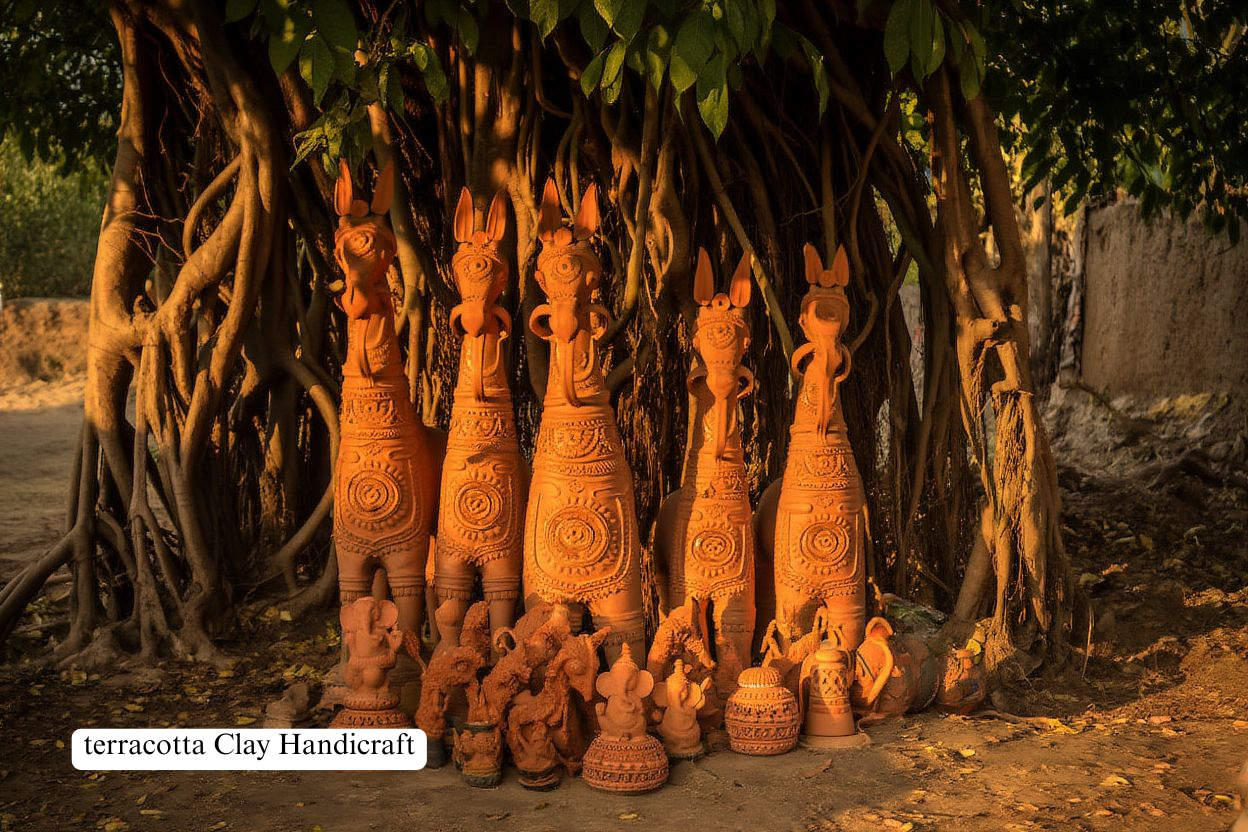
Twenty kilometers from Bishnupur, in a village called Panchmura, the Kumbhakar community of potters has been making terracotta horses for longer than anyone can precisely document.
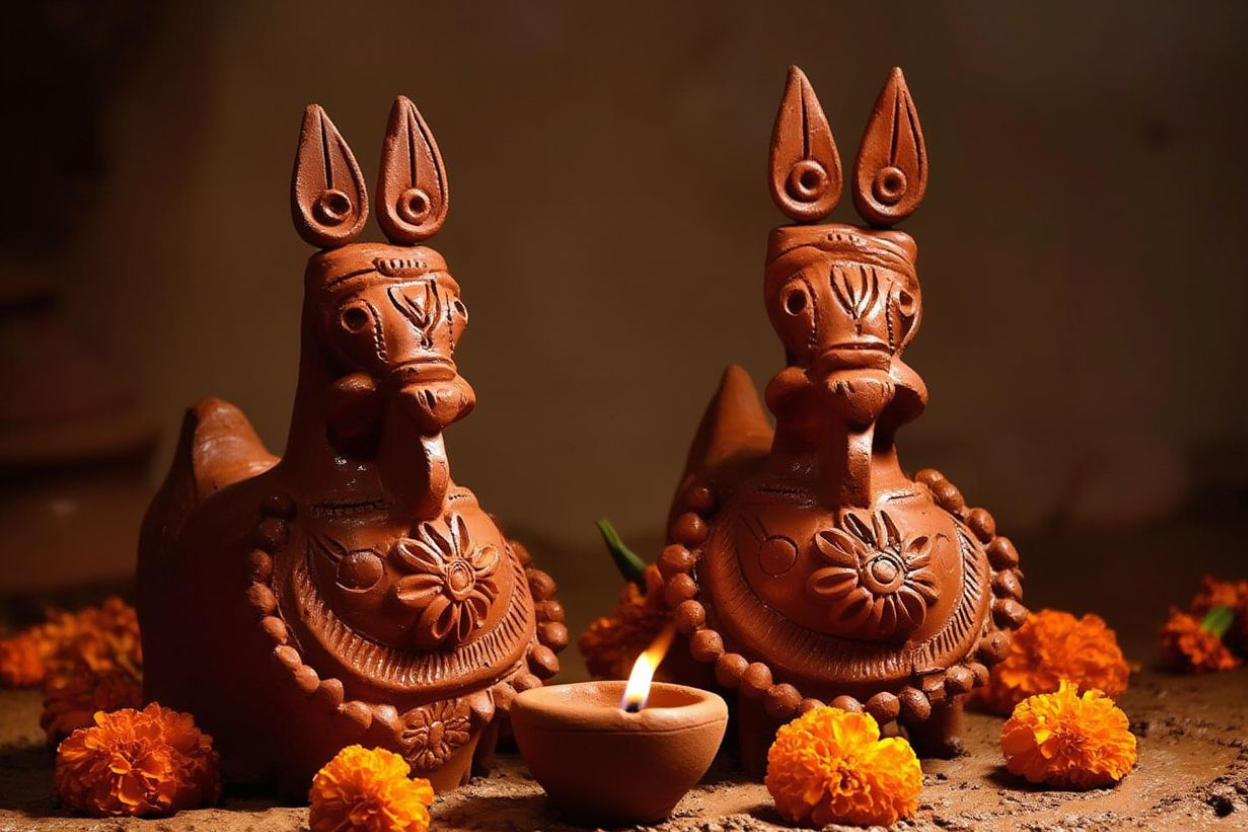
The Bankura horse is the terracotta horse produced in Panchmura village in Bankura district. It has been praised for its elegant stance and unique abstraction of basic values. Originally used for village rituals, it now adorns drawing rooms around the world as symbols of Indian folk art.
The ritual origin is essential to understanding the horse. The Bankura horse holds deep religious importance, often offered as votive figures to deities such as Dharma Thakur and Manasa during rituals, representing devotion and symbolic sacrifice. Dharma Thakur is a deity specific to the Rarh region of Bengal, a syncretic figure who combines elements of Shaivism, Vaishnavism, and tribal religion and who is worshipped primarily by lower-caste and tribal communities. In the Rarh region where Dharmathakur is worshipped, there is no end to the symbolic use of terracotta and wooden horses. Symbolic sacrifice of horses for the fulfillment of wishes is common for many village gods and goddesses, but an assembly of terracotta horses of various shapes and sizes representing sacrifice on wish fulfillment is perhaps peculiar to Dharmathakur.
The practice works like this: a devotee makes a vow to Dharma Thakur or Manasa, asking for health, a bountiful harvest, or protection. If the prayer is answered, a terracotta horse is offered at the deity's shrine as a token of gratitude. The horses accumulate over years of fulfilled prayers, some shrines surrounded by hundreds of them in varying sizes, their red-brown surfaces worn smooth by weather and time.
In a beautiful display of India's composite culture, these horses are also offered at the tombs of Muslim saints, showcasing a beautiful blend of faith and mutual respect. The Bankura Horse, like so many aspects of Bengali culture, refuses to stay within any single religious tradition.
The Form: Why It Looks the Way It Does
The visual character of the Bankura horse is immediately recognizable and deliberately abstract. Over the centuries, the potters have moved away from a realistic presentation to an abstract representation. Potter artists of different regions focused on different parts of the animal body in such a manner that representation of the same became more important than representation of the entire body of the animal.
The elongated neck is the horse's most distinctive feature, far longer, relative to the body, than any actual horse possesses. The Bankura horse is celebrated for its elegant, stylized form featuring an erect neck, wide jaws, and balanced posture. These hollow figures, ranging in height from 15 cm to over 2 meters, are fashioned from locally sourced red clay mixed with sand and organic materials, then fired in traditional mud kilns to produce a glossy red-brown surface.
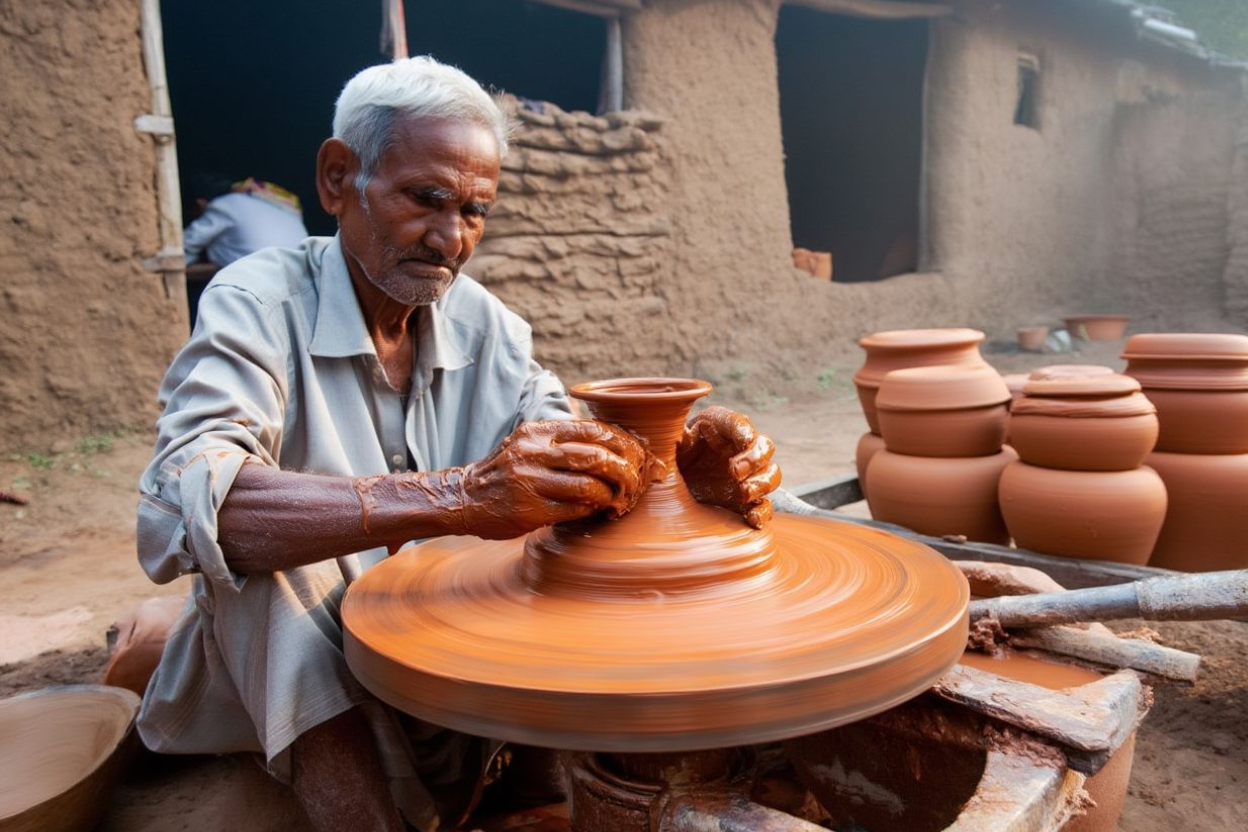
The making process is itself a demonstration of engineering in miniature. Different parts of the hollow terracotta horses are turned out in separate parts on the potter's wheel. The four legs, the full neck in two parts, and the face—seven pieces in all—are turned out separately on the wheel and then joined together. Additional clay is used for making up defects that may remain in the shape of the body. The leaf-like ears and the tails are done in molds and are later inserted in grooves left on the body.
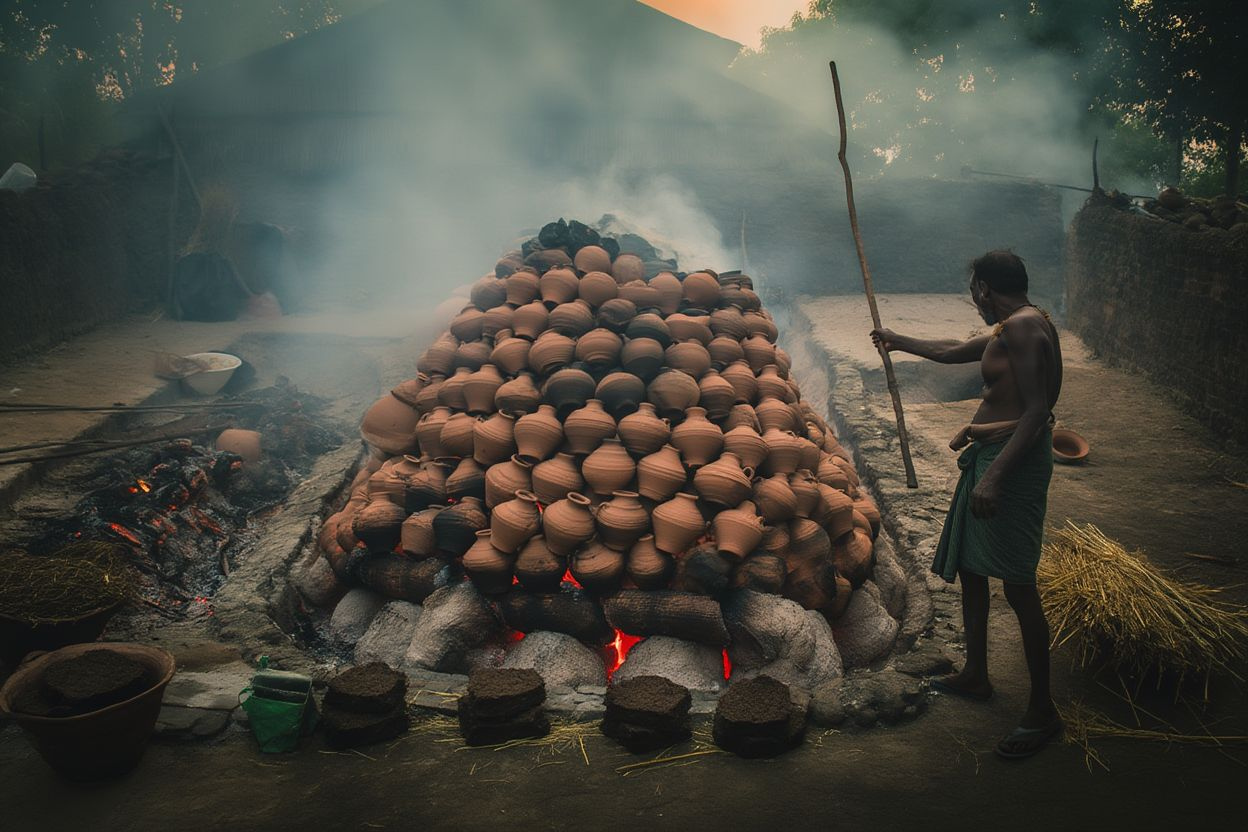
After shaping, the assembled horse is dried in the sun, then fired in a traditional kiln with eucalyptus leaves, which produces the characteristic reddish-brown surface color. The kiln atmosphere also determines finish: baked in the sun and burnt in mud kilns with dry eucalyptus leaves, the earthly ensembles in dull ochre or red are beauteous caricatures.
From Village Shrine to Postage Stamp
The journey of the Bankura Horse from ritual object to national emblem is one of the most unusual trajectories in Indian craft history.
The craft's symbolic stature was elevated in 1957 when it featured on an Indian postage stamp for Children's Day, highlighting its national cultural value. Post-independence, the All India Handicrafts Board, established in 1952, promoted the Bankura horse as its official crest motif until the board's abolition in 2020, facilitating its shift from ritual objects to artistic exports through exhibitions and institutional support in the 1950s.
The horse that once sat before the shrine of Dharma Thakur in a Bankura village ended up on the nation's postal stamps, on the official crest of India's handicrafts authority, and eventually in homes in Germany, Japan, and the United States. The Bankura horse is registered under the Geographical Indications of West Bengal, named Bankura Panchmura Terracotta Craft, on 28 March 2018.
Yet the commercial success has come with its own pressures. By the late 20th century, traditional production declined due to urbanization and economic pressures, reducing the number of artisan families in Panchmura from 300–400 to around 60–70 by the early 2000s as younger generations pursued urban livelihoods.
There are around 270 terracotta artists in Panchmura today. The Government of West Bengal's Department of Micro, Small, and Medium Enterprises and Textiles, in association with UNESCO, has developed a Rural Craft Hub in Panchmura where one can participate in craft-making workshops, learn the history of the craft, and explore the artifacts at the Folk Art Centre.
Part Three: Kumartuli: Where Goddesses Are Born and Released
The Origin Story: A Potter and a Battle
The story of Kumartuli begins with a military victory and a religious festival, two of Bengal's most defining preoccupations colliding at the same moment.
A potter from Krishnanagar in the Nadia region of West Bengal was invited by Raja Nabakrishna Deb, the founder of the Shobhabazar Raj dynasty, a well-known zamindar in British India and a close associate of Robert Clive, to make an idol for Durga Puja. The primary objective was to have him make an idol for Durga Puja. He stayed in Kumartuli because he needed to use his amazing sculpting skills. He, the first potter, started the Kumartuli tradition. People used his idol to celebrate the East India Company's triumph in the Battle of Plassey during the Durga Puja holiday.
The Battle of Plassey in 1757, the decisive British victory over the Nawab of Bengal that effectively began colonial rule, was thus celebrated with a Durga Puja. The idol made for that celebration was made in Kumartuli by a potter invited from Krishnanagar. This event is, historically, the moment that established Kumartuli as Kolkata's idol-making center.
Kumartuli is a traditional potters' colony in northern Kolkata, 'kumor' meaning 'potter' and 'tuli' referring to easily walkable localities within a quarter or half a mile. The potters treat these colonies as their place of living as well as workspace.
The Making: From Sacred River to Festival Pandal
The process of making a Durga idol in Kumartuli follows a sequence so embedded in tradition that every step has its name, its own timing, and its own ritual significance.
Usually, on the last day of the Bengali year, Chaitra Sankranti, the artisan performs a ritual before putting their hands on dry bamboo sticks that are used to make the framework of the first idol that they will make. The New Year's Eve ritual, the artisan's hand touching the first bamboo of the new idol cycle, marks the start of a process that will not reach its culmination until ten months later.
The bamboo framework is built first, then covered with hay and straw to create the basic volume of the figure. A thick layer of red soil is applied to shape the idol, followed by a layer of alluvial soil from the Ganga basin, sourced from Kolkata. For the final layer, a semi-liquid mixture is prepared using powdered soil and water. A soft cotton cloth is dipped into this mixture and applied to the clay figure to provide the finishing shape, preventing cracks. Delicate parts such as the face, fingers, palms, toes, and nails are crafted separately and attached to the idol using mud paste.
Notably, an intriguing tradition involves obtaining soil from a brothel and blending it with clay. This soil is known as 'punya maati,' blessed soil collected from a 'nishiddho palli,' a forbidden territory. The inclusion of soil from the brothel in the sacred material of the goddess's idol is one of the most discussed and contested traditions in Kumartuli. Various interpretations have been offered: that it represents the inclusion of all social margins in the divine; that it acknowledges the labor and humanity of those excluded from mainstream society; or that it is a ritual acknowledgment of the goddess's presence everywhere, without exception.
The eyes, considered the windows to the soul, are meticulously painted with acrylic or poster colors. The entire process is a collaborative effort, involving ten to fifteen skilled artisans. This intricate process takes several days to complete. The work typically begins between June and August and is meticulously finished before the puja ceremonies commence.
The most significant ritual moment in the entire process is Chokkhu Daan, the bestowing of the eyes. On the auspicious day of Mahalaya, which marks the beginning of Devipaksha, the artisans of Kumartuli invoke the powers of the female goddess by painting the eyes of the idols of Durga, famously known as 'Chokkhudaan' or 'bestowing of the eyes.' Until the eyes are painted, the idol is an object. The moment the eyes are applied, it becomes a goddess. The artisan who paints the eyes performs this act as a consecration; it is simultaneously the final technical step and the first spiritual one.
The Scale and the Impermanence
Over 400 workshops have been practicing this craft for generations in Kumartuli's maze of narrow lanes. Many artists travel great distances from West Bengal to breathe life into every detail of the goddess and adorn her divine abode, while some of their creations are even shipped abroad to places where the festival is celebrated.
These idols are eco-friendly and are crafted using materials like bamboo and clay. Most of the clay is transported by boat down the Hooghly River from a nearby village. Every material that goes into a Kumartuli idol—the bamboo armature, the river clay, the cotton cloth, the natural pigments, the Shola pith ornaments, and the jute fiber used for the goddess's hair—is biodegradable. When the idol is immersed in the Ganges at the festival's end, it returns entirely to the earth and water from which it came.
This is the theological logic at the heart of Kumartuli's craft: the goddess is invited, welcomed, worshipped, and released. The artisan's role is not to create a permanent monument but to make the temporary arrival of the divine possible. The most technically demanding, most emotionally invested work in the idol-maker's year produces something designed to dissolve.
Women Breaking Into the Workshop
Traditionally, the making of idols is a male-dominated task, and women were usually discouraged from entering the working studios. But in recent decades, that has changed.
Mala recollects this event as a turning point in her life. Though at first her family was reluctant about her choice, they eventually embraced it. Today, she works with a team of seven to eight people and specializes in miniature Durga idols that are shipped to destinations such as Germany, France, Canada, and the USA. China Pal's journey is similar. She has been in the profession for more than two decades, starting in 1994 after her father's demise just before the pujas that year. She had no formal training in the art, so there were hiccups in the beginning. But as China says, she always had a knack for it. She started working with her father's team and learned sculpting.
These women and others like them across Kumartuli are not simply maintaining tradition. They are reshaping it, bringing new aesthetic sensibilities, new technical approaches, and new markets to a craft that had effectively closed itself to them for centuries.
Clay as the Common Language
Stand for a moment and consider what the three traditions in this blog share. The temple artisans of Bishnupur, the horse-makers of Panchmura, and the idol-makers of Kumartuli are all working with the same material, the clay of the Gangetic delta. But what they do with it, why they do it, and who does it are entirely different.
In Bishnupur, terracotta was a substitute material that became something greater than what it replaced. There was no stone, so they used clay, and then they discovered that clay could be shaped into narrative, that a temple wall could be a manuscript, and that fired brick could hold the stories of Krishna and Arjuna and Rama more expressively than any stone panel they had seen.
In Panchmura, clay was always a ritual object. The horse was never decorative; it was devotional. It carried a prayer and an expression of gratitude. Its abstract, elongated form is not stylized for aesthetic effect. It is the natural result of artisans working fast, working in volume, working to produce objects that would be placed before a deity and left to weather. Beauty emerged from utility, not from the pursuit of beauty itself.
In Kumartuli, clay is temporary by design. The most elaborately constructed idol, months of work, dozens of artisans, and tonnes of material are made to be released. The artisan who paints the eyes of the goddess and consecrates the idol is also the person who knows, with absolute certainty, that this figure will not survive the festival week. That acceptance of impermanence is not resignation. It is the theological heart of the entire tradition.
Bengal's clay traditions tell you something that no other craft tradition in the state can: that the most fundamental material, earth mixed with water and shaped by hands, is also the most philosophically rich. It builds temples that outlast dynasties. It makes horses that carry prayers. It creates goddesses that come and go with the seasons.
Why Choose Folk Experience to Travel West Bengal
Bishnupur, Panchmura, and Kumartuli are not separate destinations. They are three chapters of a single story, the story of what Bengal's people have always done with the earth beneath their feet.
Folk Experience is designed to help you read that story from beginning to end.
When you travel with Folk Experience to Bishnupur, you do not simply walk through a temple complex. You stand before the terracotta panels with someone who can identify the specific episode from the Mahabharata being depicted, explain which Bengali folk drama the artisans likely heard it from, and show you how the same compositional style reappears in the Baluchari saree workshops three streets away.
A Folk An experience visit to Panchmura includes time in the workshops of the Kumbhakar potters, watching the horses assembled piece by piece on the wheel, understanding why the neck is elongated the way it is, and hearing about the Dharma Thakur shrine where the horses were originally placed. You do not simply buy a horse. You understand what you are holding.
Kumartuli is most richly experienced in the months between June and October, when the workshops are at maximum activity. Folk Experience places you in those workshops at the right time, watching the bamboo armature rise, the clay being applied in layers, and the collaborative process of ten artisans working on a single figure. You experience the craft as a process, not as a product.
The tradition of punya maati, the sacred soil from the brothel included in every Durga idol, is one of the most philosophically rich details in all of Bengal's craft traditions. Folk experience gives you the context to understand it as a theological statement rather than simply an unusual custom.
The women of Kumartuli, Mala, China Pal, and others are breaking a centuries-old gender barrier in one of Bengal's most significant craft traditions. Folk Experience connects you with these stories, because understanding how a tradition changes is as important as understanding what it has always been.
The Rural Craft Hub at Panchmura, developed in partnership with UNESCO, offers workshops where you can try the terracotta process directly, shaping clay on a wheel, understanding the assembly method, and experiencing the material that Bengal has always used to tell its most important stories.
Choosing a folk experience means travelling through West Bengal's clay traditions not as a tourist looking at objects but as someone willing to understand the earth those objects came from, the hands that shaped them, and the beliefs that made shaping them worth doing.
The temples have stood for four centuries. The horses carry prayers that are centuries old. The goddess arrives every year, and every year she is released. That is Bengal's clay tradition. And it is one of the most extraordinary things you will ever encounter.
keep wandering