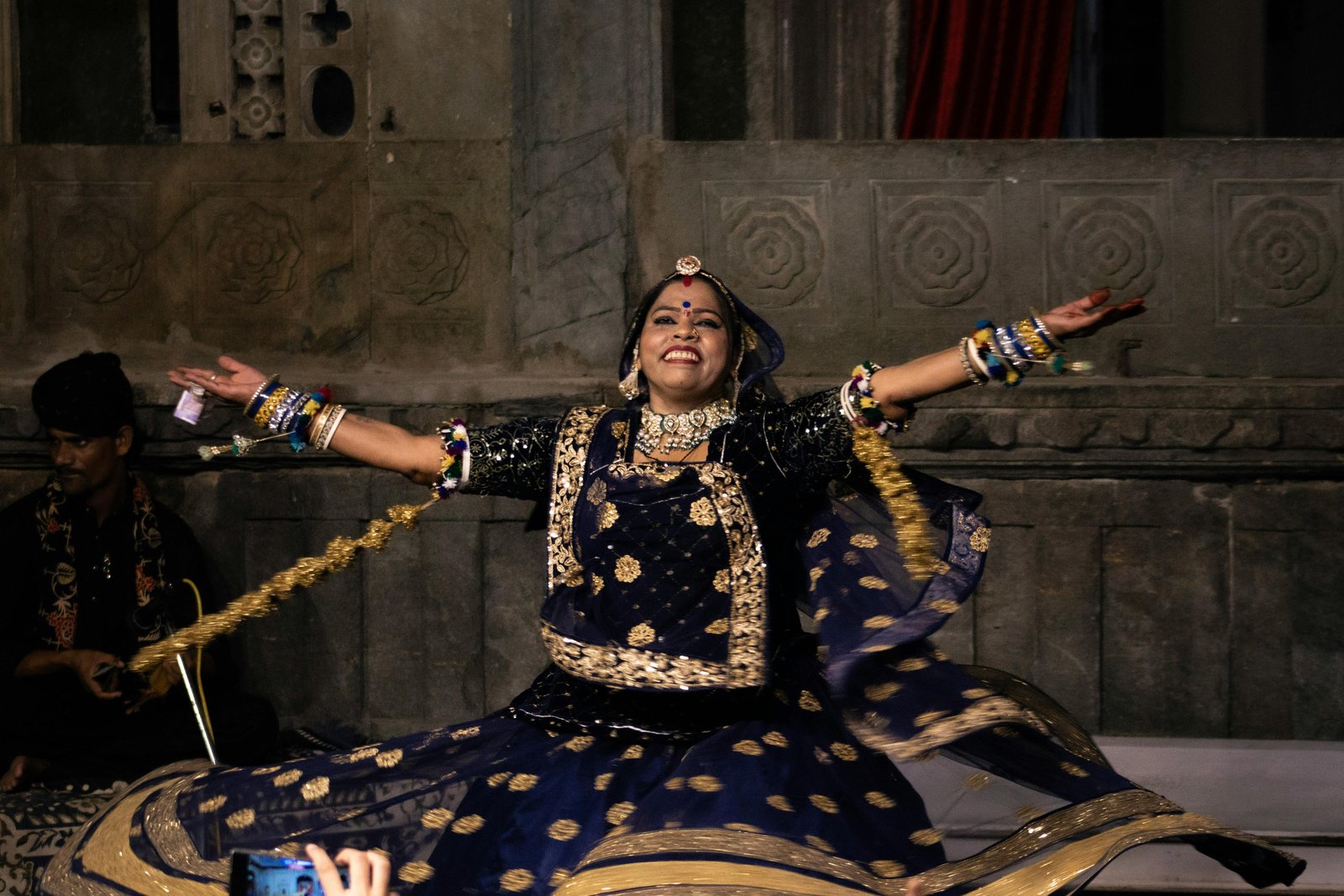
The Art and History of Kalbelia Dance: Rajasthan's Iconic Folk Dance
The first time you see Kalbelia performed properly, not in a hotel lobby or a tourist dinner show but out in the desert at night, firelight throwing shadows everywhere, it does something to your brain. You can't look away. The women are in black ghagras covered in tiny mirrors...
Meet your AI Story Guide
Turn this field note into a one-minute brief with the essential places, people, and traditions.
The Roots of the Serpent's Dance
The Kalbelia tribe were nomadic snake charmers. That was their profession for centuries: catching snakes, charming them, healing snakebites, and performing with them at fairs and gatherings across the Thar Desert. The men handled the snakes and played instruments. The women danced. Naturally, the dance took its character from the creatures that dominated their entire world.
Watch a Kalbelia dancer's movements, and the snake connection is obvious. The way they move is serpentine, fluid, low to the ground, and sinuous. Hips swaying in patterns that mimic a cobra's sway. Arms undulating like a snake moving through sand. It's not subtle. It's not trying to be. The whole dance is a physical tribute to the animal that defined their community's identity.
The music is built on the poongi, also called the 'been', which is literally the same instrument that was used to charm cobras. Add a dholak for rhythm, a morchang for that metallic twang, and a khanjari for percussion, and you've got a sound that's hypnotic in the most literal sense of the word. It was designed to entrance snakes. Turns out it works on humans too.
None of this was ever written down. No instruction manuals. There is no academy where you can learn Kalbelia. Everything – the movements, the music, the costumes, the stories – is passed from parent to child through observation and practice. This is an oral tradition in its purest form. You acquired your skills by observing your mother dance and subsequently practicing until your body memorised the movements.
The Allure of the Attire
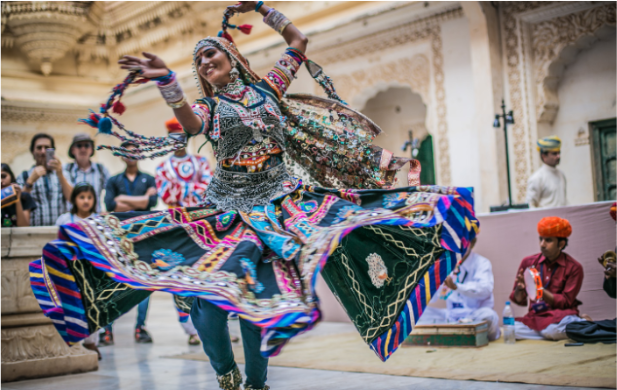
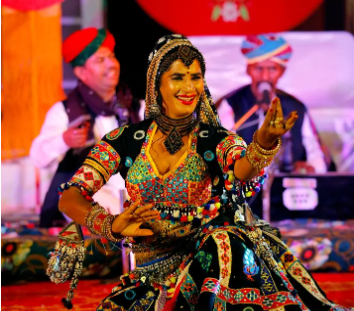
The costumes deserve their own section because they're doing serious work in this performance. Kalbelia women wear flowing black ghagras and odhanis veils covered in silver threadwork, mirrors, and beads. The black represents the serpent's skin. The silver accents are the scales catching light. When a dancer spins, every mirror on her skirt catches the firelight from a different angle, and the effect is genuinely dazzling.
The jewellery is heavy. Banjara-style, antique-looking pieces, necklaces, anklets, and armlets that add both sound and visual weight to every movement. When a Kalbelia dancer moves fast, which she does most of the time, her jewellery creates its own percussion layer. The rattling and clinking of the jewellery adds rhythm to the sound of the drums and the poongi.
And then there are the expressions. Kalbelia dancers don't have neutral faces. Their eyes are intense. Dramatic. There's a fierceness to it that matches the physicality of the dance; this isn't gentle or demure. It's powerful.
The combination of the black costume, the mirror flash, the aggressive movement, and those expressions creates something that's difficult to categorise. Part dance, part visual spectacle, part statement of identity. It's a living declaration of who these women are and what their community has survived.
The Legend of Sage Kanifnath
The Kalbelia tribe traces its spiritual origins back to Sage Kanifnath, who was a disciple of Jalandhar Nath, a renowned figure in the Nath sect of yogis.
The story goes like this. Kanifnath drank a bowl of snake venom. His guru had blessed him with the ability to withstand death, so instead of killing him, the venom turned his throat blue. Like Lord Shiva's. That earned him the title Neelkanth Mahadev. His followers took inspiration from this act and began handling snakes themselves not with fear but with devotion. Over time, this community became known as the Kalbelias. The name is derived from "kaal", which means death, and "belia", which means bowl. Those who live with death's bowl. Those who drink from it and survive.
From that point on, snakes weren't something to be afraid of. They were sacred. Central to the community's spiritual identity. The Kalbelias built their entire way of life around serpents: catching them, living with them, performing with them, and healing people who'd been bitten by them. The dance that emerged from that relationship carries all of that history in its movements. Every snake-like gesture is an echo of a worldview where cobras were family, not enemies.
From Venom to Verse: The Evolution of a Legacy
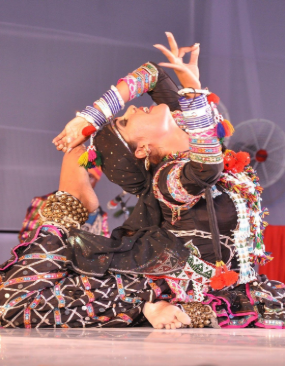
For generations, the Kalbelias were a fixture of Rajasthani social life. They showed up at fairs, royal gatherings, village celebrations, births, weddings, and harvest festivals. They performed. They healed. They entertained. They occupied a specific and valued niche in the social ecosystem of the Thar.
Then 1972 happened. The Wildlife Protection Act banned snake charmers across India. Overnight, the Kalbelias lost the profession that had defined them for centuries. No more catching snakes. No more performing with them. The thing that made them who they were became illegal.
What happened next is the part of the story that really matters. They didn't disappear. They adapted. The dance, which had always been part of their performances with snake-charming, became the main event. Women who had danced as accompaniment to their husbands' snake acts stepped into the spotlight as the primary performers. The art form evolved from a supporting element into a standalone tradition powerful enough to sustain a community.
When UNESCO recognised Kalbelia as an Intangible Cultural Heritage of Humanity in 2010, it validated something the Kalbelia community had been proving for almost four decades: that their art could survive without snakes. The dance, music, costumes, and stories all held intrinsic value that warranted preservation. Not as a curiosity. As genuine, living culture.
The Music and Movements of the Desert
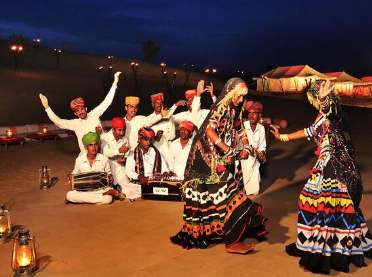
Describing Kalbelia's movements in words is a challenging task. You kind of have to see it. But here's an attempt.
The poongi sets the tone. That winding, nasal melody that rises and falls like a snake lifting its head. The dholak and morchang layer the rhythm underneath.
And then the dancer enters that rhythm and becomes part of it. She moves with a speed and flexibility that's startling, spinning, bending, and arching backwards into positions that look like they should hurt but clearly don't. The footwork is rapid. The hip movements are precise. The arms do this undulating thing that genuinely looks boneless.
Every gesture means something. A flick of the wrist isn't random; it's a specific movement with a specific reference. A sudden turn changes the energy of the whole performance. A dramatic whirl that sends the ghagra flying outward creates a visual explosion of black fabric and mirror flash that hits the audience like a wave.
The whole thing builds. The music starts to get faster. The dancer moves faster. The audience becomes more engrossed. By the peak of a fantastic Kalbelia performance, the boundary between watching and experiencing basically dissolves. People use the word "trance" to describe it, and that's not an exaggeration. There's a quality to Kalbelia at full intensity that bypasses your analytical brain and goes straight to something more instinctive.
Where to Witness Kalbelia Dance Today
Kalbelia performances happen across Rajasthan, and the setting matters more than you'd think.
The big cultural festivals are reliable options. Jaipur's cultural evenings feature Kalbelia regularly. The Rajasthan International Folk Festival in Jodhpur is excellent, with serious artists performing for audiences who actually care about folk traditions. Bikaner's Camel Festival and Jaisalmer's Desert Festival both include Kalbelia performances as part of their programming.
But the best way to see it, and this is a strong opinion, freely given, is at a desert camp or a local dhani in the evening. Small audience. No stage. There's just sand, a bonfire, an open sky, and dancers performing a few meters from where you're sitting. The poongi sounds different when there's nothing between you and the desert. The mirrorwork on the costumes reflects actual firelights instead of stage lighting. And the whole experience feels less like entertainment and more like being invited into something private.
That's when you understand that Kalbelia isn't a show. It's the desert expressing itself through a community that has spent centuries listening to it.
The Eternal Grace of the Kalbelia Spirit
The Kalbelia story is a resilience story. Full stop. The community, having lost its defining profession, rebuilt itself around its art. Snake charmers who became celebrated dancers. People who faced a government ban that could have destroyed them used it as a reason to evolve.
Every time a Kalbelia woman spins in that black ghagra, she carries all of that history, with mirrors flashing, the poongi wailing, and her body bending in ways that look more snake than human. The ancestors who drank venom. The grandmothers who danced by firelight. The mothers decided that the art would survive, even if the snakes had to go.
Culture works like that sometimes. It doesn't die when you remove a piece of it. It sheds its skin and grows something new. The Kalbelias have been proving this theory for fifty years, and the dance they have created in the process is one of the most extraordinary folk traditions in the world.
Experience the Rhythm with Folk Experience
Watching a Kalbelia video on YouTube gives you maybe ten percent of what the real thing delivers. The sound is wrong. The scale is wrong. The atmosphere is completely absent. This production, designed for desert nights and firelight, requires an immersive experience.
At Folk Experience, our journeys take you past the stage and into the actual world of the Kalbelia community. You meet the dancers. You sit with the musicians. You learn what the movements mean and where they came from. You hear the history firsthand from people whose families have been living it for generations. And then, under a sky full of stars, with a bonfire throwing sparks and a poongi cutting through the silence, you watch them dance.
It's not a performance for tourists. It's an invitation into a tradition. And the difference between those two things is the difference between watching a culture and actually feeling it.
Travel with Folk Experience, where every dance narrates a tale, and every tale resonates with the rhythm of Rajasthan's heart.