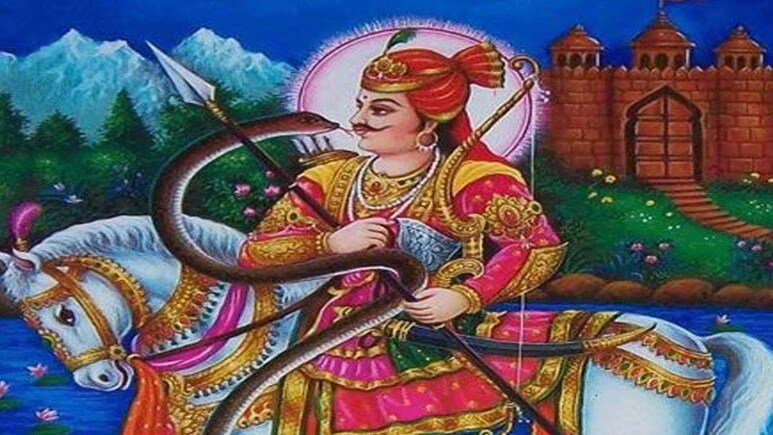
Veer Tejaji: The Divine Protector and Symbol of Folk Faith in Rajasthan
In the villages around Nagaur, when someone gets bitten by a snake, the first thing many families do isn't call a doctor. They go to a Tejaji shrine. A Bhopa priest enters a trance, sucks out the poison, ties a sacred thread in Tejaji's name, and the community prays. It happen...
Meet your AI Story Guide
Turn this field note into a one-minute brief with the essential places, people, and traditions.
The Birth of a Hero
The bardic records maintained by Bhats, the traditional genealogists and chroniclers of Rajasthan, indicate that Tejaji was born on Magha Shukla 14, Samvat 1130. That translates to January 29, 1074 CE. The village was Khirnal, in what's now the Nagaur district. He belonged to the Dhaulya gotra of the Jat community.
His father, Chaudhary Tahar, was the village chieftain. A respectable family, local authority, and the kind of household where expectations are high from birth. His mother, Ramkunwari, had prayed for a child at the Nagaraja shrine in Tyod, a snake deity. That detail matters because serpents run through Tejaji's entire life story like a thread. The blessing that brought him into the world is the same force that eventually took him out of it.
As was common for the time, Tejaji was married in childhood to a girl named Pemal from the village of Paner. The families arranged the alliance, and it quickly became complicated. Family hostilities between the two sides created friction that followed Tejaji for years. But those early difficulties shaped him. The duty. The stubbornness about doing what's right. The reluctance to compromise when a principle was in jeopardy is evident. All of it traces back to a childhood where conflict and obligation showed up early and never really left.
Tests of Honour: Resolve Forged in Fields and Feuds
Village tradition dictated that the chieftain's household ploughed first after the Jyeshtha rains. A symbolic act, the village head's family breaks the earth, and then everyone else follows. One season, Tejaji's mother pushed him to take the plough himself. He did. But someone threw a taunt at him about how he still hadn't managed to bring his wife Pemal home from her parents' house. That kind of public humiliation, in that culture, in that era, was a wound that demanded a response.
So Tejaji set out to bring Pemal home. But first, he detoured to Tabiji to retrieve his sister Rajal. On the way, a Meena chieftain tried to ambush him. Tejaji refused to be stopped instead of seeking the fight. That pattern shows up again and again in his story: he doesn't go looking for conflict, but he absolutely will not run from it when it's between him and something he's supposed to do.
When he reached Paner to collect Pemal, things went sideways again. His mother-in-law, annoyed that he'd interrupted her milking, cursed him. Told him a black snake would bite him. Tejaji, frustrated and humiliated, turned around and started heading back. He might have gone home, and the story might have ended there.
But then he ran into Lachha Gujari. She was Pemal's friend. And she was desperate. Dacoits had stolen her cattle. She begged Tejaji for help. And that plea was, 'Protect my cattle; help me.' 'I have no one else' became the moment that turned Tejaji's life from a local family drama into a legend that would last a thousand years.
The Promise, the Battle, and the Snake
On his way to help Lachha, Tejaji came across a snake trapped in a fire. He saved it. But the snake, rather than being grateful in any simple way, demanded what it was owed: a bite. Tejaji didn't refuse. He just asked for time. Let me keep my word first. Let me rescue this woman's cattle. Thereafter, I'll come back and you can bite me.
The snake agreed. Tejaji rode his mare Lilan, an animal that's famous in its own right in the folk songs, and went after the dacoits. The accounts link them to Meena raiders. The fight was brutal. Tejaji got the cattle back, but he was badly wounded in the process. Cut up. Bleeding. He was barely able to maintain his balance on the horse.
And then he went back to the snake. Because he'd said he would.
The snake looked at his body slashed and bleeding everywhere and couldn't find a clean spot to bite. Tejaji extended his tongue. The snake bit him there. And that was it. He died on Bhadrapada Shukla Dashmi, August 28, 1103 CE. Today is Teja Dashmi, and it's the centre of his entire worship calendar.
There's another version of the ending that circulates in some villages. In that version, Tejaji and Pemal faced an attack together on their journey home. Tejaji fell in battle. Pemal committed Sati at Sursura. His sister Rajal did the same. That version gets sung in village ballads with a grief that makes people cry even though they've heard it dozens of times.
Tejaji's integrity reportedly moved the serpent Basak Naga. He granted a boon: in Kaliyuga, every household would remember Tejaji as a protector. Especially against snakebite. And that boon, if you visit rural Rajasthan today, looks a lot like a prophecy that came true.
Temples, Fairs, and Living Rituals
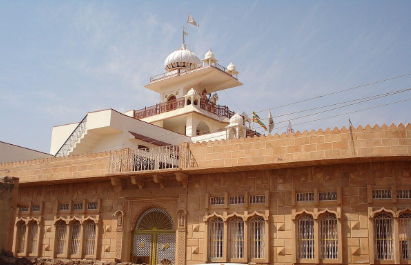
Tejaji shrines are scattered all over Rajasthan. Small ones, mostly. Not grand architecture, just a stone image of a man on a horse, a few offerings, and a Bhopa priest who knows the rituals. People come to these shrines specifically for snakebite cases. The Bhopa enters a trance state, performs the healing ritual, and ties a sacred thread. The community gathers and prays. Whether the healing is medical or spiritual or both is a question the communities themselves don't spend much time debating. It works for them. It's been working for them for a very long time.
The big annual event is Mela Tejaji at Parbatsar in Nagaur. It falls on Teja Dashmi, and it draws a giant crowd of traders, pastoralists, pilgrims, and families. The event serves as both a cattle fair and a spiritual gathering, aligning perfectly with the central theme of Tejaji's legend, which revolves around cattle protection.
There's a ritual at Sureli that's particularly intense. During Teja Dashmi, a Bhopa carries a live snake and, in a dramatic reenactment of Tejaji's sacrifice, accepts a bite on his tongue. He's then revived by devotees singing Teja bhajans. This ritual is as authentic and genuine as it can be. The community is wrestling with how to preserve the tradition without losing its sanctity or safety as the elder Bhopas, who know how to perform these rituals safely, get older. It's a live conversation. No easy answers.
Tejaji's samadhi, his final resting place, is remembered at Sursura, near Kishangarh. Before Parbatsar became the main centre, there was a cattle fair. The geography of his worship maps onto the geography of his life.
Tejaji Ballad: The Night Songs of the Monsoon
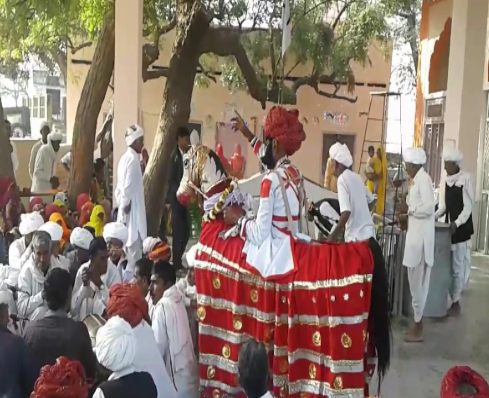
When monsoon clouds gather and the pastures go green, villages across Rajasthan call for the Tejaji Beawal. It's a long ballad, seriously long, performed at shrines and in courtyards, usually at night.
The two lead singers carry the narrative, backed by a chorus and a set of instruments that any Rajasthani folk fan would recognise: dholak, algoza, manjira, and handclaps. The performance used to stretch across two full months of the monsoon season. These days, most Beawal performances cluster closer to Teja Dashmi. Part of that is practical; fewer people have the time for months-long musical commitments. Part of it is a talent problem. The number of skilled algoza players is shrinking. It takes years to master and no longer attracts young musicians.
What makes the Beawal different from a lot of devotional music is how grounded it is. This isn't a ballad about abstract spiritual concepts or cosmic battles. It's about work. Cattle. Rain. Honour. Keeping a promise. Through the act of singing it together, the daily reality of pastoral life in Rajasthan transforms into something sacred.
The aim is practical and spiritual at the same time: invoke Tejaji's presence, ask for healing, ask for protection, and bless the fields before the first plough breaks earth. It's a community talking to its protector about the things that actually matter to them.
Why Tejaji Endures
Tejaji's legend has survived a thousand years because it doesn't ask anyone to believe in something distant or abstract. It speaks directly to the realities of rural life. Keep your word. Protect the animals you depend on. Stand up for people who can't stand up for themselves. If necessary, confront death with dignity.
He's not a deity of palaces or grand temples. He belongs to the commons. The corrals. The grazing lands. The fields where seed meets soil depend entirely on whether the rain comes. In Tejaji, Rajasthan's pastoral communities reflect their stubbornness, oath-bound nature, practicality, and fierce compassion for the things and people they are responsible for.
That's why he lasts. His longevity is not due to miracles or cosmic power. His values are the same ones that these communities need to survive. A promise kept becomes a shrine. A life given in service becomes a path the living can follow.
Experience Rajasthan's Folk Faith with Folk Experience
Tejaji's story isn't one you can fully appreciate from a distance. The weight of it lands differently when you're standing at Parbatsar during Teja Dashmi, surrounded by thousands of people who genuinely believe this warrior-shepherd is watching over them. When you hear the Beawal sung by lanternlight and performed by musicians whose families have sung it for generations, you will feel its deep emotional resonance. When you sit with a Bhopa priest, he explains the healing ritual not as folklore but as something he practices.
That's what Folk Experience offers. We take you to the fairgrounds, the shrines, and the village courtyards where this tradition is still breathing. You meet the oral historians, the musicians, and the temple keepers. You watch rituals that most tourists never even hear about, let alone witness. And you come away understanding something about Rajasthan: that the forts and palaces and camel rides can't teach you that the real spiritual life of this state happens at ground level, among people whose faith is inseparable from their daily work.
Travel with Folk Experience, where folklore is not a chapter to read but a circle to sit in, a chorus to join, and a promise to remember.