Relics of the Chenab — An Akhnoor & Ambaran Heritage Day Tour from Jammu
“At Akhnoor, the Chenab has carried monks, merchants and kings — and kept a little of each on its bank.”
- Duration
- 3–4 Hours (including the drive from Jammu)
- Destination
- Akhnoor, Jammu and Kashmir
- Best Season
- October to March is the most pleasant; in summer, an early-morning start keeps the day comfortable.
- Group
- Small group · Max 10
- Physical Rating
- Easy — short walks on open ground and a few old steps down to the ghat, between private-vehicle transfers; suitable for all ages.
- Theme
- Heritage
01The story
The Journey
This is not a fort-and-river outing; it is a reading of one riverbank across two thousand years. About 28 km north-west of Jammu, at Akhnoor, the Chenab — the Chandrabhaga of old texts — leaves the hills and opens into the plains. People settled here because of the river, prayed beside it, fortified it and crowned a king on its bank. With a local storyteller-guide, you read those layers one by one.
The day begins at Ambaran, on the right bank, where the Archaeological Survey of India excavated a Buddhist monastic complex between 1999 and 2001. Here lie the brick bases of a stupa and votive stupas and the walls of a monastery that lived from around the 2nd century BCE to the 7th century CE, before floods and the decline of Buddhism in the region returned it to the earth. At the heart of the stupa lay a reliquary: a copper casket holding a silver one, holding one of gold, with bone relics, gold leaf, pearl and coral beads. The terracotta heads of Akhnoor, now in Jammu’s Dogra Art Museum, belong to this same story.
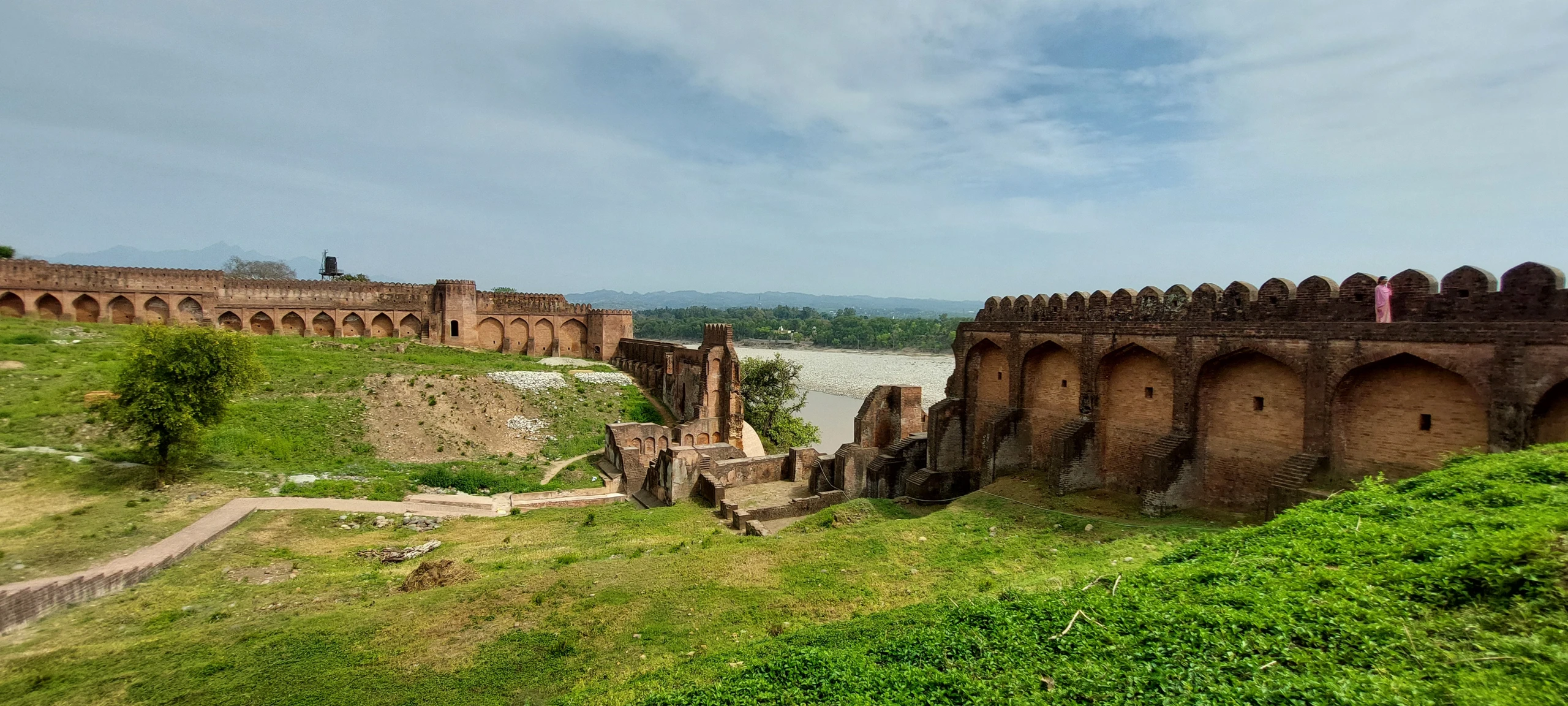
Then the river turns royal. Akhnoor Fort, begun in 1762 by Raja Tegh Singh and completed in 1802 by Raja Alam Singh, stands on an ancient mound where archaeologists have found Harappan-period remains; local memory says it was raised to give famine-struck people work and food. Below it lies Jia Pota Ghat, where on 17 June 1822 Maharaja Ranjit Singh applied the raj tilak to Gulab Singh beneath a Jia Pota tree, making him Raja of Jammu — the beginning of the Dogra rule that, by 1846, reached Kashmir.
Between the sites, the three chapters meet: renunciation at Ambaran, defence at the fort, kingship at the ghat — all written along the same water. By the time you return to Jammu, the Chenab is no longer a view from the bridge; it is a document you can read.
02The living journey
Moments you will carry home
03Photographs
Scenes from the day
04The day on film
A taste of what awaits.
05 · The community
Community & Responsibility
Every stop on this journey keeps a living place in good hands. Your guide is from Jammu and earns from the history they grew up with; your tea comes from riverside vendors, paid at their own price; and we keep groups small and walk the excavated remains with care, so that Ambaran’s village neighbours meet travellers as respectful guests, not a crowd. When you travel with us, your curiosity quietly becomes their livelihood.
06Practical notes
Good to know, before you go.
07Before you book
Questions travellers ask
All day tours need to be paid in full in advance. We do not accept cash payments.
Instant email with confirmation, invoice, itinerary and preparation notes → evening-before WhatsApp briefing with pick-up time, your guide’s name, vehicle details and a live contact number.
The Ambaran Buddhist stupa and monastery site, Akhnoor Fort and Jia Pota Ghat on the Chenab. The sequence may change with site access, weather and local events, to give you the best possible day.
Akhnoor is about 28 km north-west of Jammu, roughly an hour’s drive. We pick you up from your hotel in Jammu and drop you back.
An ASI-excavated Buddhist monastery and stupa on the right bank of the Chenab near Akhnoor, in use from around the 2nd century BCE to the 7th century CE. Its finds include a nested copper, silver and gold relic casket, Kushana-period coins and terracottas.
Yes. It is a protected archaeological site; we confirm access before every visit and keep to the paths around the remains.
No. It is a history journey through Buddhist, Dogra and river heritage. Travellers of all faiths are welcome.
Very little — short walks on open ground at each site and a few old steps at the ghat. It suits all ages, and children often enjoy the archaeology.
Comfortable shoes, light layers and sun protection. Modest clothing is respectful at the ghat.
Yes, at the open sites. Please do not touch or climb on the excavated remains. We do not fly drones on this tour, as Akhnoor lies close to the border.
Yes. You travel by private vehicle and your guide is with you throughout. Solo women travellers are welcome and looked after.
Absolutely.
Free cancellation or date change until 48 hours before departure; within 24–48 hours, 50% is retained; no-shows are non-refundable. If we cancel for weather, road closure or safety, you receive a full refund or priority rebooking — your choice.
Yes, you certainly can postpone your booking for an experience. If you have booked a scheduled experience, we will postpone your booking to the next experience on the same theme, or another tour with the same price. In case of a private tour, we can discuss the details via Email/Customer Support.
Show your interest by filling the form and from our team, a folklorist will contact you soon.
Relics of the Chenab — An Akhnoor & Ambaran Heritage Day Tour from Jammu
3–4 Hours (including the drive from Jammu) · 2 travellers