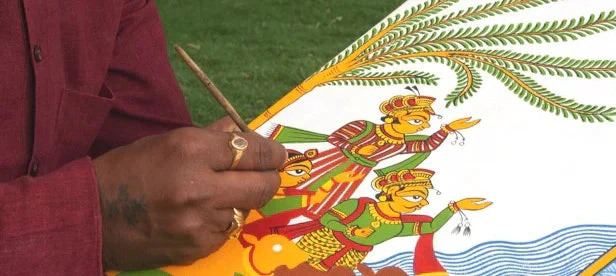
Under the golden sky of Rajasthan, where stories of kings and queens echo through sandstone forts and desert winds, there’s a rhythm that transcends time , the swirl of Ghoomar. It’s not just a dance; it’s poetry in motion, a graceful celebration of womanhood, culture, and joy. When the ghagras twirl and the anklets chime, …

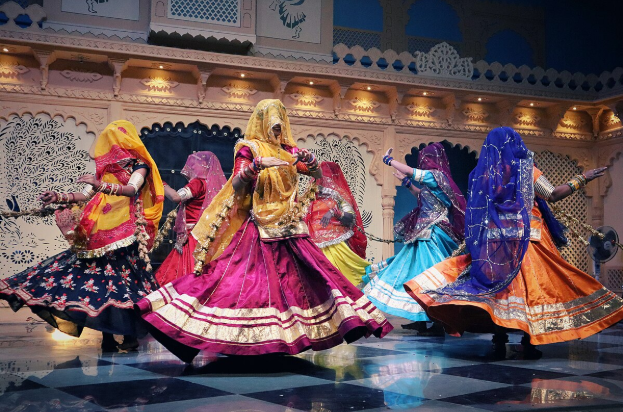
Under the golden sky of Rajasthan, where stories of kings and queens echo through sandstone forts and desert winds, there’s a rhythm that transcends time , the swirl of Ghoomar.
It’s not just a dance; it’s poetry in motion, a graceful celebration of womanhood, culture, and joy. When the ghagras twirl and the anklets chime, Rajasthan seems to breathe , every movement carrying centuries of tradition, beauty, and belonging.
“When Rajasthani women spin in unison, it’s not just a dance , it’s a hymn to grace.”
Rajasthan: Where Culture Dances Through Every Heartbeat
Known as the Land of Kings , or Rajputana, as the British once called it , Rajasthan is where history and artistry intertwine. From the bustling bazaars of Jaipur to the shimmering lakes of Udaipur, life here moves to the rhythm of festivals, music, and colour.
The people of Rajasthan wear their culture as proudly as their ornaments , vibrant, intricate, and deeply rooted in tradition. In every celebration , whether it’s Diwali, Teej, Holi, or a royal wedding , one dance always finds its way into the spotlight: Ghoomar, the heartbeat of Rajasthani folk expression.
The Origins: From Tribal Ritual to Royal Grace
The story of Ghoomar begins with the Bhil tribe, one of Rajasthan’s oldest communities. Originally performed as a devotional dance to honour Goddess Saraswati, it was both a prayer and a celebration , a way for women to express gratitude, strength, and happiness.
Over time, when the Kachhwaha Rajputs of Jaipur made peace with the Bhils, they adopted several Bhil traditions , among them, Ghoomar is prominent. What began in tribal courtyards soon entered the marble halls of palaces. Royal women embraced it, transforming Ghoomar into an elegant expression of grace and dignity.
From the Bhil hearths to Jaipur’s royal courts, the dance retained its essence , a symbol of womanhood, joy, and cultural harmony.
“Born in the forests, raised in the palaces , Ghoomar is Rajasthan’s dance of unity.”
The Spread and Style: One Dance, Many Shades
As Ghoomar spread across Rajasthan, it took on distinct regional flavours:
- In Udaipur, its rhythm softened, echoing the fluid movements of Gujarat’s Garba.
- In Jodhpur, the steps became sharper and more dynamic.
- In Kota-Bundi, the dance grew livelier, marked by expressive spins and playful clapping.
Despite these variations, its essence remained the same , celebration through rhythm. Whether performed in humble homes or majestic havelis, Ghoomar became synonymous with auspicious beginnings, weddings, and community gatherings.
It’s the dance of welcome, joy, and continuity , where every twirl honours both the divine and the everyday.
How Ghoomar is Performed: The Language of Movement
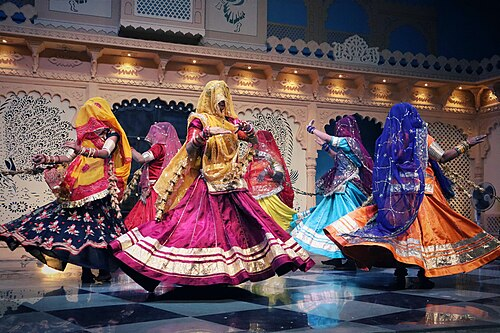
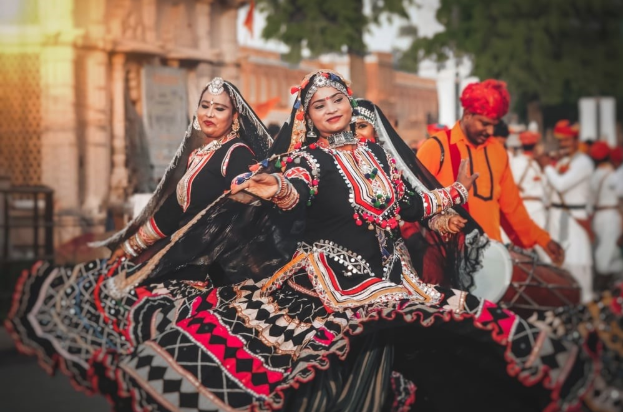
The word Ghoomar comes from ghoomna , meaning “to spin” , and that’s exactly what defines it. Women dance in circles, moving gracefully clockwise and anti-clockwise, their skirts flaring like blooming flowers.
The steps are simple yet rhythmic: swaying, clapping, and footwork that grows faster as the music intensifies. Women of all ages participate, forming concentric circles that symbolise unity and the cyclical nature of life.
The sound of ghunghroos (anklets) blends with the beats of dhol and nagada, creating a spellbinding harmony. The dancers sometimes join hands, creating waves of motion that ripple like desert dunes in the wind.
Intricate hand gestures or mudras add storytelling depth, expressing emotions of love, longing, devotion, and pride. Each turn of the wrist, each glance beneath the veil, becomes part of the narrative , subtle, yet powerful.
“The beauty of Ghoomar lies not in precision, but in the shared heartbeat of those who dance.”
Costume and Jewellery: The Art of Adornment
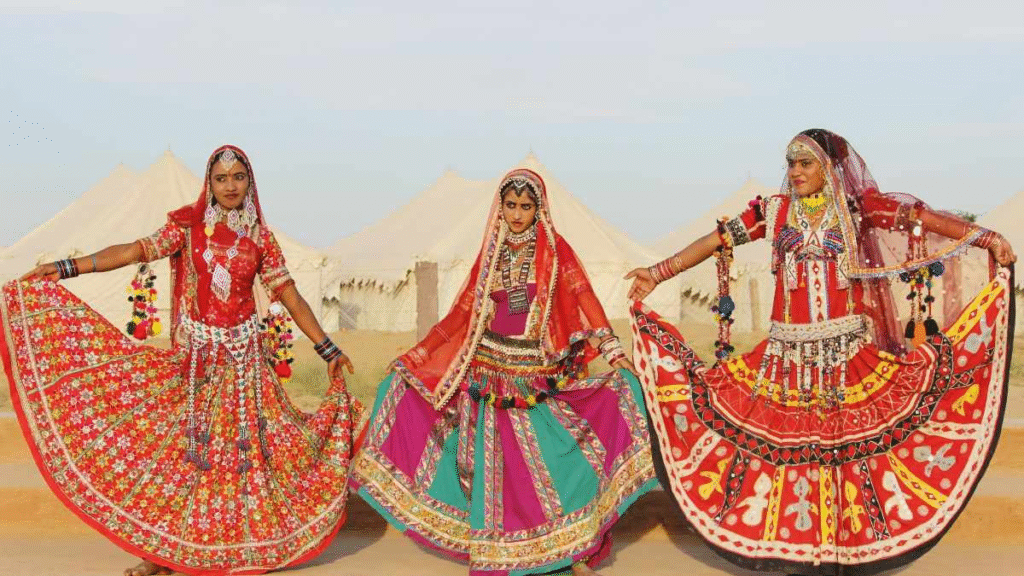
No dance celebrates attire quite like Ghoomar. The performers wear the traditional Rajasthani poshak, a magnificent four-piece ensemble consisting of:
- The ghagra (flowing skirt), often embellished with mirror work and vibrant embroidery
- The kachli (short blouse) layered with a kurti (sleeveless tunic)
- The odhna (veil), sheer yet intricately detailed, symbolising modesty and mystery
Every swirl of the ghagra catches the light, every mirror glints like a fragment of the desert sun. Heavy Kundan jewellery, silver payal, bangles, and borla (forehead ornament) complete the look, turning each dancer into a living sculpture of tradition.
As the women twirl, their skirts form radiant circles, each one a kaleidoscope of Rajasthan’s colours.
The Music of Ghoomar: Songs that Stir the Soul
No Ghoomar is complete without its music , the lifeblood of the performance. The accompanying songs, known as Ghoomar Geet, tell tales of love, heroism, longing, and everyday life.
Some of the most beloved folk songs include:
- “Ghoomar Re Ghoomar Re”
- “Gorband Nakhralo”
- “Chirmi Mhari Chirmali”
- “Mor Bole Re”
- “Aave Hichki”
Sung by Langas, Manganiyars, and Dholis, these melodies are passed down through generations. The beats of the dholak and kartal merge with soulful voices, filling the air with nostalgia and joy.
Each song celebrates emotion , a woman waiting for her beloved, a bride entering her new home, or friends dancing together under a starlit sky.
“In Ghoomar songs, every note is a memory, and every rhythm , a heartbeat.”
Cultural Significance: More Than a Dance
Ghoomar is not merely performance , it’s an identity. For centuries, it has given women a space to express themselves freely , to laugh, move, and celebrate together. It reflects solidarity, sisterhood, and spirituality, often performed during life’s major milestones.
In many Rajasthani communities, Ghoomar also marks a young girl’s transition into womanhood , a rite of passage that celebrates her strength and grace. It represents the harmony between tradition and transformation, where every turn of the dance embodies continuity.
It’s also an integral part of Rajasthan’s social fabric , performed during weddings, religious festivals, and temple rituals , preserving the state’s oral and artistic heritage.
Bollywood and Beyond: Ghoomar in Contemporary Times
In recent years, Bollywood has brought Ghoomar to global attention. The song “Ghoomar” from Padmaavat, with Deepika Padukone’s mesmerizing spins and regal grace, reintroduced the world to this centuries-old dance form. Earlier, “Dholi Taro Dhol Baaje” from Hum Dil De Chuke Sanam offered a fusion of traditional rhythm and cinematic grandeur.
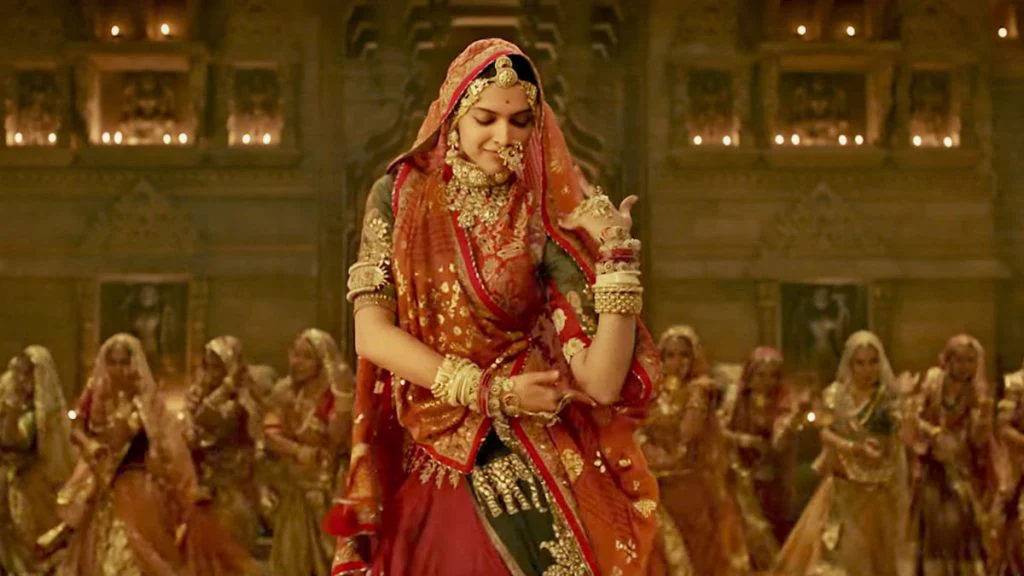
From royal courts to wedding halls, Ghoomar has transcended boundaries. Today, it’s performed not only across India but on international stages , a proud emblem of Rajasthani culture and feminine grace.
Yet, beneath the fame and glamour, Ghoomar remains what it has always been , a heartfelt celebration of joy, rhythm, and tradition.
Ghoomar: A Living Legacy
In every swirl, there’s a story. In every beat, a blessing. Ghoomar has endured through centuries because it is more than choreography , it’s emotion embodied.
It bridges tribal and royal, old and new, earth and spirit. Through its rhythm, Rajasthan continues to tell the world who it is , proud, poetic, and alive with colour.
“When the ghagras spin and anklets sing, Rajasthan doesn’t just dance , it dreams.”
Experience Ghoomar with Folk Experience
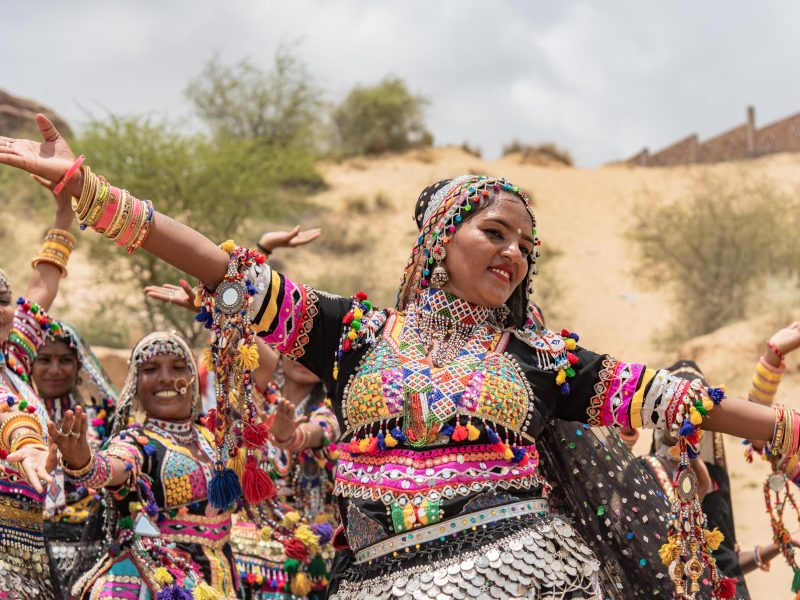
At Folk Experience, we believe Rajasthan’s culture is best understood not by watching , but by joining in the rhythm.
Our immersive journeys take you beyond performances and into the courtyards where women still gather to sing Ghoomar geet by lantern light. You’ll meet folk artists, learn the meaning behind every gesture, and even try a few graceful spins yourself under the guidance of local dancers.
Each experience is curated with respect for tradition and community , ensuring that cultural heritage is preserved, not commercialised. From private workshops in Jaipur and Udaipur to intimate performances in rural villages, our Ghoomar sessions offer travellers a rare chance to feel Rajasthan’s living soul.
At Folk Experience, we don’t just show you art , we help you become part of it. Because every dance, every song, and every smile carries a legacy that deserves to be lived, not just observed.
“Dance with Rajasthan. Learn its rhythm. And through Ghoomar, discover the grace that binds a culture together.”